| Author |
 Replies: 20 / Views: 2,171 Replies: 20 / Views: 2,171 |
|
Valued Member
United States
386 Posts |
First, I apologize for not posting a better pic. I'm just learning how to use a digital camera for this task. I picked up this 1851 cent. I picked it up because of a strange thing I saw on the reverse. If you look at the N and E in ONE you can see a group of diagonal lines running though it. I also see a few smaller lines running through the C in CENT to the wreath. The lines do not run through the letters. There are also another one or two small lines within the ONCE CENT/wreath area. I'll try to get pics of those too. Any other lines that appear on the coin do not run in the same direction as the ones you see in the pic. They run in different directions, but are the same width. The lines in the pic that you can see appear evenly spaced and they also appear raised, like rays from the sun. I ran this coin by my local coin dealer (and part time teacher, he's been in the business for +40 years and he has been mentoring me since I have recently gotten back into this hobby). We have two theories but would like to see what anyone here thinks these marks come from. I can try to work on better pics if they are needed. Thanks for any input/ideas. 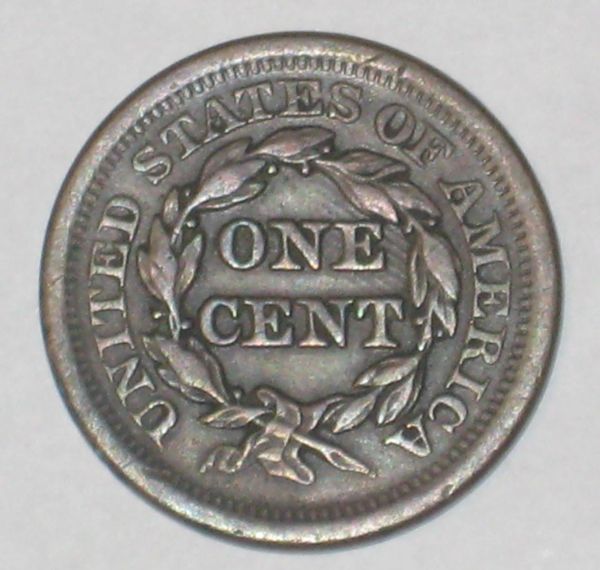 Edited by sjh241
08/10/2012 12:07 pm
|
|
|
|
Pillar of the Community
United States
2760 Posts |
I'll take a different approach: please post a picture of the obverse and I'll try to work out the N-number, and then i'll see if my books have anything about those lines in it.
|
|
Pillar of the Community
United States
8534 Posts |
Looks like a finger print to me.
Oregon coin geek.....*** GO BEAVS ! ! ! ***
|
|
Pillar of the Community
United States
2077 Posts |
I agree, the one at NE looks like a fingerprint. At the O it may be scratches on the die. Nowadays the dies go right from the die shop to the press in a protective container. Back then, they probably just tossed them onto a grimy dusty shelf.
|
|
Valued Member
 United States
386 Posts |
I'll get a pic up soon of the obverse.
The lines are definitely in the metal, so the possibility so far is that the die was mishandled and a fingerprint was transferred to the die, then when the coin was struck the fingerprint was struck into the coin?
|
|
Pillar of the Community
United States
2077 Posts |
Fingerprints could affect the corrosion of the die, but it wouldn't look like that. Most likely someone with really greasy mitts grabbed it. The print probably just rubbed off the letters because they are raised.
|
|
Pillar of the Community
United States
2077 Posts |
Actually on a second look, they are a bit too parallel for a print. They may have hit the die with a stone or file to fix some damage.
|
|
Pillar of the Community
United States
2760 Posts |
Could be N-19: look up several pictures of the reverses of this one to see if the 'heavy diagonal lines at the E in ONE' are similar to yours.
|
|
Pillar of the Community
United States
2077 Posts |
Yup, they sure do. Yours are actually more pronounced than the example on the book. Those only extend a tiny bit above the E.
|
|
Valued Member
United States
386 Posts |
This is a poor pic of the obverse 9sorry about the lighting, I just can't get it right now). About the date. The light in this pic is a bit confusing. All four numbers have something around the edges. One person told me it looks like something is under the date. Another said it's junk (dirt, etc...). I believe it's junk: 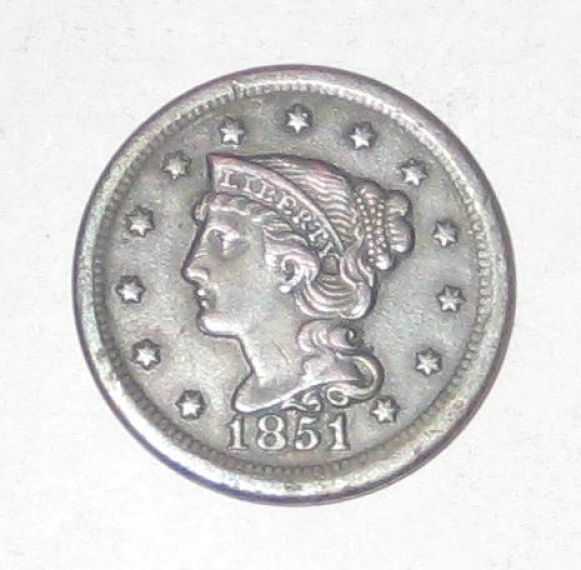 I don't have any books on Large Cents that show what you are looking at. Do you have a link to a pic showing the lines? What was the reason they attributed for the lines? Edited by sjh241
08/10/2012 1:52 pm
|
|
Pillar of the Community
United States
2077 Posts |
There is a characteristic line crossing the 1 in 51. It's short, but it looks like a bit of it shows on yours as bumps on either side.
Couldn't find any auction links that show the characteristics of yours. Many were sold in lots, so no pics. BTW, this is an R-3 variety, so I'd hang on to it. Not super valuable, but better than R-2. Of course there are 45 varieties in 1851, so how scarce could scarce really be!
BTW, thanks Robuddo for spotting this. My attention span is short. Would have lost interest at N-9.
|
|
Pillar of the Community
United States
2077 Posts |
Oh, and about the lines, it looks like a file, which doesn't make sense. The only time the die would be soft enough to be filed was before it was hardened. If that were the case, every die state would have it. The only thing I can figure is that they softened it to fix it and then rehardened. Seems like it would have been easier to give it a quick grind to clean it up. No heat treat required.
|
|
Bedrock of the Community
United States
17884 Posts |
N-19 those lines are diagnostic for the variety except in the latest states. Yours appears to be a mid state piece.
|
|
Pillar of the Community
United States
2077 Posts |
Conder- Does that mean that the marks were there when they first made the die and then ground them off later?
|
|
New Member
United States
1 Posts |
What about the possibility of the planchet itself having the lines before it was struck?
|
|
Valued Member
United States
386 Posts |
Well, someone cleaning the die with a tool and leaving those lines was one of the theories we had. That seems to be where this piece is headed.
The other theory, which was less likely, was that this coin was struck in another coins planchet/die etc... (I don't know the right terminology). So we looked for coins with the same or similar mm dimensions such as half dollars and looked for lines, rays, etc... We saw a possibility with the half dollar but the rays did not appear in 1851, only a few years later. Really didn't find any other coin with these lines from the same year, so we struck down that idea.
I'm interested like OldSkool to understand the history of this variety. It's from when they made the die? It's a gouge from trying to clean the die?
|
| |
Replies: 20 / Views: 2,171 |







 Posted 08/10/2012 12:31 pm





