| Author |
 Replies: 12 / Views: 2,720 Replies: 12 / Views: 2,720 |
|
|
Valued Member
Canada
202 Posts |
Found this dime while roll hunting.. this error is not PMD, what would you call this an example of?  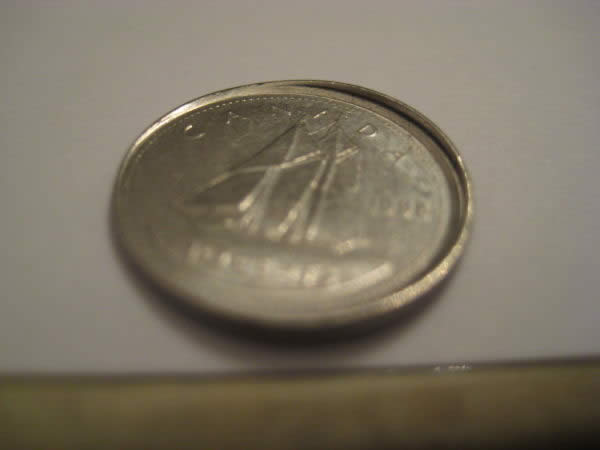 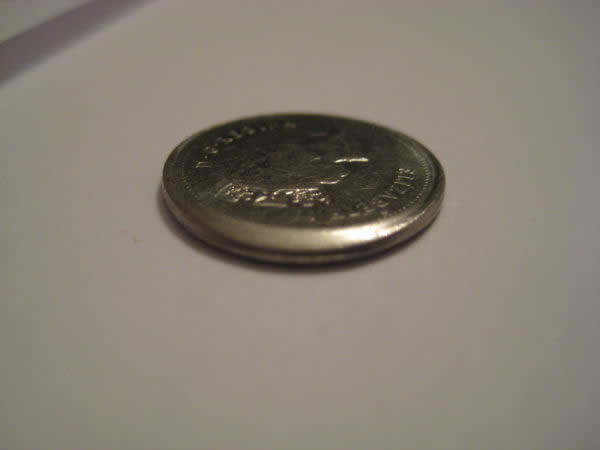 |
|
|
|
Moderator
 United States
56855 Posts |
Collar error? John1  |
|
Rest in Peace
1988 Posts |
Nice find darcyrmt...I am never that lucky.
|
|
Moderator
Canada
10476 Posts |
I don't see any missing elements from the devices, so that is a broadstruck coin. Nice find!
"Discovery follows discovery, each both raising and answering questions, each ending a long search, and each providing the new instruments for a new search." -- J. Robert OppenheimerContent of this post is licensed under a Creative Commons Attribution-NonCommercial 3.0 Unported License. See: http://creativecommons.org/licenses...0/deed.en_USMy eBay store
|
|
Valued Member
 Canada
202 Posts |
I've had someone contact me with an offer to buy this coin, but I don't know any idea of a value for this. I know it's a subjective thing and things are only worth what someone will pay but in the experts' opinions, what is a reasonable starting point? (not saying I'll do it, it's just good to know) Luckily scans are already up...
(ps I would have asked this question privately but I'm still new to send PM's yet)
Edited by darcyrmt
08/29/2012 10:48 am
|
|
Pillar of the Community
Canada
1984 Posts |
|
|
Moderator
Canada
10476 Posts |
I would be cautious using a 1958 silver 10-cent (and uncirculated) auction as a reference base for a circulated 1996 10-cent (the fact that you found it roll hunting, I am assuming this is coin-roll hunting, and not BU rolls of 1996 10-cent coins?). I have coins, like yours, in my inventory from the mid-1970s in AU grade that I sell for about $25. A coin from the 1970s is more common than one from the 1990s, but no where near as desirable as one from the silver years - so if you get $25-$35 for that coin, you are doing well. The problem is that there is little love out there for Canadian 10-cent coins, even error coins. If that was a 5c or 25c coin, you could probably double that price. The best means to answer your question, and to get a fair price is to list it on ebay, starting at 99 cents, no reserve, and let the free market take over... that is exactly what happened here: https://goccf.com/t/123251"Discovery follows discovery, each both raising and answering questions, each ending a long search, and each providing the new instruments for a new search." -- J. Robert OppenheimerContent of this post is licensed under a Creative Commons Attribution-NonCommercial 3.0 Unported License. See: http://creativecommons.org/licenses...0/deed.en_USMy eBay store
|
|
Valued Member
Canada
202 Posts |
Can you imagine if this was a 1970 AND a broadstrike? Doubly rare.. Yes that coin was from circulated rolls from the bank. I'm not really examining every solitary coin for cracks, etc, more like looking for silver and filling the coin album and then improving my album specimen..
Unless it's mentioned in the Charlton, I don't know about obscure varieties and I could be turning back valuable die errors, etc unknowingly to the bank when I'm returning unneeded dates and so on. I admire those who have the patience and interest for that. Since I'm new, I'm not quite there yet ;). But that dime was an obvious one. I might put it next to my 47 dot nickel and 57 bug tail nickel (I know that one is not as numismatically valuable as the 47 dot)
|
|
Valued Member
United States
419 Posts |
I think this is not a Broadstrike, but rather a finned rim... NICE find!  Edited by HelzelsCoins
09/01/2012 8:17 pm
|
|
Valued Member
Canada
202 Posts |
hi, what you would define is the difference?
The glossary here defines the broadstrike as: "Coin struck without a collar, thus when the coin is struck the metal is allowed to expand and increase in diameter. May be centered or uncentered, but must not have any missing lettering or design detail."
I haven't seen a coin struck so I'm not familiar with the process, but my interpretation is that when the coin was struck, the metal wanted to expand out in diameter, but hit the "round edge of the hole holding the planchet" and had to expand up because it couldn't continue out, giving the higher edge.. makes sense to me, but I'm a pure novice and can be shamelessly influenced by fancy language and snake oil ;)
What is the process that causes finned rims? Let me know, I'd rather be correct, than correct in my own mind.. And if this is a significant occurence, can "finned rim" be added to the glossary, moderators?
(would different pics be beneficial?)
Edited by darcyrmt
09/02/2012 4:07 pm
|
|
Bedrock of the Community
United States
12437 Posts |
Is the coin fully reeded, partially reeded, or not reeded at all?
|
|
Valued Member
United States
142 Posts |
It looks like it is either braodstruck or a partial collar. A Canadian 1996 dime should have a reeded edge if web resources are correct, if it is missing that edge, it was struck without the collar. The pics are not clear enough of the edge. A finned rim occurs if there is too much pressure, or if there is a tilt in the die causing too much localized pressure. A finned rim is a thin flange of metal that rises from the edge. I don't believe we are seeing a finned rim here.
|
|
Valued Member
Canada
202 Posts |
Most of the rim is clean like this: 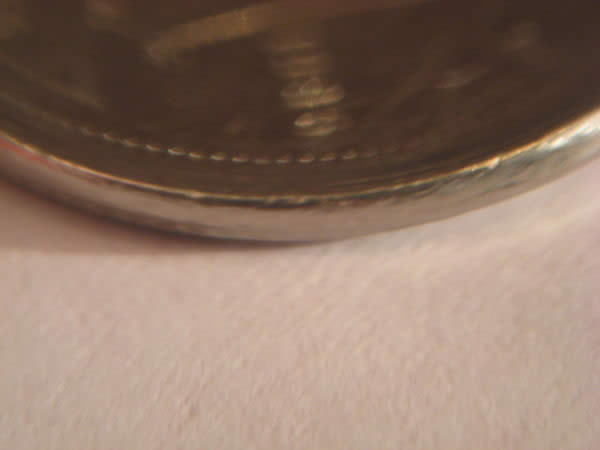 this is the highest point of the raised portion: 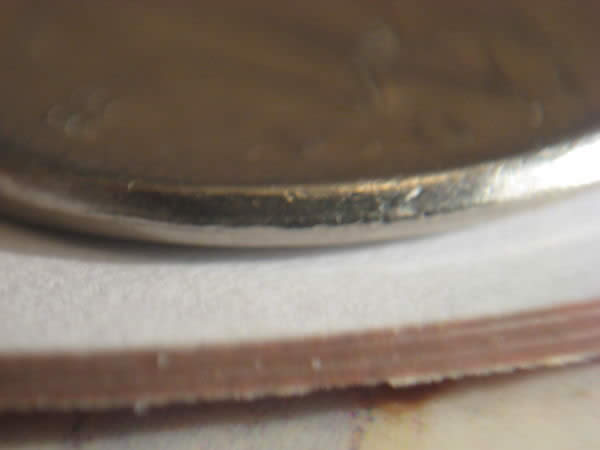 there is only one portion that has any semblance of reeding, looks like this: 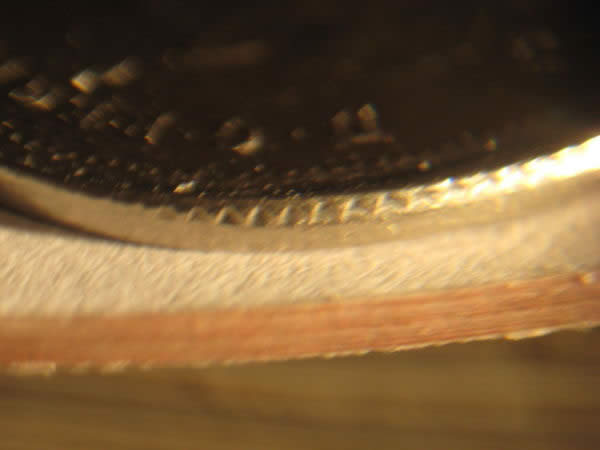 |
| |
Replies: 12 / Views: 2,720 |
|







 Posted 08/27/2012 09:30 am





