| Author |
 Replies: 16 / Views: 2,860 Replies: 16 / Views: 2,860 |
|
Pillar of the Community
United States
2589 Posts |
Aquired this recently in a lot and not sure what it is. The obverse design leads me to believe it is greek. I cant really make anything out on the reverse, but it looks like there is some sort of bird design. Any information would be most welcome. Thanks, XoG 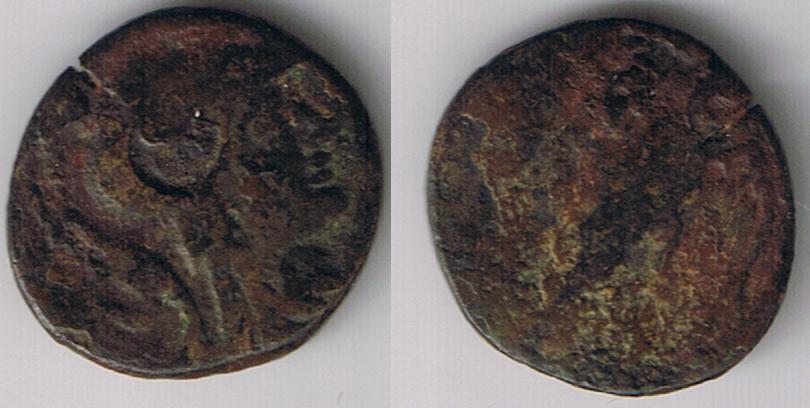 |
|
|
|
Pillar of the Community
Australia
560 Posts |
I can see a head on the left. Maybe making the light at an angle will give more detail.
|
|
Bedrock of the Community
United States
10045 Posts |
It's ancient. The circular depression is most likely a countermark--it could be Seleucid.  |
|
Pillar of the Community
United States
4253 Posts |
|
|
Bedrock of the Community
United States
10045 Posts |
This is a wild stab in the dark, because I cannot make out the reverse details. To my eyes, the 'fabric' of the coin reminds me of Seleucid coins. Here is a counterstamped Seleucid coin bearing Athena on the obverse.  SYRIA, SELEUKID KINGDOM, Antiochos I., 280-261 BC, Bronze 280-261 BC mint in Asia |
|
Pillar of the Community
United States
1315 Posts |
|
|
Pillar of the Community
 United States
2589 Posts |
The obverse motiffs are definately similar. The coin is about 17 mm in diameter. I cant really make out anything on the reverse, except for what appears to be a wing near the edge
|
|
Pillar of the Community
United States
2589 Posts |
yes it definately looks like there is a counter stamp on the obverse helmet
|
|
Bedrock of the Community
United States
10045 Posts |
Doucet--  your coin's style looks much closer. |
|
Pillar of the Community
United States
5155 Posts |
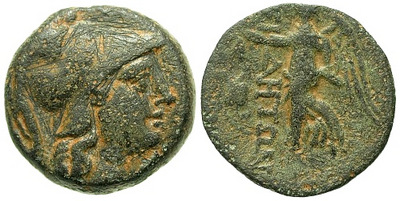
Doucet- I believe you have nailed down the coin....I am interested in the counter stamp on this one!
Very nice coin...very interesting.
|
|
Pillar of the Community
United States
2589 Posts |
The website says,
Side, Pamphylia, 2nd - 1st Centuries B.C.
81378. Bronze AE 16, SNG France 740, aVF, cleaning scratches, Side mint, 3.593g, 16.3mm, 0°, 2nd - 1st Cent B.C.; obverse helmeted head of Athena right; reverse ΣIÎ"HTΩN, Nike flying left, wreath in right hand, pomegranate left
But what exactly does that mean besides the description of the features on the coin? Does it have a specific denomination or ruler attached to it? And is it common for ancient coins to have countermarks?
I see several examples in much better condition have gone for around $70, but none are counterstamped.
|
|
Pillar of the Community
United States
5155 Posts |
Counter stamps are very common on ancient coins and sought after by many. I myself love counter marks. I have a few counter marked ancient coins and people here also have them. I have searched in vein for a good source on counter stamps and there point of origin and official use. Very cool coin. I have a Athens Tetradrachm that was counter stamped by literally everyone. Check it out here ... https://goccf.com/t/126619 |
|
Pillar of the Community
United States
2589 Posts |
So an "owl" does not refer to the image of an owl, but simply a counterstamp or other added mark on an ancient coin?
Some research shows that Side was an ancient greek city in Asia minor. This coin apparently dates from a period when the city was independent after the defeat of the Seleucid Empire by an alliance consisting of the Romans, Kingdom of Pergamum, and Rhodes in 188 BC. The area surrounding Side was not granted to any specific member of the Alliance, but the peace treaty ending the war required the Seleucids to abandon control of the area. As such the people of Side asserted their independence, becoming a haven for pirates that attacked roman shipping in the area. Side began to decline after being defeated by the romans in 78 BC and was incorporated into Rome by 67 BC.
|
|
Pillar of the Community
United States
4253 Posts |
Quote:
But what exactly does that mean besides the description of the features on the coin I do not know the size of your coin, but the coin Doucet linked to is called (in modern terms) AE16. Meaning is is base metal (AE) and 16mm. I am unfamiliar with what the denomination would have been called at the time of it's striking. Side (Greek: Σίδη Side, Turkish: Side) was an ancient Greek city in Anatolia, in the region of Pamphylia, in what is now Antalya province, on the southern Mediterranean coast of Turkey. I hope this helps some. |
|
Pillar of the Community
United States
1315 Posts |
Quote:
So an "owl" does not refer to the image of an owl, but simply a counterstamp or other added mark on an ancient coin?
The owl I mentioned was for the image, I thought I could see an owl within the counter stamp, but it could be any number of different images or symbols. For example here is a Side coin with a pomegranate counter mark. http://www.arminius-numismatics.com...um=38&pos=11And here a silver example with an anchor-like counter mark. http://wildwinds.com/coins/sg/sg5432.htmlHere is a similar coin I have from a different part of Asia Minor, Mysia Pergamon, with an owl counter mark. 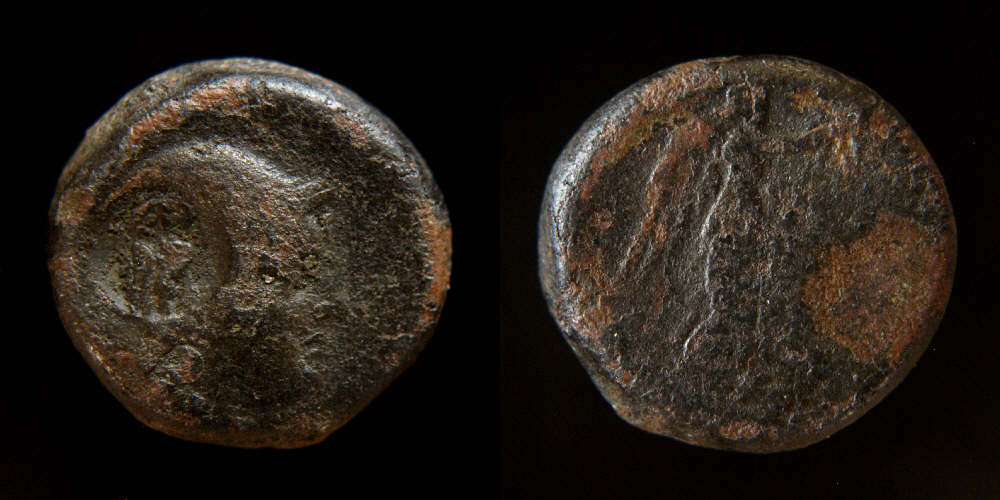 Sometimes, if you hold the coin up to the light and rotate it around at different angles you might be able to make out the image. |
|
Pillar of the Community
United States
2589 Posts |
Do countermarks generally add or detract from the value of an ancient coin?
|
| |
Replies: 16 / Views: 2,860 |







 Posted 09/02/2012 11:12 pm