Quote:
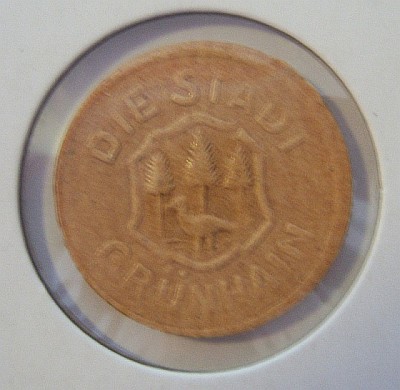
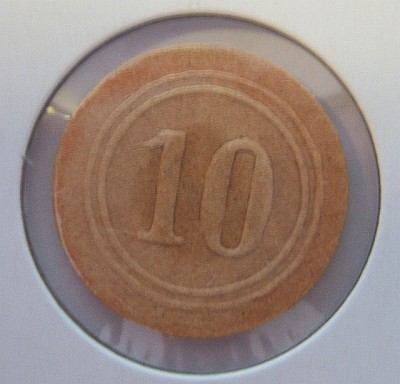
It is not in my KM World coins catalog so I am guessing it is some sort of notgeld. I have noticed that a lot of the city issues are not in the KM catalog.
There were thousands of cities in Germany alone that issued notgeld and, if you include both the "coin" and "paper money" types as well as assorted POW camp and military canteen tokens, there could be dozens or even hundreds of varieties and types issued by each of those towns. That's way too much info to fit into the Krause catalogue.
I have a book, "Guide and Checklist of World Notgeld" by Coffing. All it does is list the cities and towns in Germany and elsewhere in the world that issued "emergency money" sometime between 1914 and 1947, with some illustrations; this book is 400 pages long. The only attempt to date at actually cataloguing notgeld issues is the Keller catalogue, which currently runs to over 30 volumes listing over 100,000 types of German notgeld; the same size as an Encyclopedia Britannica, or the same size as the British Museum catalogue of their Greek and Roman Provincial coins. Even this listing is far from comprehensive, with an estimated 163,000 types known or reported to exist.
Only a few of the "non-German" notgeld coins, such as those for Anvers, Djibouti and Algiers, have made it into Krause.
Grünhain is a town in Saxony, near the Czech border. In 2005 it was merged with neighbouring Beierfeld. As a precise catalogue Coffing is not optimal for determining values, but according to Coffing, three categories of notgeld were issued in Grünhain: municipal paper, private paper and municipal metal. I'm not sure where a laminated cardboard "coin" qualifies as paper or metal, but all three types are given the most common rarity class. $4 is a reasonable price for it.
Don't say "infinitely" when you mean "very"; otherwise, you'll have no word left when you want to talk about something really infinite. - C. S. Lewis












 Posted 09/23/2012 08:43 am


