| Author |
 Replies: 7 / Views: 1,749 Replies: 7 / Views: 1,749 |
|
|
Valued Member
Canada
331 Posts |
I'm trying to teach myself how to grade higher mint state coins. I've recently acquired a box of 2011 CPZ pennies, and the best suggestion I had for what to do with them was to peruse multiple rolls, and send in the best 5 coins or so for certification with the hope that one or two might be MS-67. In order to do this I need to improve my grading skills. I've cracked open the first roll, and pulled 5 pennies. One stands out as better than the rest, one clearly worse. The following is the best of the remaining 3 pennies. The coin appears virtually problem free in terms of bag marks, but these horizontal parallel lines on all features of the coin I find to be detracting from the eye appeal. I'm not exactly sure what the cause of these lines is, but it appears on most of the coins and is very uniform. Does it affect the grade? I can only detect 2 noticeable marks in the fields and there are several bag marks on the queen's hair and forehead. Any takers on grading this coin? Explanations of grade opinions would be even better. I've shot the coin under two different lighting setups to try to accentuate different flaws. Thanks! 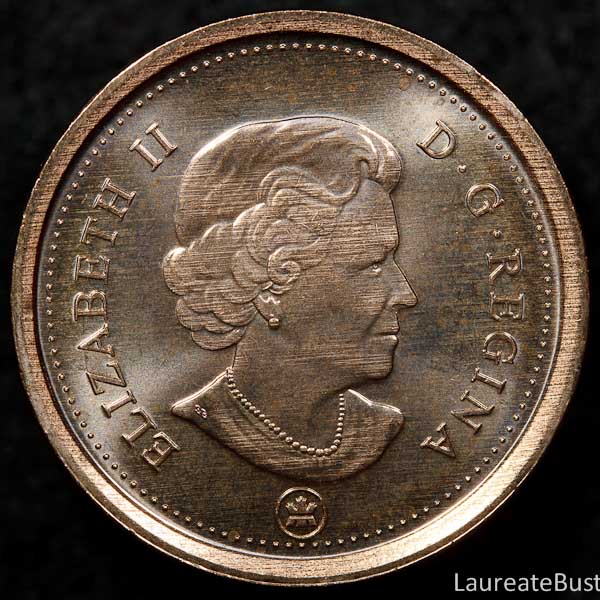 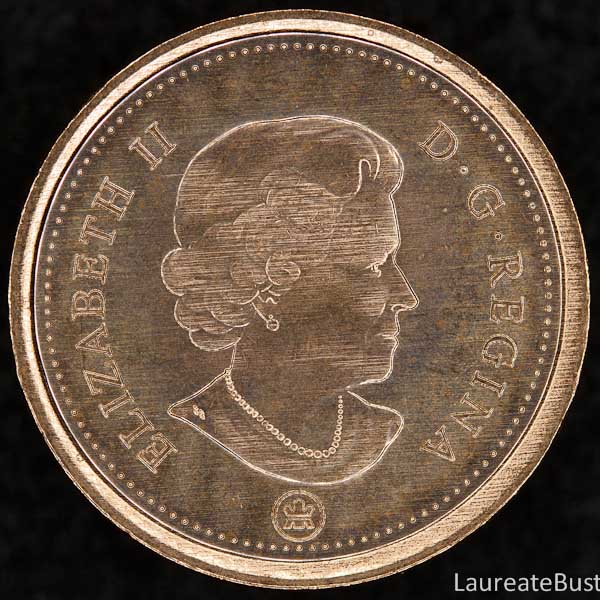 |
|
|
|
Pillar of the Community
Canada
3167 Posts |
The strike of the coins overall doesn't look to strong, but I don't know what could have caused the lines.
|
|
Valued Member
Canada
306 Posts |
I think the lines might be a plating error. I have a roll of 1999 pennies that have lines on them similar to the ones on your coin
|
|
Valued Member
 Canada
331 Posts |
Maybe if I provide some more information I'll get more responses. This penny is not an oddball that I hand-picked from my box. Pretty much every penny from this box has this type of directional lined pattern, and I've also seen it in many 2011 and 2012 pennies from circulation. It's not limited to the design either, although it appears worse there. The same pattern can be seen right through the fields. The direction of the pattern seems to be random. Could this be some lower quality standard in the preparation of planchets? Might this explain why the pattern is less pronounced in the fields? Or could this be a very widespread plating problem as CanadianCollector suggests? I'm interested in any discussion regarding this line pattern, whether if affects grade, whether 2011 or 2012 pennies are harder to find in very high MS grades, etc. I've attached a close-up of the first photo to better show this pattern. 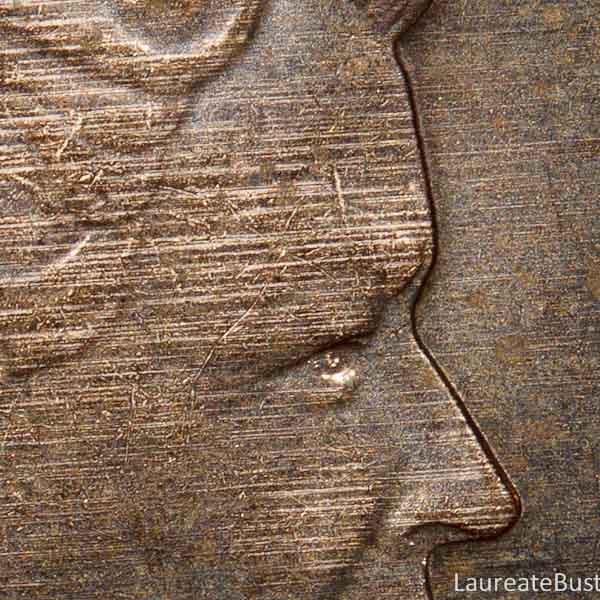 |
|
Moderator
 Canada
10473 Posts |
I notice that it is even on the rims, perhaps it is imparted upon the coin during ejection after the strike?
"Discovery follows discovery, each both raising and answering questions, each ending a long search, and each providing the new instruments for a new search." -- J. Robert OppenheimerContent of this post is licensed under a Creative Commons Attribution-NonCommercial 3.0 Unported License. See: http://creativecommons.org/licenses...0/deed.en_USMy eBay store
|
|
Pillar of the Community
Canada
3167 Posts |
Think I have to agree with Canadian Collector, it is probably inconsistent plating error.
Thats just my opinion though.
|
|
Valued Member
Canada
331 Posts |
@noahs-numismatics - I don't really know anything about the nature of plating inconsistencies. I'm wondering if this isn't just the new normal. @SPP - You're right, the pattern appears on the rim as well. I'm not sure what exactly is involved in the ejection process. Would it generally be something that has a fixed alignment with the strike? The reason I ask is that the orientation of these lines changes from coin to coin. Here is the obverse of a different coin from the same roll showing a strong 11 to 5 o'clock orientation: 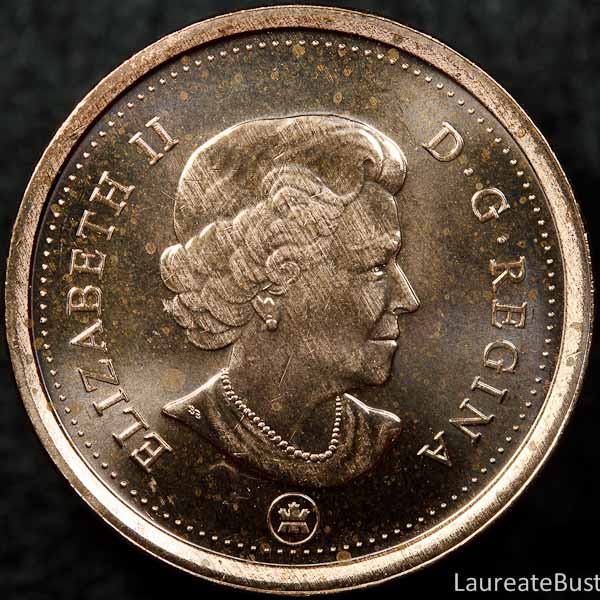 Finally, this is a circulated 2011 CPZ that is not from this box showing a 1 to 7 o'clock lined pattern: 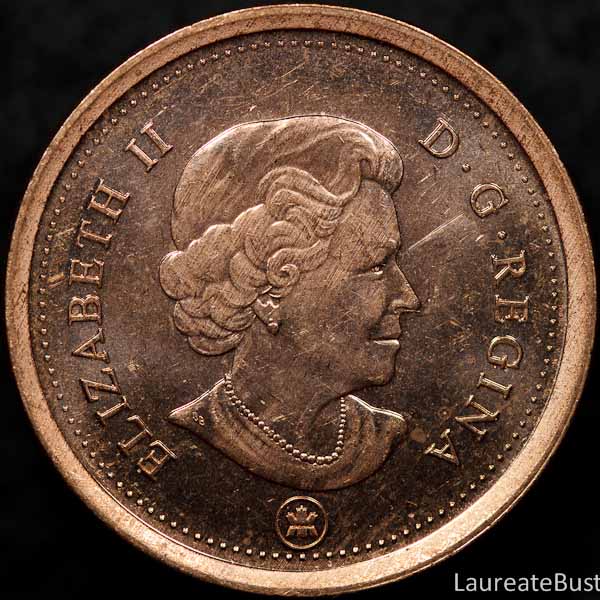 |
|
Pillar of the Community
Canada
3167 Posts |
I still don't understand how that could happen during the ejection proces.s
|
| |
Replies: 7 / Views: 1,749 |
|







 Posted 09/28/2012 12:42 am





