

 Posted 10/07/2012 10:26 pm


No, and even if they were, the answer to the second part of your question would still be no.
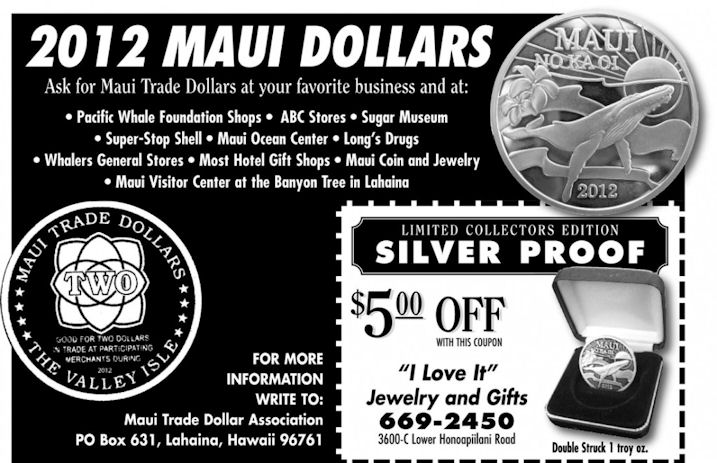
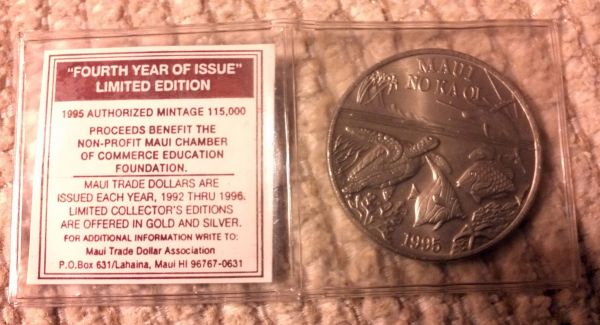
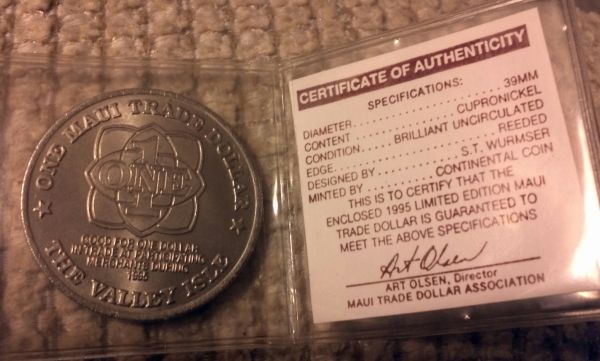
This piece was struck by the Continental Coin Company, a mass-producer of gimmicky coins and coin-like objects. In that sense, they could be considered the precursors to the National Collectors Mint. Continental eventually got taken to court for mail fraud over mass-marketing Hutt River Province coins as "legal tender coins" when the Hutt River Province is not a recognized country. They were found guilty and the company shut down soon afterwards. But these "Maui dollars" are base-metal "tourist dollars" in the literal sense, in that they were sold in tourist shops for $1 and could be redeemed for $1 at any shop that agreed to accept them, up until the expiry date.
Bernard von Nothaus, prior to running the NORFED liberty dollar scheme, ran an operation called the "Royal Hawaiian Mint". After he "retired" to found NORFED, the new owners of the company continued to strike medallic pieces, usually in precious metals. Their website shows their typical style.
This piece was struck by the Continental Coin Company, a mass-producer of gimmicky coins and coin-like objects. In that sense, they could be considered the precursors to the National Collectors Mint. Continental eventually got taken to court for mail fraud over mass-marketing Hutt River Province coins as "legal tender coins" when the Hutt River Province is not a recognized country. They were found guilty and the company shut down soon afterwards. But these "Maui dollars" are base-metal "tourist dollars" in the literal sense, in that they were sold in tourist shops for $1 and could be redeemed for $1 at any shop that agreed to accept them, up until the expiry date.
Bernard von Nothaus, prior to running the NORFED liberty dollar scheme, ran an operation called the "Royal Hawaiian Mint". After he "retired" to found NORFED, the new owners of the company continued to strike medallic pieces, usually in precious metals. Their website shows their typical style.
Don't say "infinitely" when you mean "very"; otherwise, you'll have no word left when you want to talk about something really infinite. - C. S. Lewis