|
This page may contain links that result in small commissions to keep this free site up and running.

Welcome Guest! Registering and/or logging in will remove the anchor (bottom) ads and the security checks. It's Free!
To participate in the forum you must log in or register. | Author |
 Replies: 7 / Views: 2,386 Replies: 7 / Views: 2,386 |
|
|
Valued Member
Canada
331 Posts |
A thought just occurred to me that I haven't seen addressed in the forums here, but I could have missed it.
First question: Does anyone use dedicated macro lenses with bellows? At first glance it seemed redundant. But, these lenses are ideally suited for close-up work so it seems to me that dedicated macros and bellows would make good pairings as far as image quality is concerned. The obvious downsides are that dedicated macros aren't cheap, and also, adapting them could be tricky. In my case, I have my Canon EF-s 60mm f/2.8 but adapting EOS lens to m42 camera sounds trickier than the reverse scenario (adapting m42 lens/bellows to EOS camera).
Second question: If one would have trouble adapting it via the lens mount, does it make sense to reverse mount them on a bellows? Reversing rings are fairly easy to find for filter threads like 49mm -> m42. Are there any aspects of dedicated macro lens design that would suggest to me they would offer better optical performance reversed as opposed to normally mounted? My gut says at higher magnifications these lenses would perform better reversed because the distances involved would be closer to the intended design for direct camera mounting.
Thanks!
|
|
|
|
Pillar of the Community
United States
4132 Posts |
The problem with a lens like your 60mm is that unless you get a very expensive Canon bellows or one of those (also expensive) wired Novoflex reversing adapters, you will lose aperture control. You can do a trick where you set your aperture and remove the lens from the camera with the DOF-preview button held down, but that's really inconvenient, and IMO, crazy.
The alternative is to use extension tubes. There is a Kenko extension tube set which lets you continue to use all the camera controls for aperture and focus and is much cheaper than the Canon tubes. Control of the magnification isn't as straight-forward as with bellows, but you still have the same kind of range because the lens has a focus helicoid.
|
|
Valued Member
 Canada
331 Posts |
Good point Captain, I hadn't even considered that you can't mechanically operate lens apertures anymore. So, pretend the lens in question is some classic 50mm f/3.5 or similar macro lens for which you can set the aperture manually  If cost is not a factor, would the results be appreciably better than simply reversing a normal lens like a 50mm f/1.8? |
|
Pillar of the Community
United States
4132 Posts |
No idea. Honestly, I wouldn't expect either to outperform a duplication or enlarging lens, which are optimized for a specific, narrow purpose which happens to coincide with the needs of coin photography.
|
|
Pillar of the Community
United States
3076 Posts |
one of the trade offs, or should I say the reason we choose either a dedicated Macro lens or enlarger lenses on a bellows is that they basically are meant to do the same thing...Marco lenses are expensive.. So using the bellows and lenses can be quite use full and much less expensive... I have a 90mm Macro lens, I can use for full size silver dollar close ups of the entire coin....adding it to a bellows simply does this.. 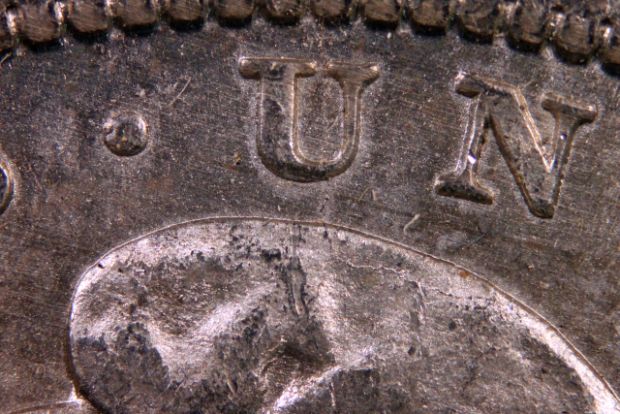 as you can see, this is an un-cropped full size image..re-sized only pic... its no longer a full size image of a silver dollar, but rather a very a very small portion of the silver dollar... The results of your outcome..full size coins or extreme close ups are determined by the set ups you play with..a many varieties can be achieved... |
|
Pillar of the Community
 United States
4051 Posts |
Quote:
Good point Captain, I hadn't even considered that you can't mechanically operate lens apertures anymore. So, pretend the lens in question is some classic 50mm f/3.5 or similar macro lens for which you can set the aperture manually If cost is not a factor, would the results be appreciably better than simply reversing a normal lens like a 50mm f/1.8? Most older, dedicated macro lenses are designed for up to 1:2 magnification. Those lenses typically achieve higher mags by simply extending the lens, like a bellows would do. To get to 1:1 you need more extension. For lenses (like your 60) that can achieve 1:1 natively, the focal length is reduced at higher mags to minimize the required extension. This reduces the working distance to a large degree and can make higher mags difficult to illuminate, especially since the lens is large in diameter and shadows your lights. For newer lenses, as the 'Cap said, you lose mechanical and electrical connection so AF lenses are difficult to operate on the less-expensive bellows. You want to reverse a lens when the optical formula favors it, which is usually beyond 1:1. For instance, the manual focus Nikon 55mm Micro-Nikkor works from infinity to 1:2 natively, and up to 1:1 with the M2 or PK-13 extension. At 1:1, You can reverse the lens and get essentially the same image quality, since images on both sides of the lens are the same size. But beyond 1:1, the optics "reverse" their properties, so for instance at 2:1 you can get a much better image quality with the lens reversed than in normal orientation. Your working distance is also improved. Since dedicated macros (and enlarging/duplicating lenses) are designed to go from flat field object to flat field sensor, you can get better image quality from them than normal prime lenses, which go from curved field object (constant radius or distance to object) to flat field sensor. |
|
Valued Member
Canada
331 Posts |
Thanks for the response, Ray. Your comparison of bellows-mounted normal and macro lenses shakes down about how I expected. One final hypothetical and I'll drop it! My objective is not to  with this thread. I've been looking at MTF figures on Mark Goodman's site. Take for example the Sigma 50/2.8. Mark tests this lens up to 1:1 and the MTFs for sharpness and resolution are both top-notch at 1:1, and are almost exactly the same as the Schneider Componon-S 50/2.8 at 1:1. Compared to the 75ELN, the Sigma's numbers are significantly better (something like 15% better at 1:1). Even though 50-60mm dedicated macros would only be designed to operate at magnifications up to 1:1 at most, I bet one that is bellows mounted, like this sigma, could yield good/excellent results at mags between 1:1 and 3:1. I missed this quote at the end of Mark's Sigma review until just now: Quote:
For imaging above 1:1 magnification, it should work well when reversed on a bellows, although I haven't tried it yet. Anyway, I thought some folks around here might have played around with this type of setup before. Even if bellows-mounted macro lenses gave excellent results over a decent magnification range, they might simply cost too much to bother buying them over, say, a 75ARD. One final note: I'm only using resolution and sharpness as possible merits for this setup, and there are obviously a lot of other tangible differences that might further set apart other types of lenses (such as working distance, CA, etc.) |
|
Pillar of the Community
United States
4051 Posts |
My biggest problem with dedicated macros is their size. It's just too hard to get lighting in with large diameter lenses. For higher mags, even small diameter objectives like the Nikon P4/0.1 are big enough to limit lighting!
|
| |
Replies: 7 / Views: 2,386 |
|
To participate in the forum you must log in or register.
 
- Video: Behind The Design Of Currency Symbols
- Video: Numismatic Finds From The Karkemish Excavations
- Wanted: Whitman And Harris Folders For US Coins In Australia
- 2026 United States Mint Proof Set Available On October 6
- Advanced US Coin Grading: Practice Makes Perfect: Summary & Student Growth, Ep. 10
- Advanced US Coin Grading: The Classroom Competition, Ep. 9
- Advanced US Coin Grading: The Importance Of Eye Appeal, Ep. 8
- Advanced US Coin Grading: Coin Grading With Jeff Garrett, Ep. 7
- Advanced US Coin Grading: Advanced Coin Grading With Don Ketterling, Ep. 6
- Advanced US Coin Grading: Determining Coin Grading Skills, Ep. 5
- Advanced US Coin Grading: Counterfeit Awareness In Coin Grading, Ep. 4
- Advanced US Coin Grading: Grading Services Progression And Current Landscape, Ep. 3
- Advanced US Coin Grading: A Review And History Of Coin Grading, Ep. 2
- Advanced US Coin Grading: Introduction, Ep. 1
- 1984 (1985) India 20 Rupee, PCGS PL-66, Indira Gandhi
- Philippine Peso 1905 S
- 2026-D Quarter Possible Doubling
- Commems Collection Classic: 1936 San Francisco - Oakland Bay Bridge Opening - Historical Tidbits
- Dominion Of Canada 1898-H One Cent Die Study
- 1957 D LWC RPM 003 D/D/D Stage B
Disclaimer: While a tremendous amount of effort goes into ensuring the accuracy of the information contained in this site, Coin Community assumes no liability for errors. Copyright 2005 - 2026 Coin Community Family- all rights reserved worldwide. Use of any images or content on this website without prior written permission of Coin Community or the original lender is strictly prohibited.
Contact Us | Advertise Here | Privacy Policy / Terms of Use
|
| Coin Community Forum |
© 2005 - 2026 Coin Community Forums |
| It took 0.3 seconds to rattle this change. |
 |
|
| |
| |





 Posted 10/15/2012 7:55 pm


