| Author |
 Replies: 11 / Views: 1,564 Replies: 11 / Views: 1,564 |
|
|
Pillar of the Community
778 Posts |
Here is a very large (70+mm, 133.6gm) uniface lead or pewter George II piece. First, the piece itself -  Then, the image reversed, so the legend is readable -  and finally, the piece shown next to a Spanish crown, to show relative size -  To me, the legend appears to be - GEORGIVS GVII DG DVX BR ET LUN Thanks for your help. Bill
|
|
|
|
Pillar of the Community
United States
4212 Posts |
Looks similar to a 1731 dedication medal. Could this be a trial of sorts?
|
|
Pillar of the Community
 778 Posts |
I was thinking along the same lines at Fioti. I seem to remember that Dies used to be prepared by the use of Reducing Machines. The design was first prepared 'larger than life' (perhaps to minutely show every detail), and then cut with the Reducing Machine into new Dies.
Might this uniface item have been part of the process to make the medal that Fioti mentions?
Bill
|
|
Pillar of the Community
United States
2605 Posts |
I believe you guys are digging in a wrong sandbox! KG2 of Britain never had crazy hair on top like this. The legend (even the fudged-by-Bill version) doesn't look British at all either. To me it looks like Georgivs (George) Gvil. (William) D.G. Dux (by the grace of God duke of) Br et Lun. I think I got your guy: George William, Duke of Brunswick-Lüneburg |
|
Pillar of the Community
United States
2605 Posts |
By the way, here's my piece of "real" George II (compare the do's): 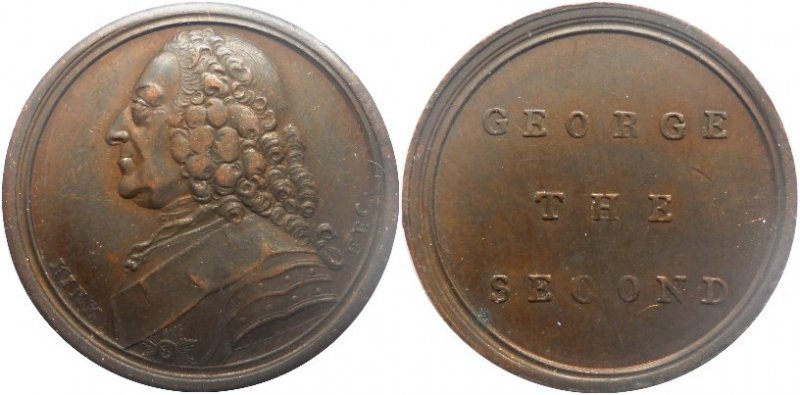 |
|
Pillar of the Community
778 Posts |
My apologies! It DOES say George WILLIAM, GVIL being short for Gvielmvs). Thanks for pointing out my goof. (I even put this on the wrong Forum, I'm thinking).
So, svslav, why did someone make this uniface, reversed image George William thingee?
|
|
Pillar of the Community
United States
2605 Posts |
The only thing I can think of is that this is a step in preparation of an obverse die for a medal.
You could do a search of medals of GW and see if the reverse could pinpoint the event and/or the date of its make.
|
|
Pillar of the Community
United States
3253 Posts |
|
|
Pillar of the Community
778 Posts |
AMAZING! Almost exactly the same, but, then again, not the same! So, as Fioti suggested, my piece may have been a trial piece. (One of several, it appears).
Thanks much for finding it!
|
|
Pillar of the Community
United States
3253 Posts |
My pleasure! How's your German, though?
|
|
Pillar of the Community
778 Posts |
Great, (with Google translate, <g>) -
St. James Auctions Ltd
> Auction 211
Auction date: 18 June 2012
Lot number: 2996
Price realized: 420 EUR (approx. 530 USD as of the auction date) Note: Prices Tellows include buyer's fees. Find similar lots in upcoming auctions at
Lot description: GERMAN COINS AND LÜNEBURG BRUNSWICK BRUNSWICK-LUNEBURG-CELLE, PRINCIPALITY George William, 1665-1705 Silver medal 1705, by E. Hannibal, on his death. Geharnischtes bust r. with a large wig and folded down coat / / In a race track, the horse jumps through the two columns labeled target after l, section two lines of writing. 59.84 mm, 101.48 g Brockmann 633rd in silver very rare. Numerous scratches, very nice house from the collection of the Prince of Solms-Lich-Hohensolms. Georg Wilhelm had from 1648 to 1665, the government in the Duchy Calenberg-Hannover held. In 1665 he compared himself with his younger brother Johann Friedrich to the effect that this was the former land of the former, and he took over George William, the rule in Lüneburg-Celle. The remains of the Duke was born on 9 October 1705 was buried in the city of Celle Church. Racecourse often symbolizes the life medals. On the present coin crosses the Welfenroß the goal (the death), while eg on a medal at the birth of the horse is at the start of the race track. Estimate: 300 EUR
|
|
Pillar of the Community
United States
3253 Posts |
Seems Ehrenreich Hannibal was one of the most acclaimed medallists of his period. Who knows if any other preliminary mock-ups of his still exist, to illustrate his methods and process?
|
| |
Replies: 11 / Views: 1,564 |
|








 Posted 10/31/2012 5:18 pm


