| Author |
 Replies: 26 / Views: 4,059 Replies: 26 / Views: 4,059 |
|
|
|
Moderator
 United States
23522 Posts |
This is axial; by definition it only passes a small percentage of light to the coin. To achieve direct-lit exposure parameters, you'd need to use 300w+ of light. And at that point, you'd probably be interfering with the lens' ability to shoot through the glass.
I'm thinking Bryan can run the ISO down to 400 - he's getting a little overexposure - but he really wants to be at f/8 with his lens. That means exposures well slower than 1/100.
The only other option is beamsplitter glass, which would improve transmission but it's not cheap. A 12x12 pane is north of $50, and that's only for 30% reflection; double the cost for 40%. You're lucky if you get 20% from standard glass.
|
|
Bedrock of the Community
 United States
14454 Posts |
I did still have the light diffused in the pictures. It doesn't matter how close the light is really it doesn't seem to make much difference if any at all. If I take the diffusion off of the lamp the glare makes it impossible to take a good shot and I am guessing it is because I am trying to shoot through the slab as well. At the settings you had me using anything short of the lights (I mean 3 of them) pointing straight at the coin is going to produce a dark picture. I usually (when shooting straight on the coin) use settings of ISO 100, F8.0 with a shutter speed of 1/60 to 1/80.
|
|
Valued Member
United States
51 Posts |
Dave, I have been able to take bright shots with my axial setup with using a single (or double) Jansjo lamps. I am not sure if its a wattage issue, or simply light positioning.
Bryan, I would really experiment with the angle of the glass, see if it will reduce the glare from non diffused light source. I would also try to point the light source to the glass so the hot spot is ABOVE the coin. Also you can try to tilt your coin a bit - by shimming a penny under one edge of the slab - this should also help you to reduce the glare.
|
|
Moderator
United States
23522 Posts |
You must have an extraordinary piece of glass, then. I've never shot axially using a Jansjo, but the laws of physics state that you're only going to get some 20% of the lumens offered to actually hit the coin regardless of how tightly-focused the beam is. The shot parameters you suggested to Bryan are roughly what I used with 2 Jansjos directly illuminating a Mint State Cent (brown).
Is the sensor of your D5000 that much better than Canon's? I'm forced to wonder, because your results and methods speak for themselves.
|
|
Valued Member
United States
51 Posts |
Dave, I am definitely out of my depth here, but here is what I was referring to. I have recently purchased this Ike, and have taken some quick pictures, just to illustrate the point. I have not prepared the slab, all the marks are still visible. ISO 200, f5.6, shutter speed 1/125 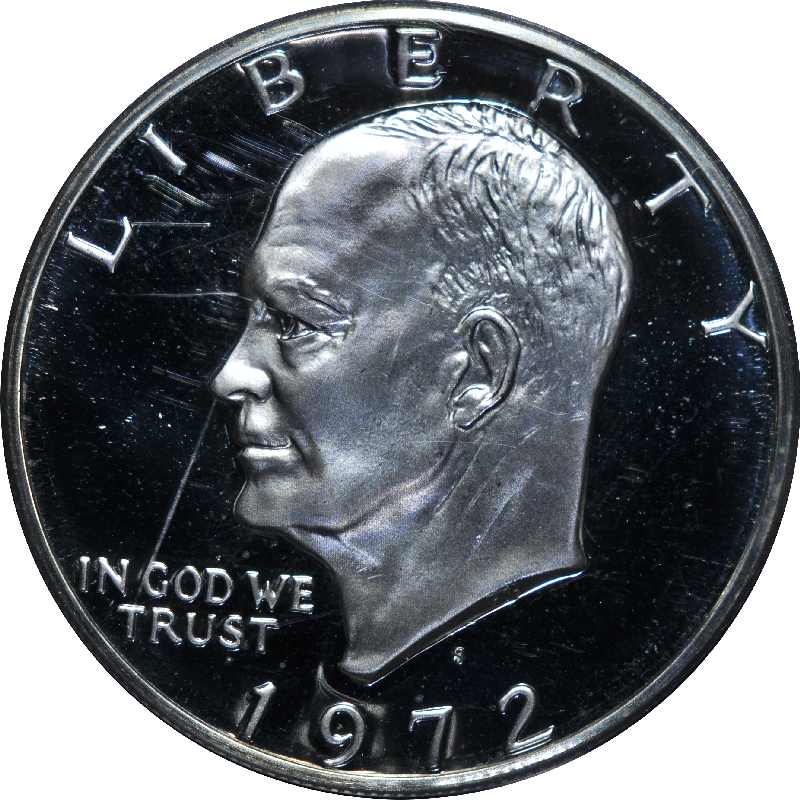 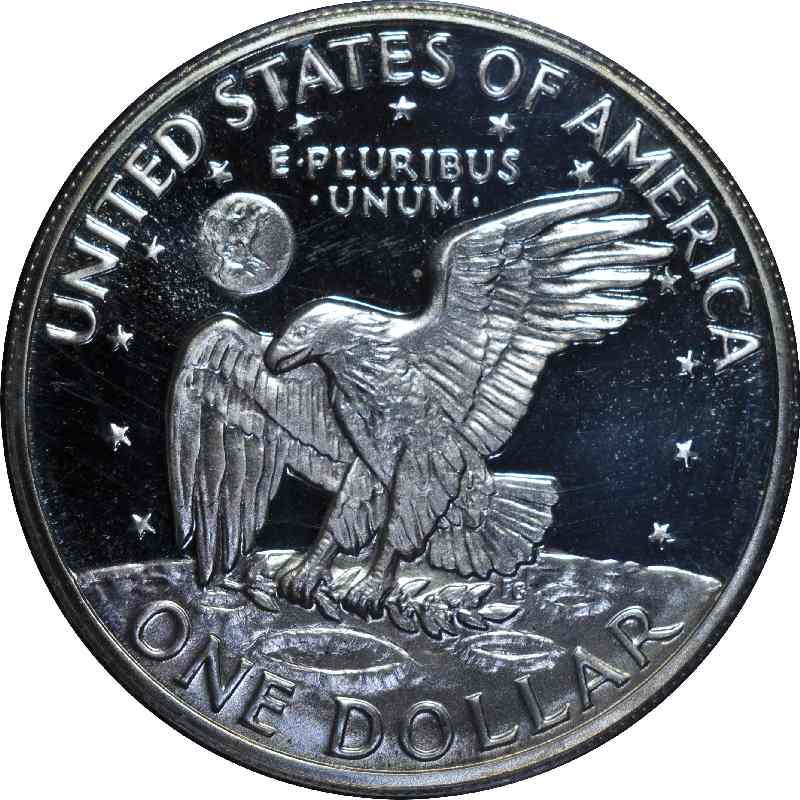 The shots were taken with combination of axial and overhead lighting. Two vanilla Jansjos were used in axial set up, wide enough so it will not create a hot spot on the coin. The overhead single Jansjo was slightly diffused, positioned at a high angle, hot spot is just above the coin (on the slab). PS I am not sure what happened to my original reply. It was posted twice, and when I removed the duplicate, it has removed the first post as well Pavel |
|
Valued Member
United States
51 Posts |
Wow, I am tottaly confused now, the reply was posted twice again  I don't own many toned coins, and none of them are in the slabs. However, I have taken another picture of a slightly toned ASE (raw coin), with a similar toning location that Bryan is trying to work with. Here are my results with the same settings as in previous shots: 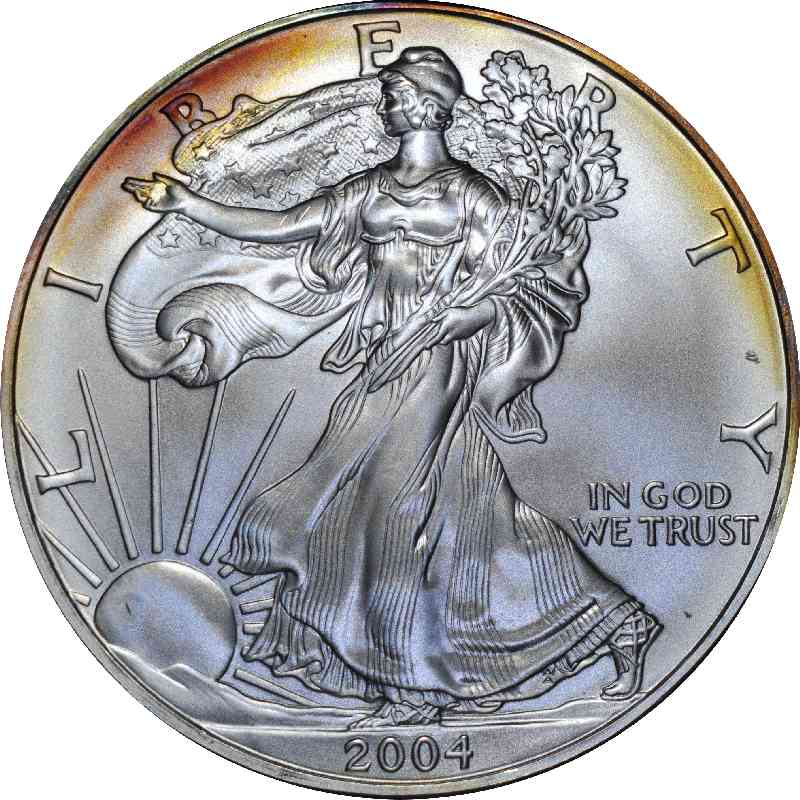 |
|
Bedrock of the Community
United States
14454 Posts |
I Just removed the duplicate posts, usually I would do this without mentioning it but since you mentioned it in your posts I didn't want people to think you were seeing things since they are no longer there. I am guessing your setup allows those settings more than mine does because I get the same results as Dave said. With the setup you are using I have to have the jansjo's pointed directly at the coin (no axial lighting) to get a bright enough shot to be able to see
|
|
Valued Member
United States
51 Posts |
Dave, Bryan, I am not sure if this is related to what you are experiencing with your shots, but I have come across something really strange. If I open my shots with Irfanview or Gimp, I can see them similar to "liveview". However, other programs (like Raw Therapy) open my images hugely underexposed. I have double checked, there are no filters automatically applied. If I apply exposure compensation filter to my image, I get very similar results to Bryan's. Bryan, if you are using a "live view" with your set up, does your image (in term of lighting) similar before and after? Pavel |
|
Bedrock of the Community
United States
14454 Posts |
with the settings you suggested in live view they are very dark and the other settings I have used do look a little different. I opened up this picture from RAW format in Photoshop and then changed to JPG and cropped and resized the image to fit on the forum (no post processing at all except for what was mentioned). Not sure if it fixes the problems or not but will wait to see what ya'll think or for further instructions 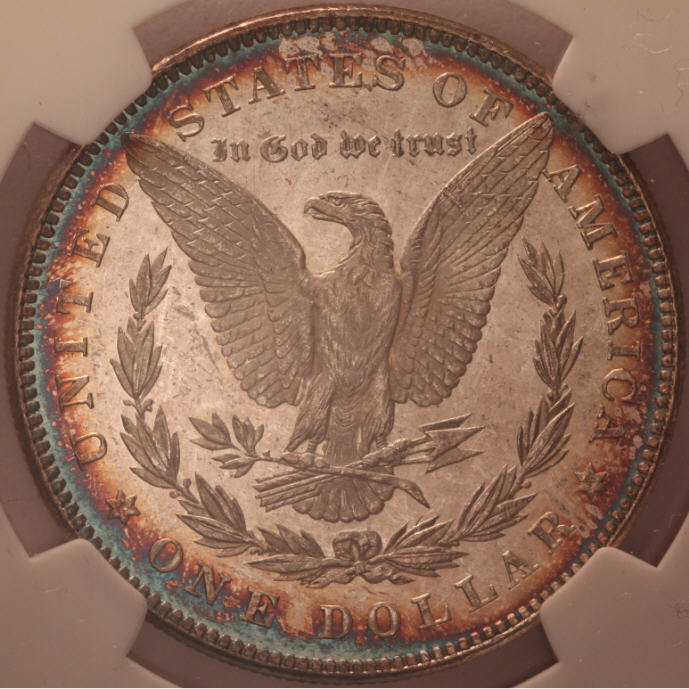 |
|
Valued Member
United States
51 Posts |
Bryan, Just to illustrate what I was suggesting, I have created the following schematics (I have used some of the previously published images on this forum, slightly modified) 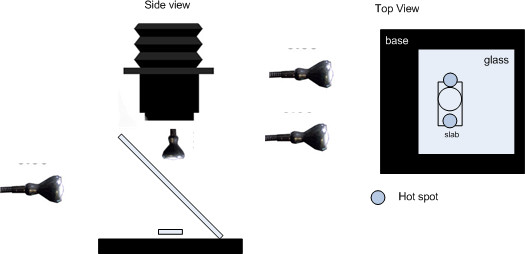 In order to eliminate or reduce the glare from your pictures, you need to change the angle by which light is getting on your slab/coin. If you use 45 degree glass, you will get a light (even thought its about 20% of the source) directly hitting your coin. By moving the angle to 42 or 48 degrees, you should see that a glare is moving to the edge of the coin. You will need to experiment with this to get to the workable angle. To further reduce the glare, you can shim a penny under one side of the slab (opposing side to where the glare has moved). The reason, I am using two Jansjo lights in my axial set up is because I can control the hot spots which causing the glare. I usually spread them apart depending on the coin I shoot (larger spread if I am shooting large dollars). When I have experimented with a single light source (like desk lamp with 100 watt bulb), I was not able to get rid of the glare, or my images were too dark. Hope this helps. Pavel |
|
Bedrock of the Community
United States
14454 Posts |
I tried it like your diagram above and I get the exact same results without the glass as I did with it. So when I set it up like that there is no reason to set up the glass at all as the one Jansjo pointing straight down gives the exact same result without the glass
|
| |
Replies: 26 / Views: 4,059 |








 First Page


 Posted 11/30/2012 8:50 pm


