| Author |
 Replies: 14 / Views: 3,797 Replies: 14 / Views: 3,797 |
|
|
New Member
United States
49 Posts |
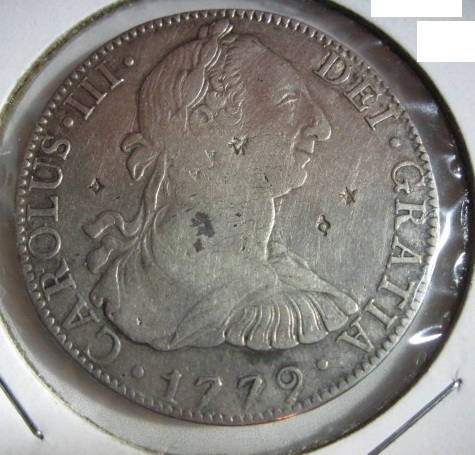
I generally collect modern US coins so I have very little experience with Spanish colonial coins. I recently acquired an 8 Reales coin dated 1779 (sorry, I still don't have a way to post photos) and I was wondering how to identify it more completely. Suggestions? What should I look for? Identified - moved to World Coins forum - Sap |
|
|
|
Pillar of the Community
United States
4897 Posts |
Edited by amida17
12/28/2012 08:57 am
|
|
New Member
 United States
49 Posts |
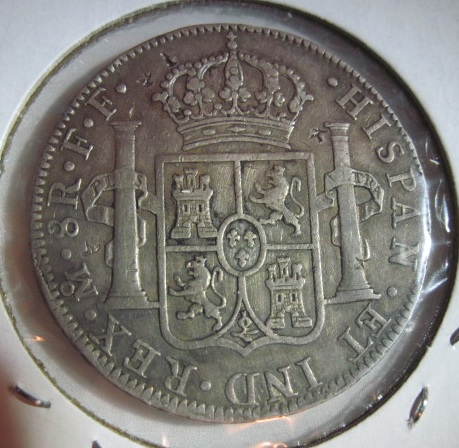
Mint Mark is that "M" with the little circle above it, just like the picture on that site you posted, but the assayer is F F, instead of the F M in that pic. So does that mean Mexico mint?
|
|
Pillar of the Community
United States
4897 Posts |
|
|
New Member
United States
34 Posts |
Your 8 Reales coin dated 1779 should bear the bust of King Carlos III on the obverse and on the reverse the coat of arms of the Kingdom of Spain surrounded by the inscription HISPAN. ET IND. (for Spain and the Indes), the abbreviation of the denomination, in your case 8R, the mark small o over large M of the Spanish Colonial mint at Mexico City as well as the initials F F for the assayers at the time: Francisco Antonio de la Pena & Francisco Arance y Cobos. The Spanish appointed two assayers at a time to supervise the quality of the silver and gold coinage at every mint and despite this precaution there were discrepancies in the percentage of silver in the alloy from time to time at the colonial mints of Spanish America.
Roderick
|
|
New Member
United States
49 Posts |
Yes, there is a bust on the obverse, I'm guessing the lettering "CAROLUS" is a spelling variation of "Carlos", right? The roman numeral III next to it would make it Carlos the third. Also on the obverse is the lettering "DEI GRATIA", what is that referring to? All the lettering you mentioned for the reverse is there plus the word "REX". So this is a spanish colonial 8 Reales minted in Mexico City under the supervision of Francisco and Francisco  (I don't know why that's so funny to me). Any further identification that I need to find out about it? |
|
New Member
United States
34 Posts |
I am glad that you found my information of some use.
DEI GRATIA is a commonly used Latin phrase in the titles of monarch meaning BY THE GRACE OF GOD. REX is Latin meaning KING. Monarch found out long ago, that being chosen by God enhances their mystique and above all is very useful in controlling the populace.
Roderick
|
|
Pillar of the Community
United States
2120 Posts |
Counterfeits are prevalent in the era, though with out photos we cant help identify.
Simple tests are weight, appearance (color), natural wear patterns, consistent edge, and Font.
Find a genuine example online of your coin and verify its details against yours.
|
|
New Member
United States
49 Posts |
Edited by harthag
01/08/2013 9:25 pm
|
|
New Member
United States
49 Posts |
I've seen counterstamps mentioned on some other threads here, but the marks on this coin seem much smaller than the counterstamps I've seen on other coins in other threads.
Are these just really small counterstamps or something else?
I was also wondering how to grade this coin (I know this is not the grading section of the forum so if I just need to start a new thread there, let me know) (I edited out what the dealer wrote as the grade to avoid biasing the answers from you folks here)
|
|
New Member
United States
34 Posts |
The older Chinese chop marks from the 18th century are normally very much smaller than those used in the mid 19th century to the early 20th century. While the chop marks appear to be correct, I have read of reportedly counterfeit Chinese 8 Reales coins punched with 18th century style chop marks in order to throw off the wary buyer.
I should mention that just because a coin has chop marks does not mean that it was actually in China. Chinese merchants could be found all over what is presently Indonesia, the Philippines, Vietnam, Cambodia, Thailand, Burma, Laos, Malaysia and others. They chopped the Spanish, Mexican, Peruvian, Bolivian and American coins all through the 19th century and in the case of Spanish Colonial coins for a few centuries before.
Edited by Roderick
01/09/2013 9:07 pm
|
|
New Member
United States
49 Posts |
Since you mentioned "chop marks" I've started trying to research those, but haven't been able to find much info.
Anyone know some good sources for info on chop marks?
Anyone know how they would affect the value or grade of this coin(or of coins in general)?
|
|
Valued Member
United States
380 Posts |
|
|
New Member
United States
34 Posts |
I am not certain that the marks on US Trade dollars will correspond to those of a century earlier. After the interest in chopmarks was brought up in the discussion, I located a book on my shelves titled "Chopmarks" by F.M. Rose which was published in 1987. I will look through it and try to identify a mark or possibly some marks on your 8 reales coin. You could try posting the question on this coin forum http://foromaravedis.forosgratis.info/forum and see if you receive a satisfactory response. There is also an excellent website available with considerable information regarding chopmarks on the Spanish Colonial coinage of the Philippine Islands. Here is the link http://www.chopmarks.com/ Edited by Roderick
01/11/2013 11:36 pm
|
|
New Member
United States
34 Posts |
The chopmark just to the left of the capital of the Pillar of Hercules on the right is the character 'liang' which according to F.M. Rose is an alternate word for tael which was a standard Chinese weight for silver. By standard, I mean that it was the principle designation for silver in the amount of just over one troy ounce. Over the centuries and with locally accepted variations a tael could vary in weight from 33.9g to 40g.
|
| |
Replies: 14 / Views: 3,797 |
|







 Posted 12/28/2012 10:19 am