| Author |
 Replies: 16 / Views: 3,627 Replies: 16 / Views: 3,627 |
|
New Member
United States
10 Posts |
Were the 1921 Morgan silver dollars (D) minted in both D1 and D2 reverse? I have never seen one with the D1 reverse. Also, were all D1's minted with 17 berries or did some have 16 and did all D1 and D2's have the same reed count? Any information is helpful. Thanks so much. |
|
|
|
Moderator
 United States
23522 Posts |
Welcome to Coin Community, Vondas. The D1 reverse is the 17-berry, and it's only found on 1921-P issues (which also used the D2). Both Denver and San Francisco used the 16-berry D2 reverse exclusively, and all should be found with 189 reeds. Only the "Infrequent Reeding" 1921-P issues used a different reed count of 157 (the lowest-ever in the Morgan series), and to date all but one of those varieties is known to have used the D1 reverse. The Infrequent Reeding with the D2 reverse - VAM-44 - is a ridiculous rarity.
|
|
New Member
 United States
10 Posts |
Thank you for the info Dave. I have a 1921 which I believe has a D1 reverse and I thought I was seeing a faint D mint mark. I have read many of your posts and was very happy to see that my reply had come from you. Here are a couple of pictures, let me know what you think. Thank you again. 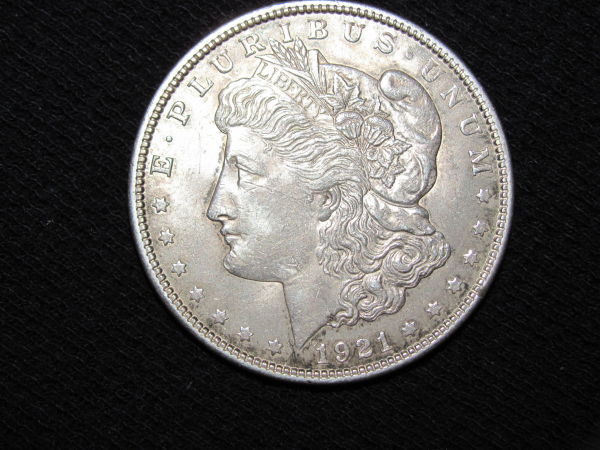 |
|
New Member
United States
10 Posts |
Reverse- I hope you can work with this image. Where the mint mark is usually located under close examination I thought I was seeing a D. 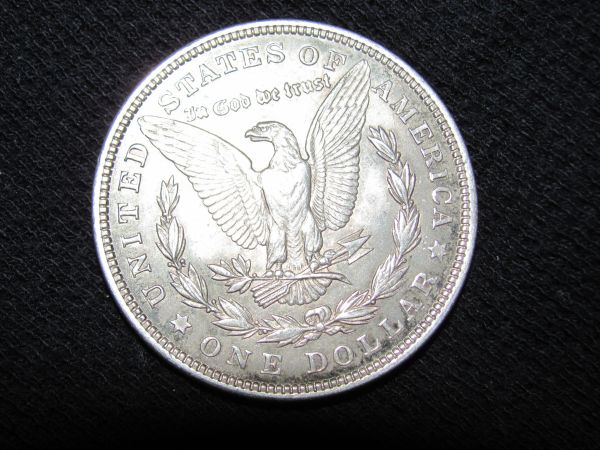 Edited by Vondas
01/29/2013 6:45 pm
|
|
Moderator
United States
23522 Posts |
That's a pretty good strike for a 1921. Not "huge," but decent. D1 reverse, and just a little bit of circulation wear. Meaning no offense (I do this all the time; it's what I do best), I think you're trying too hard to see stuff, seeing a "D" mint mark. There are less-prominent "D" impressions known, but nothing you'd have to strain to see short of a Grease Fill. That's admittedly a possibility, but it would be the first D1 Denver coin known and I have to consider such a discovery to be very unlikely this late in the game. People have been looking at thousands upon thousands of these for decades. This isn't like the recent discovery of two new 1878-P B1 Reverses, which were relatively subtle differences easily understood to have escaped detection. A D1, 1921-D would jump off the screen at me with enough force to knock me out of the chair, at first glance. |
|
New Member
United States
10 Posts |
Absolutely no offense taken sir. Most of what I have learned about this coin has been absorbed through your writing. I was trying to figure out where it was minted so I took a few pictures and zoomed way in and that's what I saw. I wish I had better photoshop software, perhaps you can tell me what I am seeing? This is a zoomed in look of the same photo of the reverse side shown above. 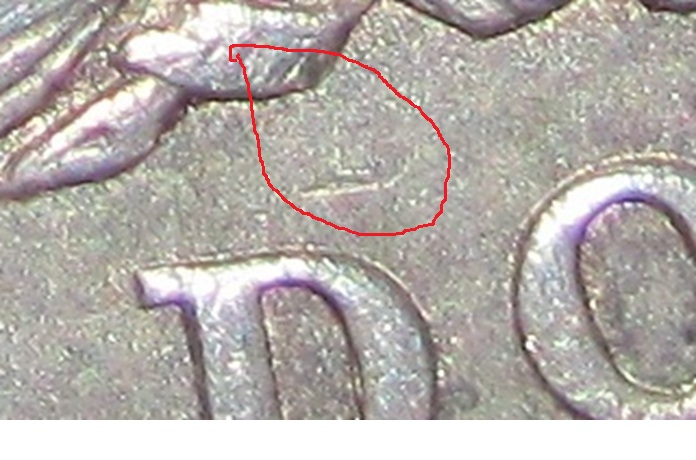 Almost looks like it could be a B. The Bottom line seems pretty profound to me. The lighting must have been just right because other photos I have taken show nothing. 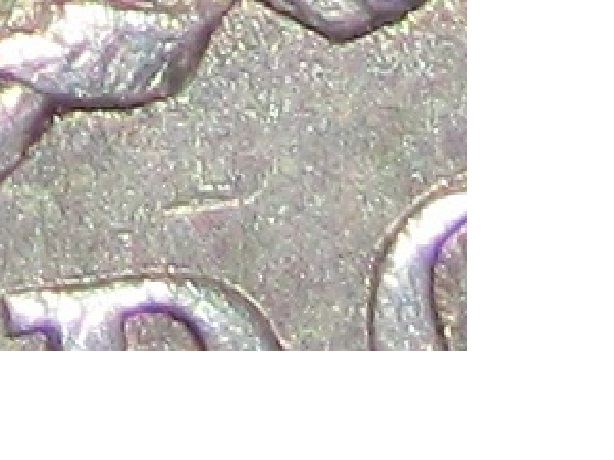 Edited by Vondas
01/30/2013 07:41 am
|
|
Pillar of the Community
United States
900 Posts |
It could be a clash from the "B" in "PLURIBUS". Just a thought. Where are my manners?  Edited by scurry64
01/30/2013 11:44 am
|
|
Moderator
United States
23522 Posts |
Fascinating. The only likely culprit for a clash in that area is the wheat kernels, and off the top of my head I cannot recall ever seeing such a clash with any Morgan. Nor would it have that shape if it were. Aside being too large, it looks exactly like a "D" mint mark. It doesn't match any letter sizes on a Morgan, though. The first thought is obviously PMD, but it's awfully regular to be accidental contact. OK, next thought, Vondas. Do you have the ability to apply magnification to eyeball the coin? If so, have the closest-possible look at it and see if you can determine whether it's raised or depressed. |
|
New Member
United States
10 Posts |
My digital camera is my only tool for magnification but I will try and figure something out. If I had to guess I would say raised because of the way I have seen it sort of twinkle in the same way the berries do under a lamp; I have also seen spots that appeared damaged do this which led me to believe it was the silver exposed from under the finish. Many thanks again for helping, I will update when I get something figured out.
|
|
New Member
United States
10 Posts |
I'm not really seeing that "twinkle" I mentioned since I put it in a coin capsule. On the bottom of the the alleged "D", where the mark is most significant, I can start to see the whole thing under good lighting. The "D" isn't in a normal location for a mint marking, (as far as I can tell). After Dave mentioned the size I figured I should be able to see this if I look closely. Sorry I don't have anymore information right now or something a little more concrete, but judging from the bottom line of the "D", it sure looks raised to me. I will try and buy a magnifying glass to get a better look. By the way, thank you both for the friendly welcome.
Edited by Vondas
01/31/2013 05:44 am
|
|
Pillar of the Community
United States
3453 Posts |
Vondas, this is very interesting. I hope you post updates when you get the pictures you want.  |
|
New Member
United States
10 Posts |
After patiently taking roughly 30 additional photos, I could not come anywhere close to what is already posted. Not only are these not as clear, most of the others show nothing at all. Staring and taking pictures are only taking me so far. For a moment, I was positive it is raised above the surface, minutes later, I was convinced it's sunken below, and back and forth. Lighting has to be strong, but even more importantly, the angle I am looking from and tilt or positioning of the coin. 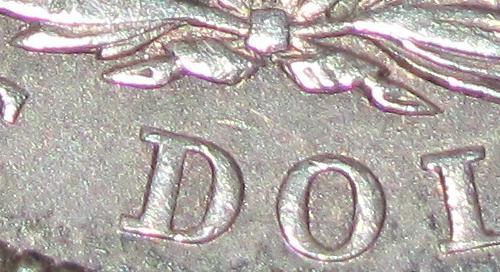 The first picture I posted with the red circle is starting to feel like some kind of a freak occurance. The best results have come from using the flash. 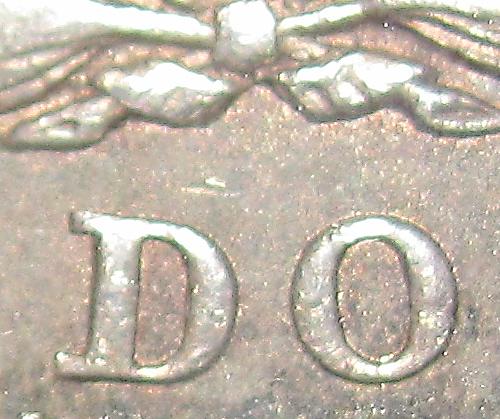 Magnifying glass later today, not so sure it's going to help much. |
|
Pillar of the Community
United States
3453 Posts |
I see what you mean about these pictures. In hand with a loupe, does it look raised or depressed?
|
|
New Member
United States
10 Posts |
With the equipment I have gathered, this is a really tough, tough, call. I have owned a long, skinny, tube shaped magnifier for over 15 years and it's not in great shape, but it gets me pretty close, a lot closer than the cheap magnifying glass I used prior. After repeatedly adjusting light and angles for over an hour, I finally got a decent look.
I am feeling pretty strongly that the "D" is raised above the coin's surface. It looks like there is a pretty decent scratch right at the base of the profound botttom line I mentioned. The way it commences into the bottom of that perfect D shape partially brought me to this conclusion; it made trying to distinguish the mark's height a little easier to gauge. The rectangle inside of the D is the most definitive evidence as it appears clearly sunken below the letter's inner outline.
The top half of the "D", is most difficult. The photograph which captured the entire letter so clearly was pure luck and completely baffles me,(especially considering it was taken without direct intent of doing so). The other half of the letter "D" from roughly the center down is what is most visible, as I said before, this is really tough; the mark is incredibly weak and extremely dainty.
I can't stress enough how difficult it is for me to feel comfortable with my assertion. My eyes are sore from squinting and this process was surprisingly exhausting. I wanted to be 100% certain but I believe this is as close as I'm going to get and I'm going with my gut feeling.
By no means can I state that I am absolutely positively certain. I'm not even in the minor league with coins and I have no experience with examining them. If I weren't feeling pretty good about this, I wouldn't have created this post. I know it's not much, but it's my honest, conscious opinion.
Edited by Vondas
02/01/2013 4:48 pm
|
|
New Member
United States
10 Posts |
I'm considering taking my coin to a local shop for someone to take a better look at it for me, or looking into my school as a potentional resource. I would feel a little awkward approaching someone in the science department to ask if I could use a microscope to examine a coin. I can't afford to purchase one for myself right now. I have a crazy fear that somebody (at a coin shop) will take it in the back and come back with a different coin and make me out to be this dillusional person that needs to be removed from the premises. More than likely, there isn't anything extra special about my 1921, but admittedly, I am a bit skeptical by nature,(understatement). Is that a ridiculous concern? Judging from what I know, it also has a nice 17th berry. 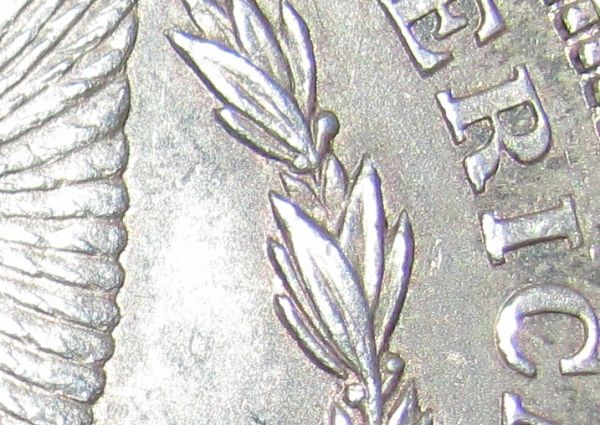 I couldn't find a VAM for the three marks next to the star on the right. 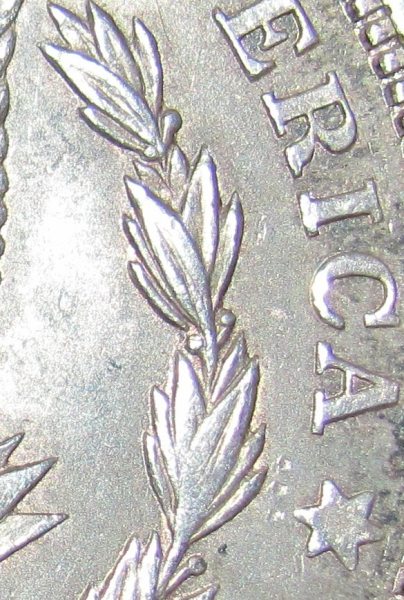 Edited by Vondas
02/22/2013 04:36 am
|
|
Moderator
United States
23522 Posts |
Quote:I couldn't find a VAM for the three marks next to the star on the right. That's a bagmark, caused by the reeding of another coin hitting it in the bag they were stored in. |
| |
Replies: 16 / Views: 3,627 |










 Posted 01/29/2013 6:38 pm


