Got back from the London coin fair yesterday with two coins, one of which i'll post here, the other belongs in the world section.
Background Well I started out in collecting many years ago and I always wanted to do a denomination set, in a nut shell one coin of each denomination for a give year. I had tried an 1887 date set, a 1912 date set, a 1937 date set and I didn't get too far on most.
The one I got nearest to completion on was my EF+ 1887 Victorian Jubilee issue set Sovereign - Threepence. I had the half sovereign, crown, double florin (Arabic 1 in date), halfcrown, florin, shilling, both types of 1887 sixpence and the threepence. All that was missing was the double florin with a Roman I in the date and an 1887 sovereign. Although I did have an 1889-S sovereign filling in.
In the end though I sold them and moved into sixpences and latterly into hammered coins. A few months ago I thought, 'wouldn't it be a good idea to try this collecting approach again but how about trying it with hammered coins?'
So I looked around and I thought what's the cheapest monarch around where I can get one of each denomination in decent condition all dating to roughly the same period?
A New HopeThen I happened to stumble upon Henry VI of England (a rather unfortunate fellow) who reigned from 1422-1461 before being overthrown, although he did managed to find himself back on the throne unexpectedly in 1470-71 before being deposed and imprisoned in the Tower of London for a short spell before being murdered.
As for the coinage it appears that in the earliest years of his reign 1422-27 coins of most denominations were struck in abundance and turn up here and there in not too bad condition.
Coins of the medieval period prior to Edward III are generally identified to a particular period in the reign based on their style and thus they are assigned into classes. I think that sometime in Edward III's reign this changes or is beginning to change as numismatists begin to refer to coins by certain issues, often based on their 'mintmarks', marks which don't so much indicate the mint the coin came from but more the time period it was struck in.
By Henry VI's reign coins are generally identified as to a mintmark type, Annulet issue (an Annulet looks like an 'o') Leaf issue, Trefoil issue, Pinecone issue, amongst many others. These little mintmarks are hidden within the legends and main design.
Anyhow the Annulet issue was the first struck from 1422-27 before they switched to the next issue. And this first issue is quite common. Thus I thought well what about a 'date' set (so far as dateless coins can be called that), from gold noble at the top to little silver farthing at the bottom? Now I like a challenge so I went and decided to give it a try...
The coins I need to get are;
Gold (with original medieval value in brackets)
Noble (Eighty pence)
Half Noble (Forty pence)
Quarter Noble (Twenty pence)
Silver
Groat (Four pence)
Halfgroat (Two pence)
Penny
Halfpenny
Farthing (Quarter Penny)And I managed to pick up the Halfpenny yesterday!

(Apologies for the dark scan in advance).
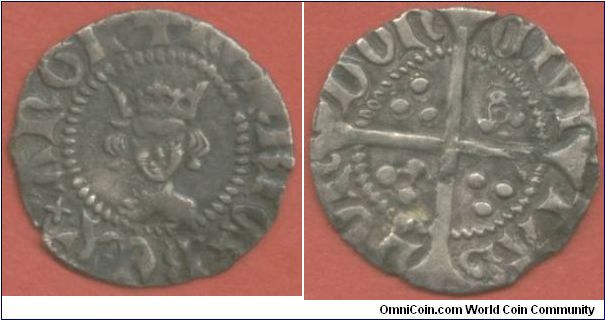
This little fellow is smaller than a US dime, 14mm to be precise. (The much rarer Farthings are about 7mm to 8mm so image how frustrating they were, also it explains why they are rare...)
There are two annulets visable on the reverse of the coin. If you look at the groups of three pellets in each of the four angles, the three pellets on the left and the three pellets on the right have annulets between them.
Obverse Legend; + HENRIC x REX x ANGL (Henry King of England)
Reverse Legend; CIVITAS LONDON (City of London) which is where it was minted.







 Posted 06/12/2005 1:03 pm





