| Author |
 Replies: 25 / Views: 3,234 Replies: 25 / Views: 3,234 |
|
Valued Member
United States
161 Posts |
I have an interest in coinage from infamous regimes such as Islamic Agfhanistan, Nazi Germany, Iraq under Saddam, Islamic Iran, USSR, Communist Cuba and the like. What are some of the coins you all have from regimes such as these. Some are interesting like Cuba depicting Abraham Lincoln on a coin. The US would never show anyone other than an American on a coin unless that person contributed to the countries founding or history in a great way. I have dial up so won't be posting many photos. I've got 2 Che Guevara Cuban 3 pesos, a few German 3rd Reich coins, a Saddam bill, and an Islamic Afghanistan coin coming in the mail. I wouold love to see some of the photos of coins the members have depicting infamous regimes or people. I guess in many cases the notoriety of the person also depends on the country the perception is from.
|
|
|
|
Moderator
 Australia
17037 Posts |
I don't have any portrait coins of the most famously psycopathic Roman emperor, Caligula, but I do have one of his relative, Nero (ruled 37-68 AD). He may not have fiddled while Rome burned, and his persecution of Christians was fairly mild compared to some later emperors, but he was still a pretty mean piece of work:  It's not a "real Roman coin" (can't afford one of those for Nero), but a Roman Provincial from Alexandria, Egypt. The language on the coin is Greek; Nero's name appears at 8 to 9 o'clock, near the green fuzz (which is, apparently, stable). I've bumped up the brightness so y'all can see him better. 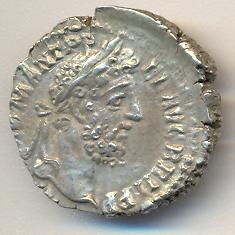 This one is from emperor Commodus (ruled 180-192 AD). The movie "Gladiator" had a fictionalised, sanitised and somewhat abbreviated depiction of this bad-boy emperor's rule. quote:
I guess in many cases the notoriety of the person also depends on the country the perception is from.
Here's an example of what you were talking about. 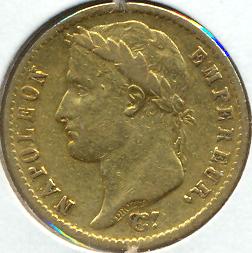 Napoleon Bonaparte probably isn't seen as particularly tyrannical by Americans, because in the War of 1812, he was on your side. He even sold you Louisiana. But to British folks and parts of Europe (like Germany), his Revolution (and later his Empire) is still seen as evil incarnate, second only to Hitler's Nazis.  North Korean coins used to be pretty hard to obtain - just about the only way to get some was to visit there, and even then they gave you special "visitor's money". This one is a genuine, intended-for-the-locals 50 chon piece. However, the regime has lately discovered that westerners are prepared to hand over fistfuls of hard cash for metal trinkets in the shape of coins. Collector coins from this country have since proliferated. Don't say "infinitely" when you mean "very"; otherwise, you'll have no word left when you want to talk about something really infinite. - C. S. Lewis
|
|
Pillar of the Community
Czech Republic
803 Posts |
Not a coin, but a medal commemorating 50th Anniversary of Iraqi Air Force in 1981:  |
|
Pillar of the Community
Germany
1238 Posts |
quote:
But to British folks and parts of Europe (like Germany), his Revolution (and later his Empire) is still seen as evil incarnate, second only to Hitler's Nazis.
Cannot comment on how he is seen in the UK, but in Germany his perception is definitely, hmm, multifaceted. At least here in Rhineland which became French shortly after the 1789 revolution, was under French rule for more than 20 years, then under Prussian rule for 130 years. The civil law that Napoleon brought here (and which remained in use in Rhineland long after Prussia annexed it) was certainly an improvement compared to the "old style" monarchies and their laws. Now of course his war in Prussia, Russia, etc. turned people against him. But an incarnation of evil? Nah. We may, however, have a more differentiated view regarding Napoleon than what seems to be common in France. Now as for coins from dictatorships, yes, I have several from Nazi Germany and also the GDR (Communist East G.). But I do not collect those coins just because I like or dislike a specific regime. I don't have any problems with "foreigners" on our coins. But here in Europe it can be difficult anyway to draw strict lines. Was Franz Kafka for example Austrian, German, or Czech? What about Albert Schweitzer? What I do have problems with is coins that don't have anything to do with the issuing country. Like a coin "from" Palau depicting Wilhelm II and the Imperial German Eagle. Give me a break.  Christian |
|
Valued Member
 United States
161 Posts |
I like the North Korean coin. I have looked at some myself but just not dove in yet. I also hadn't considered Napoleon coinage, now another one for the search.Lets keep them coming.I will try to post the Che Guevara 3 peso coins I have later today or tomorrow. Dial up takes forever though. Are there any coins with Iran's Khomeini?
|
|
Pillar of the Community
United Kingdom
2217 Posts |
Have you tried collecting the U.S. ones from January 20th 2001?
|
|
Valued Member
United States
161 Posts |
No, I just spend those. We will have to wait until the Presidential dollar comes out in about 10 years for that one. |
|
Moderator
Australia
17037 Posts |
quote:
Libertad Peso said:
Are there any coins with Iran's Khomeini?
Not really. Iran is a fundamentalist Muslim country. The Qur'an is explicit: "No graven images". While Islamic scholars are uncertain that a picture of a person or animal on a coin counts as a "graven image", most fundamentalist regimes take the line that it's better to be safe than sorry, and not use any on their coins. There are, however, a few exceptions - the "azadi", a .900 fine gold bullion coin issued intermittently since 1979, has featured the Ayatollah's portrait since 1991. There are still plenty of other, more affordable coins which can illustrate this regime nicely. Like this one, a 10 rials of 1989: 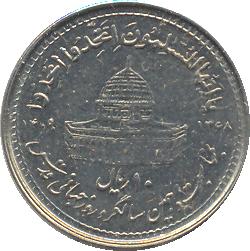 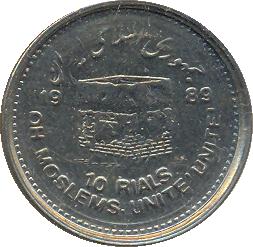 The obverse shows the Dome of the Rock, in Jerusalem. The reverse shows the Kaaba in Mecca, the holiest of Islamic holy sites. The motto "Oh Muslims, Unite! Unite!" (the only Western wording on the coin) is a common slogan in Iranian politics, and you can see right there on the coin the two reasons the regime believes Muslims should unite: their common religion (all Muslims revere Mecca) and their common cause, the removal of the Israeli occupation of Jerusalem. Don't say "infinitely" when you mean "very"; otherwise, you'll have no word left when you want to talk about something really infinite. - C. S. Lewis
|
|
Pillar of the Community
Canada
1106 Posts |
Non Communist & Communist Cuban  USSR USSR  
|
|
Pillar of the Community
Germany
1238 Posts |
Interesting that during the Machado and Batista dictatorships, the Cuban coins mentioned "liberty".  At least the Castro coins are a little more obvious in that regard. The pieces for tourists look much nicer, by the way. I wonder why, hehe. Of course many others could be added to the list - dictatorships in various African and South American countries, or (closer to home from a European POV) in Portugal and Greece until 1974, and Spain until 1975. But if you focus on those regimes that were not only infamous but also act(ed) against US government interests, the list will of course be shorter. Also, some regimes did not make any "ideological" changes to the coins of their countries. The Soviet Union piece is the earlier type which had the "Proletarians of all countries, unite!" motto. Under Stalin that was dropped a little later ... Christian |
|
Valued Member
Australia
335 Posts |
Chrisild wrote:
I don't have any problems with "foreigners" on our coins. But here in Europe it can be difficult anyway to draw strict lines. Was Franz Kafka for example Austrian, German, or Czech? What about Albert Schweitzer? What I do have problems with is coins that don't have anything to do with the issuing country. Like a coin "from" Palau depicting Wilhelm II and the Imperial German Eagle. Give me a break.
Christian,
The reason Palau featured Wilhelm II on thie coins might be explain in this history of the islands:
Palau's first Western contact took place when English Captain Henry Wilson also shipwrecked off the island of Ulong in 1783. Wilson dubbed Palau the "Pelew Islands".
The Spanish claimed Palau as part of the Spanish East Indies, and was governed from the Philippines, until the emergence of 1875 British protests.
In 1885, after Germany occupied some of the islands, a dispute was brought to Pope Leo XIII, who made an attempt to legitimize Spanish claim to the islands (but with economic concessions for Britain and Germany). Spain in 1899, after defeat during the Spanish-American War, sold the islands to Germany.
In 1914 Japan invaded the islands, then formally took over under the Treaty of Versailles after the WWI German defeat. Over three decades the Japanese enforced cultural change. Introduction of an exclusive market economy geared towards Japanese citizens temporarily revoked tribal ownership. Although some reparation was made, defeat did not restore complete order. US intervention only served to widen the legal semantics needed to recover from such an event spanning three different countries with three different tongues.
Bombardment of Anguar in WWIIPeleliu was the scene of a costly battle between American and Japanese forces in 1944, resulting in an Allied victory, though the cost in human terms was high for both sides. After WWII the United Nations played a role and it was decided the US would administer Palau as part of the Trust Territory of the Pacific Islands. Eventually, in 1979 Palauans voted against joining the Federated States of Micronesia based on language and cultural differences. After a long period of transition, including the violent deaths of two presidents (Haruo Remeliik in 1985 and Lazarus Salii in 1988), Palau voted to freely associate with the United States in 1994 while opting to retain independence under the Compact of Free Association.[/i]
|
|
Valued Member
Australia
335 Posts |
A country's infamy is only relative to the period in history and the people being suppressed.
England, Spain, Portugal, United States, Australia, South Africa, all could be classed as imfamous countries that suppressed, raped, enslaved, murdered the indigenous peoples of the lands they occuppied or ruled over. History is full of brutality. It is not limited to that which occurred in our lifetime in some other country other than our own.
|
|
Pillar of the Community
Germany
1238 Posts |
Yes, the 100th anniversary of the 1899 deal was the official reason for issuing those. But I doubt that the pieces from this series (with coins bearing the German language (!) inscriptions "Deutsch Kamerun", "Deutsch Togo", "Deutsch Neu-Guinea", etc.) have much to do with the country. The latest oddity from Palau, by the way, is this piece http://modernworldcoins.nl/mwc/imag...7lourdes.jpg ... a coin with actual water from Lourdes. Ah well, Palau may have an infamous coin issue policy, but not an infamous regime, I think. Christian |
|
Valued Member
United States
161 Posts |
Certainly "infamy" is a point of perception. Hugo Chavez is an extremely unpopular person in the US for his remarks about Bush (not completely unfounded) but I certainly respect the man for his support for his country and countrymen against being taken advantage of by outside interests. It is just an interesting aspect of the hobby to collect coins from important periods of history, especially infamous periods (they grab our attention). We certainly have a history of brutality and deprivation of human rights as do most countries. We actually have Confderate States Of America currency from our Civil War in the 1860s and that certainly would qualify as an infamous period of US history.
|
|
Rest in Peace
United States
3730 Posts |
Yep Sap, Little Boots and Commodus were Monsters. In a way I wish I had samples of their coins, but looking at them would make my blood run cold.
|
|
Pillar of the Community
Australia
1262 Posts |
I collect coins from Nazi Germany (1936-1945) and almost have a full set of each coin from each mint. I am missing 10 coins to complete my set.
Was very surprised at the number of coins from this era including a few commemoratives.
If you are ever after any from Nazi Germany I have a number of duplicates.
In the meantime will keep searching for the missing ones.
|
| |
Replies: 25 / Views: 3,234 |




 Posted 04/24/2007 10:43 am





