Bought this last week.
Septimius Severus
193-211 AD
AE20
O..Λ CEVHPOC, laureate bust facing to the right.
...CIΛEV-ABGammaA-POC BA, draped bust of Abgar VIII, facing to the right, wearing a Parthian crown, with ✵, ✵ above ◡ and ✵ on it and holding a sceptre before him.
Weight: 5.78 g, Diameter: 20.5 mm
Mint: Edessa (Urfa), Mesopotamia, 197 - 212 AD
Reference: B.M.C.G.16
In its style, it reminded me of the AE's of Vabalathus (267-73 AD) with the bust of the Roman emperor on one side and the local ruler on the other. This shows how the empire had depended upon local rulers to "guard" the eastern frontier for them.
Of course with the destruction of Palmyra in 273 AD it seems the empire preferred to guard its own frontiers.
And so, until the rise of the powerful Ghassanid kingdom in the 4th century (in modern Jordan) there were no local rulers to "guard" the frontiers on behalf of the empire.
With the coins of Vabalathus, we know it represents him, and that they were issued for him.
Should this coin be treated as a coin of Abgar VIII, with "a nod" to Septimius" as his overlord?
http://en.wikipedia.org/wiki/Abgar_VIII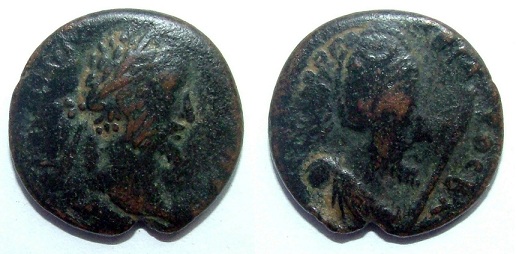










 Posted 02/25/2013 7:31 pm


