| Author |
 Replies: 10 / Views: 3,756 Replies: 10 / Views: 3,756 |
|
|
Pillar of the Community
United States
1721 Posts |
Earlier today I found this in a pawn shop. It's an early creamer and I believe (or at least want to believe) that it's a coin silver piece. There is one hallmark on the base depicting an Indian holding a bow and an arrow. This is also the early Massachusetts State Seal. It has the initials ERH engraved on the lower portion of the front. Any connection? I have been all over Google and this ones got me flustered. The creamer is 6 1/4 inches tall from the top of the handle down to the base and weighs 208.9 grams or 6.7 ounces. Anybody have any information? 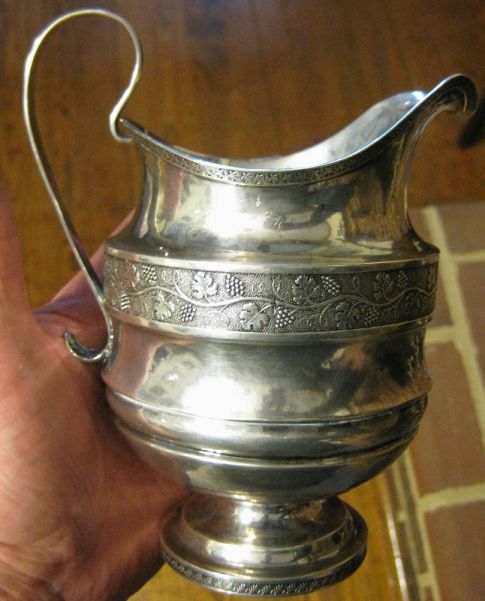 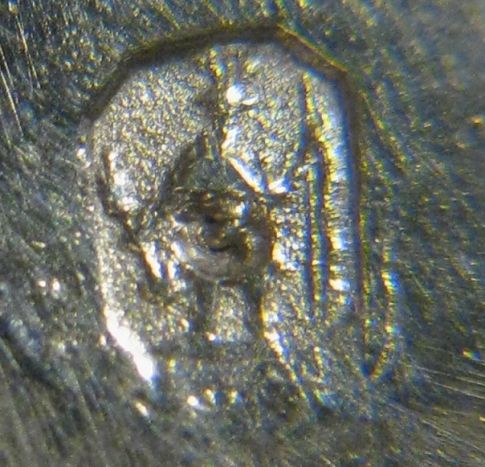 |
|
|
|
Pillar of the Community
United States
4897 Posts |
|
|
Bedrock of the Community
Australia
21789 Posts |
I find it hard to believe that even a pawnshop owner would have sold this for coin silver price.
Certainly, an antique dealer wouldn't have!
Definitely worth further investigation. Take it to a good antique dealer who knows his stuff.
Even in the world of antique silver, fakes are to be found, so always bear that factor in mind.
|
|
Pillar of the Community
 United States
1721 Posts |
The piece is all hand forged, hand chased and hand soldered. The workmanship is unbelievable. The dealer thought or assumed it was silver plated. I paid 30 dollars. That was my offer which he accepted. About four years ago, I sold an 1840s repousse creamer with Skinners in Boston. It sold for 1900. I had to split that one with a friend but we got it for free.
Edited by mds308
03/02/2013 9:24 pm
|
|
Pillar of the Community
United States
2335 Posts |
With just the one hallmark I'd be suspicious. I know this isn't your first rodeo....so what did your acid test show?
|
|
Pillar of the Community
Japan
666 Posts |
|
|
Pillar of the Community
United States
1721 Posts |
I'm familiar with 925-1000. I posted a thread about it once before.
I did a hard rub on a stone with acid and got a positive test for silver. However, if it's heavily plated this would give the same result. I hate cutting deeper in fear of messing up the piece. Only for scrapping would I do a destructive test. There's a company Rosewell Gleason & Sons from Dorchester, Massachusetts. They were one of the first companies to work with silver plating. Their various marks are their name spelled out in letters. They did have an image of an Indian similar to mine but theirs was more detailed and the bow and arrow are opposite of mine. Even if this is an early plated Rosewell Gleason it is still very desirable.
Edited by mds308
03/02/2013 11:00 pm
|
|
New Member
United States
2 Posts |
The mark shown is a variant punch of the Indian used by Theophilus Bradbury. It was apparently reserved for use on hollowware, while the better known version in an oval was used on flatware. Your coin silver creamer is a typical version of the form dating to c 1815. In all likelihood it was not actually made by Bradbury, but bought in from one of the larger wholesale shops in Boston, a typical practice of the time. The grape leaf milled band at the top is known to have been used there by the partners (and brothers) Alfred and George Welles. Quite a nice example, considerably better than the seller realized. Edited by wev
03/24/2013 8:21 pm
|
|
Pillar of the Community
United States
1721 Posts |
wev, You are the man (assuming you're a man). Here is a link with more and better pictures of the creamer. https://goccf.com/t/145603This piece was racking my brain. I had a very strong hunch about it being from Massachusetts. If you look at my comparison image in the other link, I show an early Massachusetts State Seal button with the same image. I will take this new information and do some more research on this piece. At last, a new direction to move into. Thanks again and before I forget.....  |
|
New Member
United States
2 Posts |
Yes, male and thank you for the welcome. The little research project mentioned in the second post is mine. It is believed (though yet unproved) that Bradbury's marks were cut or, at the very least, inspired by Jacob Perkins, who had cut the dies for the 1788 Massachusetts copper cent featuring the same distinctive Indian on the reverse. He is known to have had business dealing with the shop involving his rolling press for embossing decorative designs on spoon blanks. Your mark is known, with a companion eagle strike, on several counter-marked coins. |
|
Pillar of the Community
United States
1721 Posts |
wev, I found the site where you are a moderator. That is chock full of great information. I found another silver site that too was filled with great information. Both links are below. The 'milled bands' or decorative bands were made by different silversmiths which adds to the pieces diversity. The 'grape vine' pattern was made by Alfred & George Welles of Boston. The 'oak leaf' and the 'leaf & vine' were both made by Nathan Hobbs of Boston. I believe the creamer was assembled by Theophilus Bradbury of Newburyport, MA. This has been quite the education. This first site shows some interesting counterstamps (your site): http://www.coinbooks.org/esylum_v14n29a14.htmlSecond site: http://www.smpub.com/ubb/miscel/mil...lossary.html |
| |
Replies: 10 / Views: 3,756 |
|










 Posted 03/02/2013 8:50 pm


