










 Posted 03/11/2013 02:06 am


Hi,
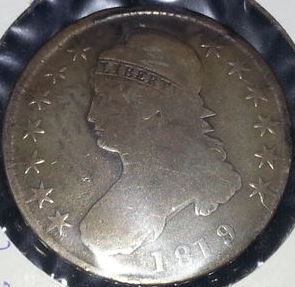
Let's go ahead and run with the assumption that your opinion is correct ref the 'O-101 small 9' call.
Since I don't have a clue about these types of coins, I can only go on what I see.
Therefore, per the next attached comparative photo grouping containing the 50 cents Bust half in question(partially obscured and positioned underneath) and a NGC-slabbed higher grade similar 50 cents Bust half please review the areas that I have notated with sets of black and red-colored arrows.
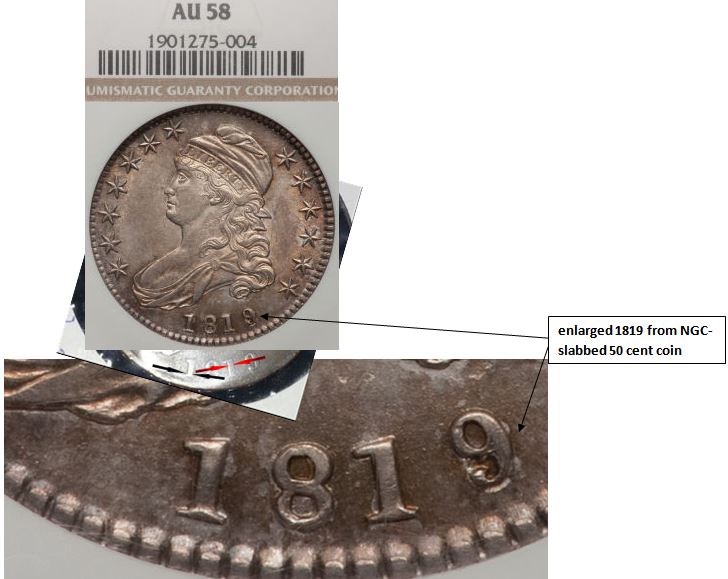
If these two coins are supposed to be the same one except for the grade, why do the areas on each '1' marked by both sets of colored arrows appear to point out widths of both '1s' that seem notably thicker compared to the same positions on the same '1s' of the NGC-slabbed coin's date?
To preserve consistency as much as possible I measured both the slabbed coin and the worn coin's diameters in this comparison photo and came up with the same diameter for both coins.
Is this width variation an optical illusion?
Or could this difference in width girth be accounted for from the excessive wear that the coin in question has been exposed to?
Or do different varieties of this 'O-101 small 9' exist?
I am just shooting out possibilities and would appreciate any feedback whatsoever since my skin is thick and would love to learn more about these type of cool coins.
Also, where does the designation of 'O-101' originate from(and by what author) and does a web site exist where users can access these types of alphanumeric designations(supported by illustrating photos) for better identifying their bust coins(dime, quarters, halves, & dollars) going forward etc.?
Thanks,
mdpmedia
Let's go ahead and run with the assumption that your opinion is correct ref the 'O-101 small 9' call.
Since I don't have a clue about these types of coins, I can only go on what I see.
Therefore, per the next attached comparative photo grouping containing the 50 cents Bust half in question(partially obscured and positioned underneath) and a NGC-slabbed higher grade similar 50 cents Bust half please review the areas that I have notated with sets of black and red-colored arrows.
If these two coins are supposed to be the same one except for the grade, why do the areas on each '1' marked by both sets of colored arrows appear to point out widths of both '1s' that seem notably thicker compared to the same positions on the same '1s' of the NGC-slabbed coin's date?
To preserve consistency as much as possible I measured both the slabbed coin and the worn coin's diameters in this comparison photo and came up with the same diameter for both coins.
Is this width variation an optical illusion?
Or could this difference in width girth be accounted for from the excessive wear that the coin in question has been exposed to?
Or do different varieties of this 'O-101 small 9' exist?
I am just shooting out possibilities and would appreciate any feedback whatsoever since my skin is thick and would love to learn more about these type of cool coins.
Also, where does the designation of 'O-101' originate from(and by what author) and does a web site exist where users can access these types of alphanumeric designations(supported by illustrating photos) for better identifying their bust coins(dime, quarters, halves, & dollars) going forward etc.?
Thanks,
mdpmedia


