| Author |
 Replies: 10 / Views: 1,468 Replies: 10 / Views: 1,468 |
|
|
Valued Member
United States
131 Posts |
Suddenly I'm finding RPM's in a couple of mint sets. They aren't giant splits and I would feel better with a second opinion. Thanks. 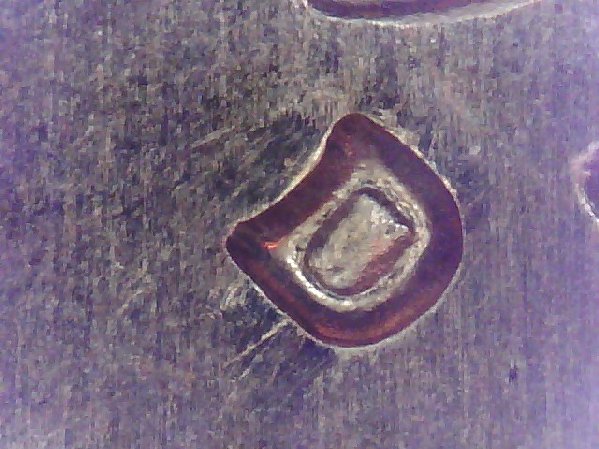 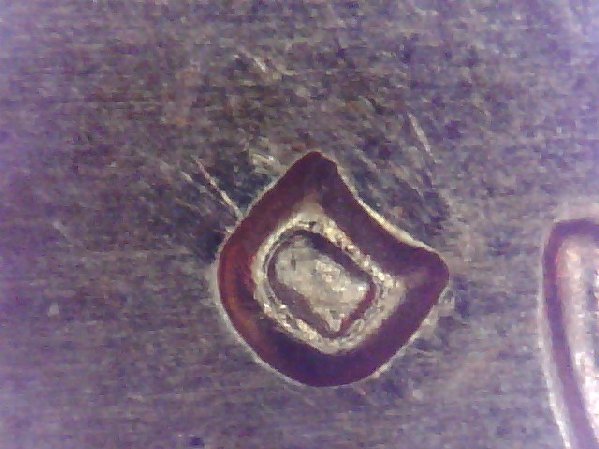 |
|
|
|
Pillar of the Community
United States
1620 Posts |
Look on coppercoins.com for the lincoln
|
|
Pillar of the Community
Canada
618 Posts |
Die Deterioration I feel--die state at end of life--must happen to thousands of coins--miss-management at the mint?
|
|
Bedrock of the Community
United States
62064 Posts |
If all the coins has the same split on the lower serif, it sounds like a bad punch issue?
|
|
Valued Member
 United States
131 Posts |
lambecolin: How does Die Deterioration produce split serifs on both ends of the "D" and nowhere else on the coin? coop: If the MM is punched onto the hub or die then wouldn't every coin's doubling look identical? Edited by whatsthedillio
03/12/2013 3:51 pm
|
|
Bedrock of the Community
United States
62064 Posts |
Hubs are used to create dies. Dies are created to make coins. Mint marks are added to the dies (Pre 1990 by hand) to the dies to show from mint the coins were struck. Here is the progression: 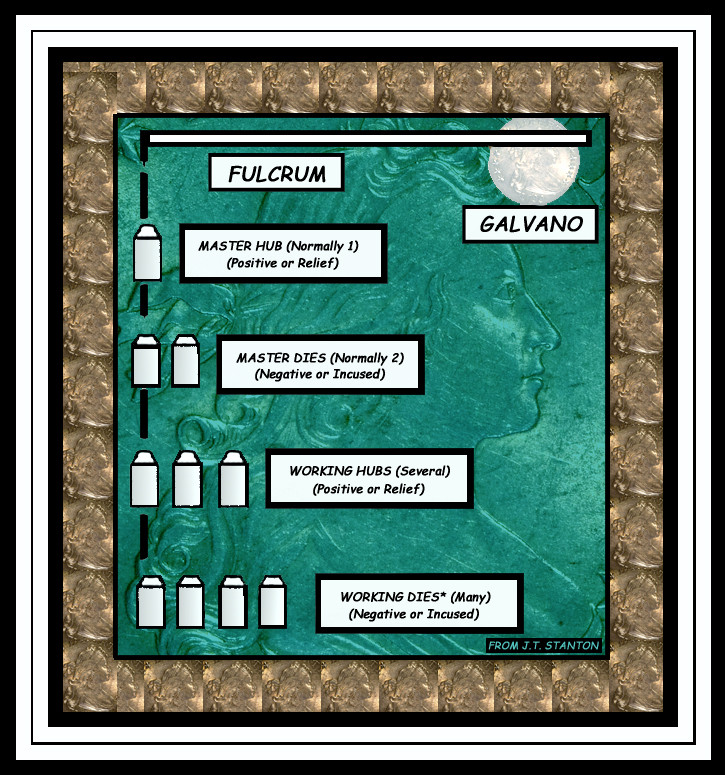 The same punch is used on all denominations from a mint until it is retired. So if all you coins have the same splits, they may have been caused by the punch and not from re-punching? |
|
Valued Member
United States
131 Posts |
Thanks for the diagram, I like knowing that type of things. Yes, the punch may have been broken with the operatives word being "may have". I'm still new at identifying broken punch but the ones I've seen that were labeled as such had a different look then the split serif when examined closely. Broken punches seem to have a conical shape where the top part comes to a point. One of the 1973's I posted I drew arrows showing a broken part next to a serif shape. The doubling I'm seeing here doesn't come to a vertical point but gently curves over the top of the letter. As I'm beginning to research this a little more I see that there are different grades for the doubling part (see also the link I provided where an example of class VI doubling). I'm getting the feeling that there is push back on any doubling that isn't spectacular. Why have different grades if only the top grade is acceptable? But it doesn't look at all like die deteriation to me because that looks more like smooshing of the metal. These MM are pretty crisp. http://www.errorvariety.com/OFD/DDD.html |
|
Bedrock of the Community
United States
62064 Posts |
1. Grades are based on 1-59 for circulation coins. MS-60-70 are mint state grades for condition of a coin.
2. Die states vary from the fresh dies-EDS-MDS-LDS-VLDS and in between. These denote the state of die wear. Some varieties are affected by die wear. The outer doubling on a doubled die may be concealed toward the rim, but the inner devices may still show the doubling. On RPMs the shape of the mint mark changes some with age. So RPMs may get weaker with die wear (When it is on the mint mark) and some times they get stronger when they are in the field areas.
3.Then there are die classes that identify the problem of how the doubled die was created during the hubbing process.
These are different aspects of a coin.
Normal coins will be graded by the first note in the thread.
Varieties are graded with the parts 2 & 3 of this thread.
I think this is what is confusing you. If not, ask another question.
|
|
Pillar of the Community
United States
1620 Posts |
Coop comes and saves the day lol good class
|
|
Valued Member
United States
131 Posts |
Quote:
1. Grades are based on 1-59 for circulation coins. MS-60-70 are mint state grades for condition of a coin.
2. Die states vary from the fresh dies-EDS-MDS-LDS-VLDS and in between. These denote the state of die wear. Some varieties are affected by die wear. The outer doubling on a doubled die may be concealed toward the rim, but the inner devices may still show the doubling. On RPMs the shape of the mint mark changes some with age. So RPMs may get weaker with die wear (When it is on the mint mark) and some times they get stronger when they are in the field areas.
3.Then there are die classes that identify the problem of how the doubled die was created during the hubbing process.
These are different aspects of a coin.
Normal coins will be graded by the first note in the thread.
Varieties are graded with the parts 2 & 3 of this thread.
I think this is what is confusing you. If not, ask another question. My topic is really about this coin which I believe to be an RPM. The pushback I'm referring to is the example provided to convince me that it's not in fact a proper RPM. The example was what I would consider the most extreme example of RPM available. Just a quick search in my browser came up with a different example of an RPM that claims to be a CONECA listing. http://www.briansvarietycoins.com/shop/view/3989If that is an RPM, then I feel pretty sure the one I posted here is also. |
|
Moderator
 United States
56855 Posts |
Have you checked coppercoins.com? There are a couple there that look close to yours,have a look. John1  |
| |
Replies: 10 / Views: 1,468 |
|







 Posted 03/12/2013 2:05 pm





