| Author |
 Replies: 9 / Views: 1,371 Replies: 9 / Views: 1,371 |
|
|
New Member
Israel
3 Posts |
Hi all, I am new to this forum and hope I am posting my query on the correct board. I live in Israel and recently discovered a collection of old coins left by a previous tenant. The coins are from a variety of countries (France, Italy, UK, US, Netherlands, Switzerland, Belgium, Denmark, Egypt, Israel, Jordan and Palestine). Most don't appear to be worth very much - they are mostly from the 1940s-1960s. Because of the poor storage of the coins (including years left outside in the natural elements) most of the coins have taken on a special rainbow toning. I've uploaded a sample photo for your reference because I can't find anything similar on Google Images. My question is, are these coins something a collector would want to add to his or her collection? On some coins the toning is so heavy that you can't even see what the original coin looked like. I'm not a collector myself and would like to eventually sell the entire collection. Thanks for your time and opinions :) 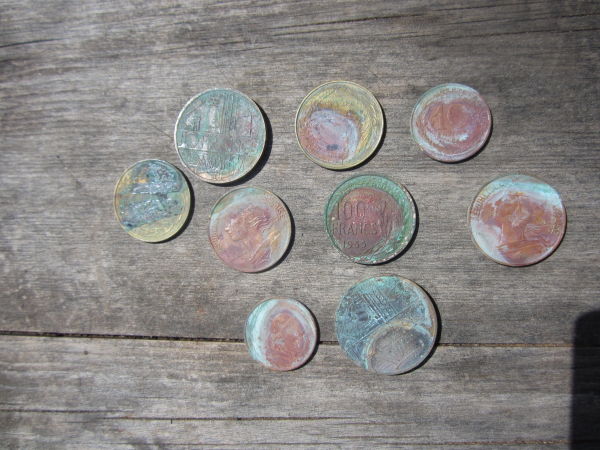 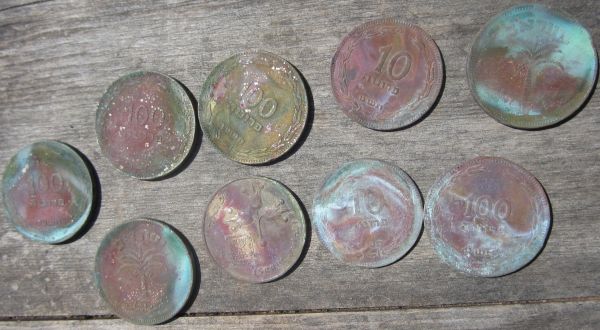 |
|
|
|
Bedrock of the Community
13014 Posts |
Im not familiar with those coins so I cant comment on their rarity.
Toning in general on coins is hit or miss. Some collectors like it some dont, there is a market for it though.
Unfortunately it looks like the green you are seeing is verdigras or corrosion basically which makes the coins undesirable unless they are rare in which case they would be worth less but rare coins generally sell in any condition
|
|
Pillar of the Community
Australia
3841 Posts |
This seems like they have been washed and toned, i.e. artificial toned.
My partial coin collection http://www.omnicoin.com/collection/gxseriesMy numismatics articles and collection: http://www.gxseries.com/numis/numis_index.htmRegularly updated at least once a month. |
|
New Member
 Israel
3 Posts |
Thanks, basebal21 - some of the coins are pretty green/black and not nearly as 'pretty' as the ones in the 2 photos. I guess corrosion is likely the answer. It's a shame!
Thanks for your reply, gxseries. As I mentioned in the original posting, these were found in my apartment and then left outside for quite awhile. I suppose it is possible that the original collector tampered with them (though most of the coins are normal, I took photos of the extreme examples to post here). Or, it could just be the Mediterranean/desert weather played a role in naturally turning the coins into what they are. That's my guess, anyway.
|
|
Pillar of the Community
 United States
1907 Posts |
That's not toning, it's serious corrosion. The green is copper oxide, caused, like you say, by [VERY] "poor storage". No collector is going to want common coins in that condition, because they are cheaply available in high grades. They are essentially worthless as coins, but if you want to 'preserve' them and remove the green gunk, just soak them in a jar of household vinegar for a couple of hours, then rinse well with water. No value lost, but afterward they will look a lot more like coins than junk.
|
|
Bedrock of the Community
United States
20038 Posts |
Your coins are not toned, they are corroded with verdigris from improper storage. Whatever you do, if they have any numismatic value, DO NOT soak them in vinegar. I have to disagree with the above post. They will certainly look like cleaned, junk coins after using vinegar on them.
|
|
Valued Member
United States
178 Posts |
Good coins but for me is not toning is a copper oxide...
|
|
Pillar of the Community
Russian Federation
5186 Posts |
Seriously, if you call this toning, you're a quaternion. (Then again, I don't particularly like toning, either. But this is just awful.) This is serious corrosion/oxidation; it might look beautiful to someone (heck, a few of these might look beautiful to me - the 100 franc piece is particularly lovely), but whoever buys it would probably pay a small fraction of the value for an undamaged coin (or metal value if it happens to be higher). I personally have about a dozen coins in my collection with such discolored oxidation; most of them are coins that had been in my collection since before there properly was a "my collection" (mainly drop-offs from my father's collection), while the rest are French 19th-century coins that were so ridiculously cheap that I just couldn't pass on them  (that is, about a dollar each, which is the absolute limit you could expect for your stuff unless you happen to have a key date and/or something silver). EDIT: Hey, you're in Israel? Contact my grandma in Karmiel. I'll try to talk with her about it, but I suppose she'd be just fine with buying these coins from you (for a reasonably low price of course), and my collection would greatly benefit from a lot of these (as currently I don't have many of these types in any condition; that especially refers to Israeli coins, but anything else would also be a bonus). Though you might have to wait a bit until you get 50 posts... I won't dare reveal my grandma's full home address outside a PM, and I'm not sure you're able to make a PM before you get 50 posts |
|
Bedrock of the Community
13014 Posts |
Quote:
Thanks, basebal21 - some of the coins are pretty green/black and not nearly as 'pretty' as the ones in the 2 photos. I guess corrosion is likely the answer. It's a shame! Certainly is a shame, from the sounds of how they were stored they never stood a chance |
|
New Member
Israel
3 Posts |
Thanks, all, for the insightful feedback. As a novice, I was obviously using an incorrect term to describe these coins. Now I know the proper term is corrosion, not toning. January1May - I do live in Israel, but will be visiting family in the U.S. this week and next (which is why I thought about bringing the coins with me, if they would be of interest to anyone). I'm afraid that I am unable to send a private message on this board, but I do have an Etsy shop where I sell sea glass, so you are welcome to contact me there. The shop is called Israel by the Sea. Thanks again everyone! |
| |
Replies: 9 / Views: 1,371 |
|










 Posted 04/07/2013 06:12 am


