| Author |
 Replies: 38 / Views: 4,897 Replies: 38 / Views: 4,897 |
|
New Member
United Kingdom
18 Posts |
Hello everyone, my name is Joseph I'm from the UK. I found a very interesting object 3 weeks back and have been doing research for a while on this object. I have got as far as it's Portuguese, was gold gilded and had stones integrated into the object itself, for example Ruby's sapphires etc. The object is 40 mm in diameter and 3.4 mm thick and a weight of 17.2 grams. I would be very grate full if someone can shed some more light on this object. Or to point me in the right direction to get some answers. I have tried the Portuguese museums but I'm getting no response back. So I have come to this forum which has people with a wealth of knowledge to help me find the provenance and era of this lovely object 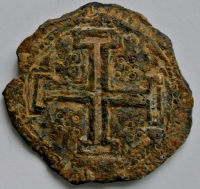 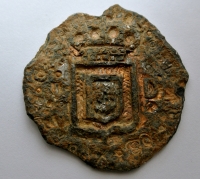 *** Moved by Staff to a more appropriate forum. *** *** Moved by Staff to a more appropriate forum. *** |
|
|
|
Moderator
 United States
14463 Posts |
 Joseph, I have moved your question. |
|
New Member
 United Kingdom
18 Posts |
|
|
Pillar of the Community
United States
3253 Posts |
Seems to follow the design of some 17th century Portuguese coins, like this 100 reis of Filipe II, which is a about a centimeter smaller, and silver ( which this coin does not seem to be). Note the moneyer's initials to either side of the shield, and the five pellets in each angle of the Maltese cross: 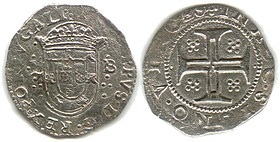 Same design can be found on Azorean coins of the 1790s, but those were of Maria I, and we can see on the lower left of the legend on the shield side the word REX (probably followed by PO...); this is after the design of a king's coin, not a queen's. Edited by philadelphian
04/22/2013 4:26 pm
|
|
Valued Member
United States
99 Posts |
India. Portugese colonial somewhere around the late 1700'S
|
|
Pillar of the Community
United States
3253 Posts |
The Portuguese coins I've found seem to have a voided Maltese cross; do you have an image of a coin of Portuguese India that has a voided cross potent like this, Jim?
|
|
Pillar of the Community
United States
567 Posts |
Portuguese India, Tin Bazaruco, 17-18th centuries. I'll have to look for a more concrete attribution.
Just a common everyday coin, never studded with rubies and gold. Tin is abundant in Indonesia and was used as a cheap substitute for more expensive copper. Crosses on Portuguese Indian varied from regular homeland issues. Less so on precious metal issues.
|
|
Pillar of the Community
United States
3253 Posts |
Just a quick search shows these Portuguese India issues are varied enough to include a coin like this one, and tin seems to be a likely metal given the corrosion here. But I would still like to see one with a shield and cross that come closer to this design.
|
|
New Member
United Kingdom
18 Posts |
You can see the gold gilding on the inner shield if you look closely, British museum have said this was gold gilded and had stones recessed into the object, plus I have been told its to big to be a coin in thickness and weight. I was told more like a decorative item worn maybe, I noticed the Rex word as well used my the Romans for the meaning king. Also the D on the right had side I think its an L on the other side, This object was found within a mile from Leeds castle in Maidstone Kent. British museum dated the coin between 1200/1600, around crusader period hope this info helps. As I'm stuck I have searched numerous sites and gone through books upon books of coins and find similarities but nothing that matches this object, hence why the though of a coin is a little to easy to say it is a coin, as theres not many of this design around quoted from british museum
|
|
New Member
United Kingdom
18 Posts |
If anyone wants bigger and clearer photos I can email them to you, its not made from tin I can tell you that, the brown substance you see on this coin is dirt I havent tried cleaning it in anyway as to be honest I have no idea how to do this I'm trying to find a expert in the field where I live to try and get this clean
|
|
Pillar of the Community
United States
3253 Posts |
|
|
Pillar of the Community
United Kingdom
739 Posts |
I suspect it is a medal / medallion from the crusades if it did have jewels in it. One side is a Crusader (jerusalem) Cross and the other side holds the key as to who issued it. Who had crowned shield L? D ? Here's a similar coin issued by Mary Queen of Scots http://en.wikipedia.org/wiki/File:M...6_641662.jpg |
|
New Member
United Kingdom
18 Posts |
im assuming its L on the other side of the object, it looks like it to me. Also the cross had enamel in it according to the museum, alot of enthusiast have said its crusader period, and either a medal or medallion... Reason measuem have not said coin, due to not having many in circulation of this kind infact none which makes them think its not a coin either way its special and unique maybe..
|
|
Pillar of the Community
United States
3253 Posts |
Those letters, on the Portuguese India issues, are a mintmark. G and A stand for Goa; a D and O are also seen, for Damão, or perhaps Diu.
|
|
New Member
United Kingdom
18 Posts |
im wondering if it has any connection with leeds castle as it was found very near to this castle which is situated in maidstone kent
|
|
Pillar of the Community
United Kingdom
739 Posts |
Coinsoul please can you email me large pics - your account is set to not receive email so couldn't send PM
|
| |
Replies: 38 / Views: 4,897 |







 Posted 04/22/2013 12:57 pm





