| Author |
 Replies: 62 / Views: 12,449 Replies: 62 / Views: 12,449 |
|
Pillar of the Community
Belgium
506 Posts |
You usually find them classfied under "Austrian Netherlands", which more or less corresponds to what is now Belgium, Luxemburg and only little of the Netherlands. (Liège and surroundings was autonomous under the rule of a Prince-Bishop). While thalers had been minted much earlier, the Kronenthaler (originally with the Burgundy cross and four crowns) had been designed for circulation in the Austrian Netherlands and minted in Antwerp (rather few) and Brussels. The design changed under Joseph II, with the emperor on the obverse (instead of the coat of Arms of the Habsburgs) and a cross with three crowns and the golden fleece beneath. By then it was minted throughout the Habsburg empire with the mintage workshop indicated by a letter (or 'angelface' symbol for Brussels). Kronenthalers with mintmark M are minted in Milan, most often they're called Crocione. Unlike many other Kronenthalers there doesn't seem to be any lettering on the edge (at least I find no mention of it). An example: 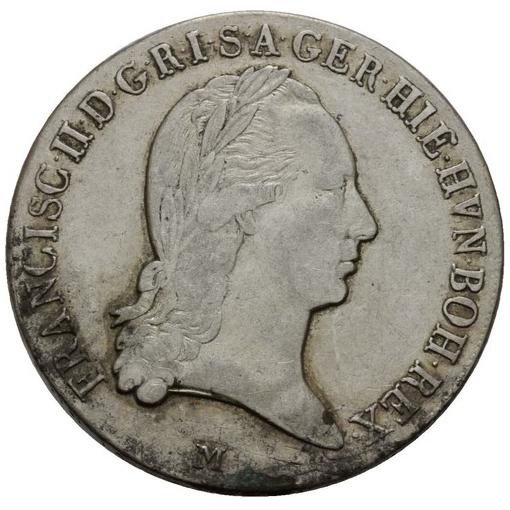 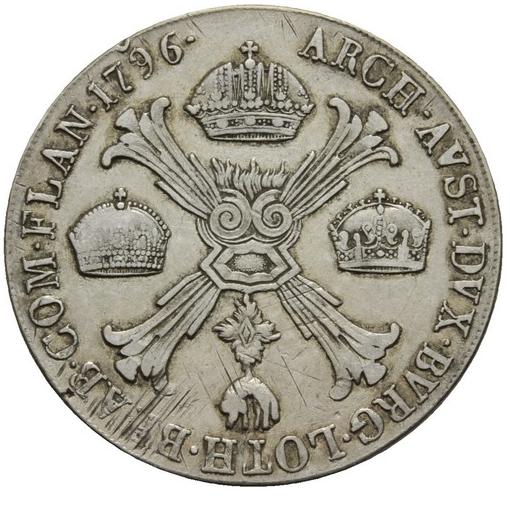 and a question: the wear on the coin is consistent with close to half a century circulation. Is the flan smaller than what is should be? The rim has vanished and there's hardly anyting left of the pearls inside the rim. Is that the result of some silver shaving? Or is there something dodgy about this coin? |
|
|
|
Pillar of the Community
2087 Posts |
Nothing leaps out as wrong with this piece. It has justification scratches and the wear seems appropriate to the age of the coin. I assume the weight is appropriate, I would anticipate it will be a few 100ths of a gram light due to the wear this coin has experienced
|
|
Pillar of the Community
United States
3499 Posts |
Gwyde- Nice coin! However, this particular kronenthaler is actually not from the Austrian Netherlands/ Belgium. Rather, the "M" mint mark means that this coin was minted in Milan, Italy. SO it should be listen in Krause under Italy and "Austrian Administration."
|
|
Bedrock of the Community
Australia
21792 Posts |
I note that this piece has what looks like a few adjustment marks on it.
7 o'clock rev.
|
|
Pillar of the Community
United States
5362 Posts |
Is the edge plain?
At this point in time a plain edge seems very inappropriate. Filing and clipping are a distinct possibility - is the coin the correct weight?
This coin has been forged before but they usually use better looking originals without adjustment marks if possible so I do not suspect the coin is a forgery based on what I know now.
|
|
Pillar of the Community
 Belgium
506 Posts |
The edge is not plain: there are the remnants of what has been a motive like a chain and stars (or leaves and flowers?). There are also a few vertical bars that might be the bottom part of some lettering: 'IIUL' and whatever more has faded beyond recognition.
|
|
Pillar of the Community
Belgium
506 Posts |
With about 29g, the weight of the coin seems within tolerance.
|
|
Pillar of the Community
United States
5362 Posts |
The weight sounds fine and with the trace of the edge still present - it is quite likely the coin is real.
I see no clear evidence of forgery and would not vote against it.
|
|
Pillar of the Community
2087 Posts |
For that period the weight for an MS strike should be 28.06grams with the wear on that coin I would anticipate the actual weight to be around 27.90 -28.08 grams. 29grams is just too heavy. Given that the coin looks genuine I would guess you use a scale that does not measure to 2 decimal places
|
|
Pillar of the Community
United States
5362 Posts |
I guess this must be another case of Krause got it wrong. The old Krause I checked listed the weight of this coin as 29.44 grams.
|
|
Pillar of the Community
2087 Posts |
Quote:
For that period the weight for an MS strike should be 28.06grams with the wear on that coin I would anticipate the actual weight to be around 27.90 -28.08 grams. 29grams is just too heavy. Given that the coin looks genuine I would guess you use a scale that does not measure to 2 decimal places I must remember to check my references and not rely on aging memory ( written 500 Times)!!After seeing swamper bobs post I wanted to check properly I often doubt Krause so I used Eypeltauer And to my embarrassment: A Hoffkammer Verordnung of 19 July 1755 set the weight of Kronenthalers to 29.44 grams.  I had just relied on the Konventions Muenz standard |
|
Pillar of the Community
United States
5362 Posts |
|
|
Pillar of the Community
Belgium
506 Posts |
Numista classifies this Crocione among "Austrian Netherlands", though it was minted in Milano. http://en.numista.com/catalogue/pieces27567.htmlThe design is the same as those minted for the "Austrian Netherlands" and so is the weight (29.44g). I checked out on thalers for use in Austria; they are lighter (28.08 g) hence the confusion. My balance is precise only to about 0.1g. |
|
Pillar of the Community
2087 Posts |
Interesting thread its made me do some digging, Kronenthaler were also produced in Vienna(mint mark A)
|
|
Pillar of the Community
Belgium
506 Posts |
Quote:
Interesting thread its made me do some digging, Kronenthaler were also produced in Vienna(mint mark A) ... and "B" (Kremnitz, now in Slovakia and a former silver mine) "C" (Prague) "E" (Karlsburg) "F" (Hall, in Tirol) "G" (Nagybanya in Hungary) "H" (Günzburg) Some mintmarks/years are rare, but mintage numbers have not always been recorded. The first design of Kronenthalers were minted only in Brussels and Antwerp, but starting with the rule of Joseph II, that only was a minority of the total mintage. It's peculiar that in Austria thalers with slightly different weights have been circulating at the same time. But then perhaps they were worth a different number of 'Kreuzers', the name given to the copper and billon change. |
|
Pillar of the Community
Belgium
506 Posts |
The silver content of a Kronenthaler is 0.873. This rather odd amount suggests that may have been the available silver purity in the Kremnitz mine where most of the Austrian empire got its silver from.
Is it possible to check this?
A few more questions:
What would have been the precision of any 'specific weight' measurement of the silver content in the 18th century? Could they differentiate 0.873 from 0.900?
Was it possilbe to purify silver back then? Obviously electrochemistry was yet to be invented...
|
| |
Replies: 62 / Views: 12,449 |








 Posted 05/01/2013 03:23 am


