| Author |
 Replies: 62 / Views: 12,451 Replies: 62 / Views: 12,451 |
|
|
|
Pillar of the Community
United States
5362 Posts |
Quote:
The silver content of a Kronenthaler is 0.873. This rather odd amount suggests that may have been the available silver purity in the Kremnitz mine where most of the Austrian empire got its silver from The specific assay 873 fine is most likely a very simple fraction in terms of whatever unit was used as the standard of measure when the coin was made. The mint obviously did not use a decimal system of purity. That is just a modern standard equivalent. My background is in Spanish American silver which for a long time used 903 fine as the standard. But the real measurement was actually 10 Dineros 20 Granos in their terms. In the Spanish system pure silver is 12 Dineros and each Dinero contained 24 Granos. Stated in decimal terms each Dinero represents 1/12 of 100% or 8.333333333...%. Each Granos represents 1/24 of 8.33333333 or 0.34722222222% If you do the math that works out to about 0.9027 fine. The alloy was therefore ten and 20/24 dineros of "pure" silver mixed with 1 and 4/24 dineros of copper. Keep in mind Spain was on an eighths base accounting system. So Spanish silver used a measurement stated in terms that were unrelated to the decimal system. This is the case for most of these odd decimals. It has absolutely nothing to do with the purity of silver coming out of any mine. The next two questions you ask can be treated at once: Quote:
What would have been the precision of any 'specific weight' measurement of the silver content in the 18th century? Could they differentiate 0.873 from 0.900?
Was it possible to purify silver back then? Obviously electrochemistry was yet to be invented... Weight measurement itself was not a problem by 1796 most mints had scales that could weigh metals very accurately. Several museums house great examples of scales used ca. 1800 and they were accurate to 1/1000th of a gram. The second problem you hit on is that silver refining techniques were still "relatively" crude by present standards. By this I do not mean plus or minus 5% - that is horrible. I mean about 1% at the very worst. The method normally employed up to the 1550s was fire refining (cuppelation) which is based on the principle that precious metals do not oxidize when heated. The other metals in the ore melt combine with oxygen and form slag the precious metals remain behind. The yield can be 99% pure or better but the silver will contain gold and platinum as well as other minor impurities. The Patio process developed in 1550 used silver amalganation to extract more silver out of lower grade ores. The ore was crushed and mixed with mercury. Precious metals amalgamate with the mercury and can be separated. The resulting bars are then smelted. So in the colonial era silver could be purified to 99% and was often weight checked by Specific Gravity. The traces of gold and platinum increased the SG and often accounted for the range of SG provided in period handbooks. The next step occurred about 1870 when the cyanide leaching techniques were added. This lowered the gold and platinum content of silver. Other refinement brought silver purity to 99.9% in this time period. The history of silver refining had been stable from Roman times until the early 1800s when 99% was normal with gold and platinum making up the rest. But between 1800 and 1970 purity standards and the ability to separate silver from all other metals went from 99.0 to 99.999 pure. This is an interesting topic and forms part of the base theory that allows XRF testing to assist with dating old silver. |
|
Pillar of the Community
 Belgium
506 Posts |
Thanks a lot, Swamperbob. I'm not familiar with metallurgy, yet most of the techniques you describe ring a bell. Cuppelation Quote:
The method normally employed up to the 1550s was fire refining (cuppelation) which is based on the principle that precious metals do not oxidize when heated. The other metals in the ore melt combine with oxygen and form slag the precious metals remain behind. The yield can be 99% pure or better but the silver will contain gold and platinum as well as other minor impurities. Most importantly, I was not aware that several of those techniques date from centuries (if not millennia) ago: Amalgamation Quote:
The Patio process developed in 1550 used silver amalganation to extract more silver out of lower grade ores. The ore was crushed and mixed with mercury. Precious metals amalgamate with the mercury and can be separated. I had heard of mercury amalgamation still used in illegal mining in remote areas of Latin America and in Central Africa. Apart from the environmental hazard, it also damages the health of the miners and purifiers when the amalgamates are heated above the mercury boiling point. Again I didn't realize this process goes back to the 16th century. |
|
Pillar of the Community
United States
5362 Posts |
Actually mercury amalgamation is still being used. The toxic effects can be monitored and controlled. Cyanide leaching beds are also still used although the impact is more environmental.
|
|
Pillar of the Community
Belgium
506 Posts |
Sunset over a currency... Habsburg rule over the Austrian Netherlands came to an end in 1796 when Napoleon started his quest to liberate Europe from the rule of monarchy and aristocracy. Kronenthalers were melted and changed over for for francs. The last Kronenthaler minted in Brussels is a unique type coined with Franciscus II on the obverse and the Brussels mintmark within the date 1794 (after the century). Despite its 280765 mintage this coin not common. A picture at sunset is quite merciless, revealing all scratches, dust and specks. However it also enhances the depth of design and lettering. 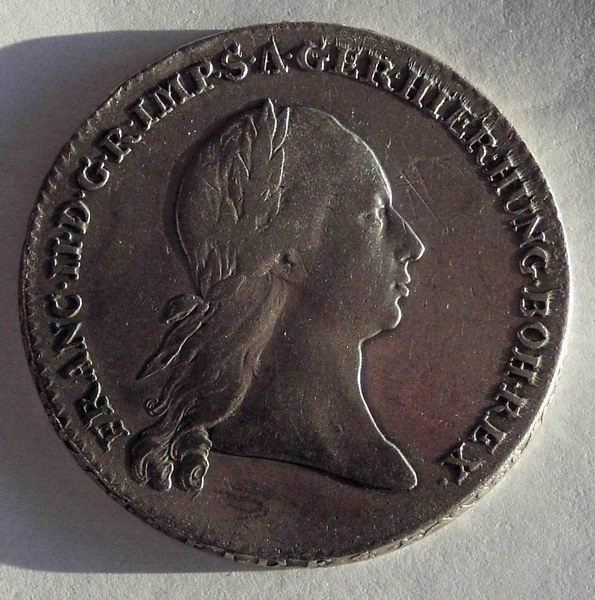 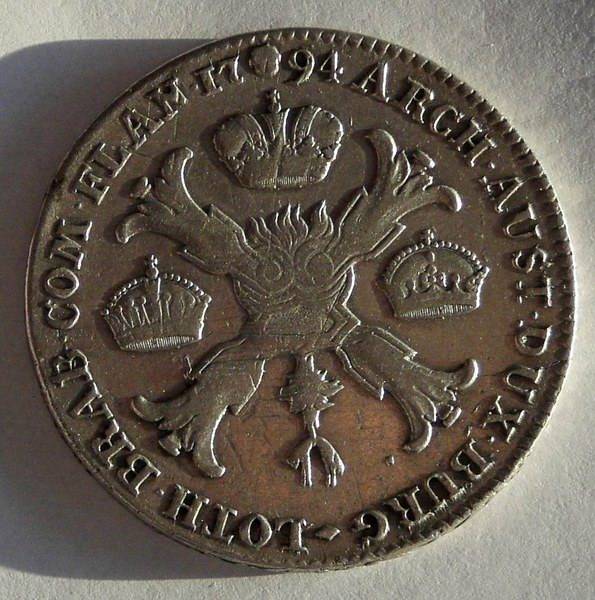 |
|
Pillar of the Community
United States
5362 Posts |
Personally - I like that picture it gives the coin character. Something all MS coins lack terribly.
Perhaps that is why I find so much of interest in counterfeits and old worn originals - they are the working man's coins.
|
|
Pillar of the Community
2087 Posts |
Quote:
Despite its 280765 mintage this coin not common I have the impression,incorrectly perhaps, that some times people look at mintage numbers from the 18th century and earlier while applying a modern frame of reference. The survivability of silver coins over 200+ years was not good , as already pointed out many were re-minted into other coins in the intervening years. With 12 to 18th century coins I am less worried about the mintage numbers and far more interested in how often the coins come up for sale. Some so called rare coins( from sub 50,000 mintages) can be obtained easily every week. Where as other, some times regarded as common coins, can take years to find. |
|
Pillar of the Community
Belgium
506 Posts |
Quote:
The survivability of silver coins over 200+ years was not good , as already pointed out many were re-minted into other coins in the intervening years. Exactly. There is however even more to it: Kronenthalers were legal tender within the Austrian Empire till 1857. When Austria lost the Austrian Netherlands to France, the currency change only affected these regions. Older Kronenthalers (from Franz I and Maria Theresia) were highly spread in all regions. Hence, even of a 200K mintage, many were likely to survive. This was not the case with the 1794 Kronenthaler minted in Brussels: not many of those had left the Austrian Netherlands and a comparatively large fraction was melted and changed over for francs. This makes that particular coin much less common than suggested by its mintage number. |
|
Pillar of the Community
Belgium
506 Posts |
Edge inscriptions on Kronenthalers of the Holy Roman Empire (1755 - 1800)
Franz I, Holy Roman Emperor till 1765 and husband of Maria-Theresia. Edge inscription: In te Domine speravi.
Maria Theresia: the Kronenthalers carry the Burgundy cross on the reverse with four crowns (instead of three with the golden fleece (the imperial design)). Edge inscription: Justitia et Clementia.
Under Joseph II (1780-1790), the emperor is depicted on the obverse, rather than the Habsburg coat of arms as before. Edge inscription: Virtute et Exemplo.
Leopold II (1790-1792) ascended the throne after his brother Joseph died without living heir. There are but few Kronenthalers minted during his reign and none were minted in the Austrian Netherlands. Does anyone know about the edge inscription on these kronenthalers?
Francis II (1792-1835), son of Leopold II and last Austrian emperor of the Holy Roman Empire. Kronenthalers were minted till 1800. The edge inscription was "Lege et Fide", except for the last 'Crocioni' (1799-1800) minted in Milan on which the edge inscription read: "Ivstitia et Fide".
|
|
Pillar of the Community
United States
3363 Posts |
Doing a little math on the precious metal contents, a colonial 8R would contain about .25g of Au/Pt. So if you find one in the silver scrap heap sold by weight for $20 for the silver, you're getting another $10 worth of Au/Pt thrown in for free.
"Two minutes ago I would have sold my chances for a tired dime." Fred Astaire
|
|
Pillar of the Community
United States
5362 Posts |
thq - you are correct that you can get more than the theoretical metal value - but have you ever tried to sell scrap platinum? The assay and refining costs would mean you would not turn a good profit unless you had quite a few coins.
If anyone starts buying junk 8Rs from scrap bins - holes etc - run them by me first. You will find a lot of counterfeits that way and most of us counterfeit nuts LIKE drill holes so melting them might cost you money.
|
|
Pillar of the Community
United States
3363 Posts |
It's just a feel-good factor swamperbob. An Au/Pt "billon" sounds good, even if you couldn't economically recover the metals. It's been a while since I've seen a shiny wrecked 8R in the scrap box, but it has happened. My most recent find that would qualify was a well-worn Napoleon I 5F ca 1800 for $19.95.
"Two minutes ago I would have sold my chances for a tired dime." Fred Astaire
|
|
Pillar of the Community
Belgium
506 Posts |
Electrum used to be mined in antiquity. It's a material proof that gold alloyed with silver naturally occurs on some mining sites. Some silver mines have an important production stream of gold or vice versa.
It's less evident that silver gets contaminated by platinum. The two metals do not segregate from a volcanic melt under similar circumstances. Hence you need counting on migration of platinum after its host rock has eroded away. Any coincidence of metals may so occur in sediments.
|
|
Pillar of the Community
United States
5362 Posts |
Gwyde --We are using the Pt/Au ratio as a de facto proof of a genuine coin made before 1830.
Our hope is that anyone trying to match an alloy from antiquity would find it hard because of contaminants now found in 999 silver and especially in commercial grades of copper. Even using melt coins is a problem because the minute traces of mercury and iron present would be difficult to introduce without adding other contaminants that do NOT belong.
The forgers would have to start with nearly PURE elemental metal, at least of a 999.999 fine standard to replicate the contamination levels accurately. Possible perhaps, BUT prohibitively expensive in practice. So for "normal" coins under $10K range the XRF tests seem definitive - so far.
|
|
Pillar of the Community
United States
864 Posts |
Remember that a main source of gold, silver, & platinum-group metals today is the "anode mud" resulting from the electrolytic refining of copper. All these substances occur in association. It would be very rare to find native gold entirely free from platinum, silver, or copper ; or silver without traces of the other three. The formation of intermetallic compounds, & compound sulphides, is the most readily assignable cause.
|
|
Pillar of the Community
Hong Kong
1270 Posts |
[quote]Does anyone know about the edge inscription on these kronenthalers?[/quote
For Leopold II, the Kronenthaler of Miland 1792, edge inscription is PIETATE CONCORDIA. I don't know what it means and is it Italian?
|
| |
Replies: 62 / Views: 12,451 |








 First Page


 Posted 05/07/2013 04:34 am


