TwoKopeiki The coin in question is almost without a doubt real. It is not a casting. I have looked at it a few times and I have compared it with the 8Rs in my collection and I think it would prove to be a late state copy of a die pair I already own. The die cracks at the corners of the cap are rather distinctive on this die (however, they have occurred on more than one die pair). That seems to be a point of high stress concentration. That is why I can't be 100 % positive about the match. It would absolutely require a side by side point by point analysis.
The 1832 through 1835 Zacatecas 8Rs have some of the poorest planchets produced by that branch mint. The pores visible on the enlargement are caused by the casting and rolling process. Just read what Dunigan has to say in "Resplandores". Couple that with both 1834 and 1835 being exceptionally high production years and you get myriads of funny looking coins. Dies were made quickly and were used until totally worn out. I have examples where nearly all the lettering has melted into the dentils. So die overuse clearly happened until mid 1836.
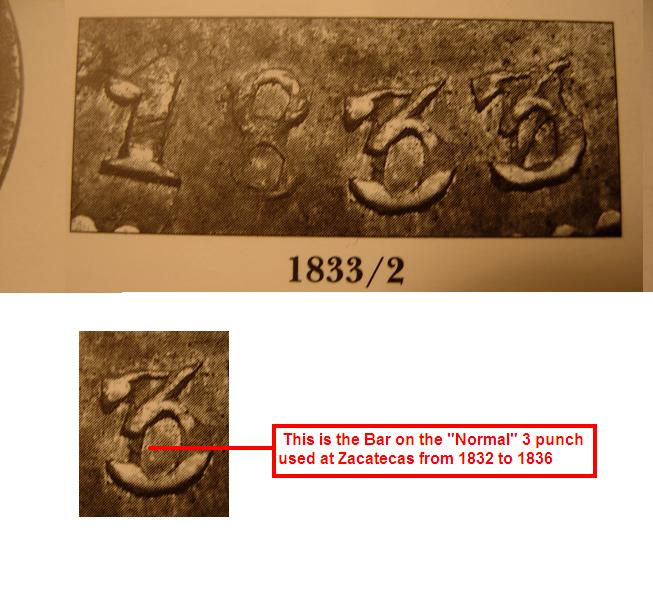
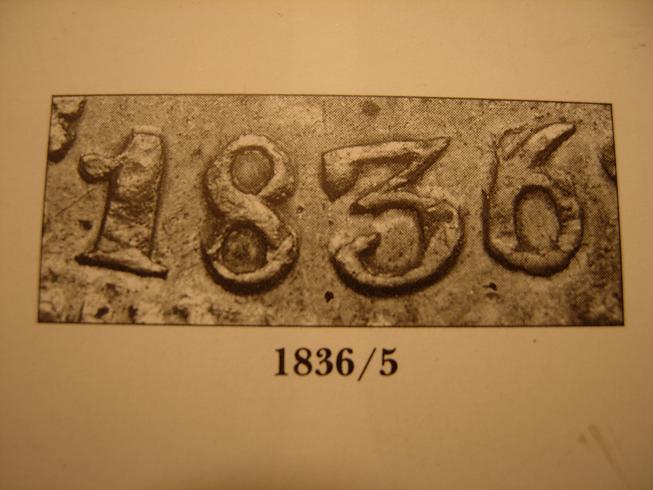
This particular coin is in my opinion not a 3/6 as Bob Hurst states. I believe that what he has is a worn version of the standard 3 punch with the "extra" line connecting the lower loop to the center of the digit. The top of the 6 (the tail) is the remnant of the cross bar of the three with the center eroded out. Under 1832, Dunigan concludes that "the 3 punch was converted from a 2 punch, possibly after the 2 punch broke." I firmly agree with that conclusion. He shows a nice micro photograph of the punch in question. In my experience, that 3 punch with the extra line was used from 1832 to 1836. Some time in 1836, a new 3 punch finally appears and persists until 1839. When this older 3 punch deteriorates, it really does look like a 3/6. I have several that look like this.
I would be very reluctant to conclude that this is a new previously unrecognized die. The die is simply far too worn (indicative of a very high mintage) - so where have all the other earlier copies gone? I would prefer to conclude it is simply a terminal state strike from a known deteriorating die which DOES have the 3 with the extra bar punch.
The planchet metal was quite porous on some coins, but they are NOT cast. This is likely indicative of the need to process high volumes of silver bullion. I also suspect that the cutting apparatus was worn to near an unusable state in 1835. The planchets made in 1834, 1835 and early 1836 are particularly bad. They deteriorate over this interval. Some planchets had chunks split out of the rim while others have large burrs. Some burrs were so big that they jammed the edger and "pop outs" are common in those years. These planchets were heavily adjusted to bring the weight within tolerance as evidenced by the survival of so many deeply gouged coins, which in my opinion proves a worn punch was making OVERSIZED planchets.
The planchet production methods also turned around sometime in 1836. Dunigan notes that the STATE of Zacatecas ran the mint from 1825 to 1836, but that during 1836 it fell under the control of the Central Mexican Government. I believe that this transition marks the point of coinage improvements at Zacatecas. It is very likely that the Government stepped in to correct the horrible mess created by worn State equipment.
I do not for a second believe that Bob Hurst would be intentionally deceptive about an 8R coin. But I frankly doubt he has handled enough Cap and Ray coins to be totally familiar with the manufacturing issues involved.
Jaobler Just one quick comment. The crude coins that are associated with early Mexican mint products was largely a mint by mint issue. It also varied widely over time. I would point to the very beautiful coins made at Durango in 1832 and the standardized coins produced by Guanajuato from 1830 to 1840.







 Posted 05/14/2007 5:32 pm





 Knight of the Coin Table #56


