| Author |
 Replies: 13 / Views: 1,470 Replies: 13 / Views: 1,470 |
|
|
Valued Member
United States
60 Posts |
All-
I've been thinking about this "how many countries do you have" question- it's an interesting one, but perhaps not for obvious reasons. While I haven't intentionally built my collection around the premise of maximizing the number of countries, the novelty of a new (to me) political entity is a strong draw.
One obscure aspect of "country counting" that interests me is the information theory angle- how to consistently translate the rather mushy and fluid real-world (some "countries" are temporarily subsets or hybrid combinations of others) with a static, standardized linear presentation in the collection itself (I face the same thing, but worse, with the insect collection).
Now I don't have a strong philosophical notion of what *is* a country versus what is *not* a country, so I don't have a problem with appealing to authority on this one- in this case, the Krause catalogs. Maddeningly, though, they have been inconsistent from edition to edition in what they consider a "country". I've found the "county" organization in my latest copy (2011, 13th ed. 20th Century circulating issues) as good or better than any of the previous ones and have re-tooled my collection to match their definition of a "country".
In this case, they've atomized "countries" that used to be lumped together in older editions, considerably inflating the total number of countries. Again, I don't really care- if they say Yemen, Yemen Arab Republic and Yemen Republic are three different countries (but Newfoundland is merely a subset of Canada)- that's fine with me, whatever. However, I've had to do some serious fudging to get my 19th Century coins to jive with the 20th Century organization. Maybe there is more consistency between centuries in newer catalog editions, I don't know.
Anyway, using the 13th ed. as a guide (and not counting Chinese provinces, German or Indian states) it looks like I have about 217 "countries", for what that's worth. I still have to puzzle out a lot of my early 20th Century Chinese issues so, depending on one's definition of "country" I probably have 225 or more on hand.
German and Indian states as well as the more obscure 19th Century political entities really represent the only "growth" areas left for me, if that were my aim.
The categories or hierarchical ranks below "country" are a little more problematic for me and much less consistent within the catalog, but that's a topic for later. Maybe I'll post a picture of a page in my collection to illustrate how I've handled the issue...
cheers,
tbg
|
|
|
|
Pillar of the Community
Canada
2785 Posts |
i dont think in terms of "countries" but more "coin issuing entities".
major political changes, example imperial russia, communist soviet union, modern russia are, 3 seperate entities, but each individual german state is not.
|
|
Pillar of the Community
United States
1088 Posts |
That is a great way of putting it Wade, "coin issuing entities". I like it.
|
|
Valued Member
 United States
60 Posts |
Wade-
Thanks for the comment. Yes, "country" is kind of an artificial, but IMHO useful rank. "Coin issuing entity" is an interesting concept and useful as one rank in the hierarchy though it, too is a bit "fuzzy" and one probably wouldn't want to physically arrange their collection in this way- there would be literally thousands of them if you go back far enough. Brandenburg and Wurtzburg were two "coin issuing entities", but would wind up on opposite ends of the collection if they weren't grouped under the higher rank of "German States" (or some such).
In my system "coin issuing entity" most closely correlates with my second rank, under "country". The third rank is coinage or monetary series. Here's an example:
"country": German East Africa
"political entity": German colony
"coinage series": German East Africa Co.
"country": Germany, Democratic Rep.
"political entity": Democratic Republic
"coinage series": standard
"country": German States
"political entity": Bavaria
"coinage series": standard
"coinage series": reform
"political entity": Prussia
"coinage series": standard
"political entity": Saxony
"coinage series": standard
"country": Germany
"political entity": Empire
"coinage series": standard
"political entity": Weimar Republic
"coinage series": mark
"coinage series": rentenmark
"coinage series": reichsmark
"political entity": Third Reich
"coinage series": standard
"political entity": Federal Republic
"coinage series": standard
"coinage series": euro
In this sense "country" is rather arbitrary, but intuitively useful for physically organizing the collection...
cheers,
tbg
|
|
Pillar of the Community
Canada
2785 Posts |
i forgot to mention, I also count each currency changeover (ie sterling to decimal etc) as a new "entity". my one from each "country" collection includes 2 from england, 2 from australia etc, but I haven't started with euros yet.
|
|
Valued Member
Austria
194 Posts |
Oh very interesting point of view and system.
but: before the foundation of the german empire (1871), each german state was an independent authority.
they had their own money, own government, own army, embassies, borders, own toll and taxes....
either kingdom (as bavaria or saxony), free city (Hamburg, Bremen,),duchy or principality.
i would use this system:
"country": German East Africa
a:"political entity": German East Africa Co. 1890-1903
"coinage series": Rupie/Heller
b: "political entity": Empire or better: Ministry of Finance
"coinage series": Rupie/Heller
"country": saxony, kingdom (1806-1918)
"political entity": Saxon king and ministry of financial affairs
"coinage series": standard, heller, groschen, mark etc...
"country":Duchy Sachsen-Coburg and Gotha (1826-1918)
"political entity": duc and ministry of financial affairs
"coinage series": standard heller, groschen, mark etc...
|
|
Valued Member
United States
60 Posts |
All- Interesting comments... I appreciate your level of historical detail, platinrubel, though it would be unfeasible to consistently apply to my collection- I have approximately 217 "countries", and as an example just one of them, Brazil, has four "political entities" (Portuguese Colony, United Kingdom, Empire and Republic) and 11 "coinage series". Still, it would be nice to have a compiled source for more of the historical data you mention. I've adapted the bare-bones information presented in the Krause catalogs, though their descriptors are not always consistent or intelligible- probably due to different editors working on different sections at different times. For example, for my rank of "political entity", they use British Colony, British Protectorate, British Caribbean Territories, British Dependency, British Commonwealth, Constitutional Monarchy within the Commonwealth, etc, all of which reflect some sort of political reality, though I'm not at all convinced Krause applies the terms consistently. The concept of naming the coinage series after the names of the currency is an interesting one. Again, I've arbitrarily used Krause's descriptors in most cases, though I'm not sure what the functional difference (if any!) is between "standard" coinage vs. "circulation" coinage or between Australia's "sterling" coinage vs. British West Africa's "pound" coinage vs. Great Britain's "pre-decimal" coinage vs. Jersey's "standard" coinage, etc. I'm not sure if there are real historical/monetary distinctions here, or the editors are just being sloppy- probably a little of both. The Brazilian Republic mentioned above has gone through seven different coinage reforms since retiring their "standard" coinage in the late 1930's. In three out of the seven reforms the denominations were in centavos and cruzieros, making them rather confusing to refer to by their currency. Instead, I've simply numbered them in chronological order: reform I, reform II, reform III, etc. etc. I've probably gone on long enough about this, but I thought I would post a semi-random page from one of my binders to illustrate how I label and arrange my countries, entities, and coinage series: 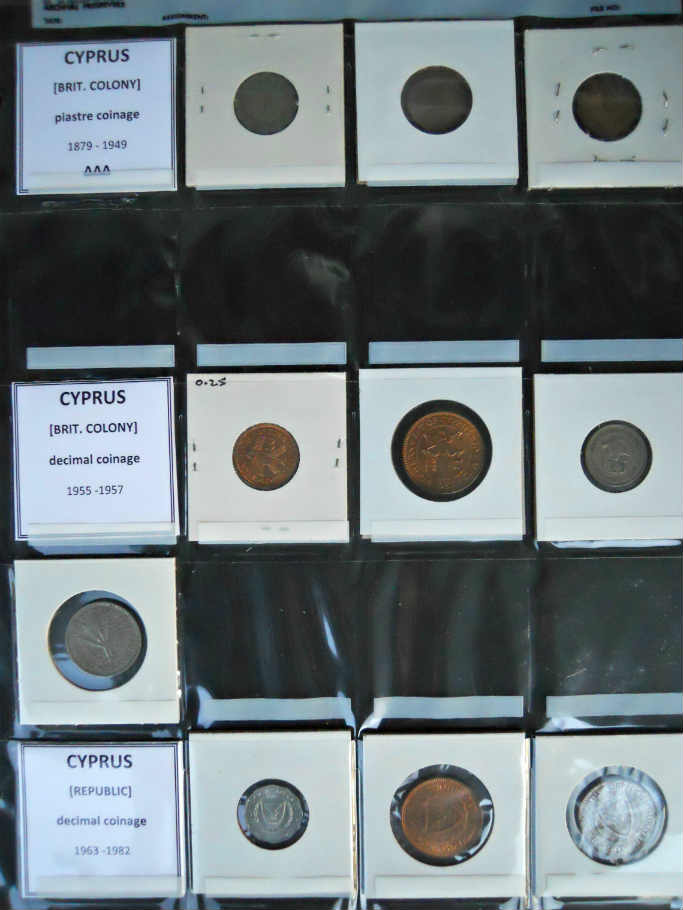 "Country" is on the top of the label, the "political entity" is in brackets and the "coinage series" is third. I also put the date range of the mintage years of the coinage series, not its political lifespan (that is, what is the earliest and latest date I would find on a coin from that series). The triple triangles on the first label denotes the first entity and coinage series for a given country. cheers, tbg |
|
Valued Member
United States
60 Posts |
I'll add that of course, in the end, people are going to use whatever system is best suited for them and their collection. I'm just sort of fascinated how people arrange, keep track of and display essentially the same objects in so many different ways with so many different tolerances for standardization....
cheers,
tbg
|
|
Moderator
 Australia
16961 Posts |
Very neat and organized there, tbg. But I have to say, for me personally, I'd tire of constantly moving the little card-tags whenever I got a few too many new coins from country X.
As for the whole "political entity" and "coinage series" labels which Krause uses, I'd agree they're a bit of a joke. Particularly the way the labels carry across several volumes, where the distinction that may have been helpful in, say, the 1700s Krause is no longer needed in the 2000s Krause. The "Kingdom resumed" subtitle under Great Britain comes to mind; this is a legacy of the 1600s Krause, when Britain was briefly a Republic (1649-1660). "Standard" coinage usually refers to normally struck circulation coins, as opposed to "countermarked coinage", "emergency coinage", "token coinage", "trade coinage" or something similar that may have been issued in the 1800s or earlier.
Don't say "infinitely" when you mean "very"; otherwise, you'll have no word left when you want to talk about something really infinite. - C. S. Lewis
|
|
Pillar of the Community
United Kingdom
2927 Posts |
It's a tricky task to come up with something definitive and is most certainly open to an individuals interpretation. Personally I list mine (for records purposes) under broad geographical headings - eg Great Britain) then list coin issuing authority as a more exact reference. Of course it's not perfect nor is it consistent. I list coins of the Northern Sung dynasty differently from those of the Southern Sung or Ming - yet I don't distinguish between the Tudors and the Stuarts which I should if I was consistent - I also don't distinguish between Cuban tourist money and Cuban local money but that probably is consistent .. but the whole shaky recording edifice works for me :).
|
|
Valued Member
Austria
194 Posts |
I can only recommend you the german standard cataloges: but they have not been published in english. http://www.gietl-verlag.de/blaetter...og/index.phphttp://www.gietl-verlag.de/blaetter...og/index.phpfor germany, it is better as following: 1.holy roman empire (middel ages - 1806) 2: German states (1806-1918) 3: German Empire (1871-1918) 4: Austrian Empire (1806-1918) and then the time after the end of monarchies, which is simple. (weimar, IIIrd Reich, Saar, GDR, BRD,...) ---------------------------------- This includes also the coinage of (parts of)countries, which today are existing as poland, slowakia, italy, france, switzerland, belgium, the netherlands, romania, balkans. and further: mexico (maximilian), greek (otto of bavaria) |
|
Pillar of the Community
United Kingdom
2927 Posts |
i have the Otto 5 Drachma but I count it as definitely Greek, not German. wwhile Otto was from Baveria the issuing authority was the kingdom of Greece..
|
|
Valued Member
Austria
194 Posts |
@bacchus"2:
of course it is a greek and not a german coin, but you can also collect them as a bavarian dependency, though it is not bavaria or an bavarian area.
it´s ofcourse also the same with the mexican coins of emperor maximilian.
|
|
Pillar of the Community
Russian Federation
5186 Posts |
It's still a bit confusing whether you call it "country" or "coin issuing entity".
I have a copper "pulo" coin from Tver... at least that's what it says on the coin ("pulo tverskoye"). I've been told, by a person who probably knows what he's talking about, that it was likely minted in the 16th century when the Principality of Tver was already part of Muscovy. Nevertheless, I still consider it a coin from the "country" (or "entity") of Tver.
I don't have any of these (they're rather expensive - as in $50+ expensive), but supposedly the German Empire continued to mint large-denomination coins (2 mark and up IIRC) in the name of various local-ish rulers up until it fell in the 1910s - and by 1900+ it was a rather unitary affair otherwise. Would such a coin of "Bavaria" or "Baden" or "Wurttemberg" or whatever be considered as a coin from that "country"?
Heck, here's an even more confusing example. In the 1950s (or so), British shillings intended for Scotland had a rather distinctive Scottish design on them; I have one of these "Scottish" shillings. Some might consider it as a coin representing the "country" (or "entity") of "Scotland"; I don't feel comfortable doing so, even though I know that I might never get a real Scottish coin from back when it was actually independent (of course 17th century Scottish coins are probably affordable enough, it's just ridiculously unlikely that I ever see one offered where I could buy it).
...Mind you, there's still a bunch of weird "country or not" cases where I'm not sure myself - even counting only coins that are indeed in my collection. Are all the Yugoslavia versions the same country, and if so is the Kingdom of Serbs, Croats and Slovenes a different one? Is 1940s Slovakia (a Nazi puppet) distinct from post-1993 Slovakia, or pre-WW2 Latvia from post-1991 Latvia? Do British coins from 1699, 1797, 1807, 1899 and 1971 represent more than one different "country", and if so, how many? Are RFSFR or Weimar Germany distinct from their predecessors and successors? And, can I count every single French Republic (plus intervening Empires and Kingdoms where applicable) I have coins minted in? (I probably missed a few, too...)
|
| |
Replies: 13 / Views: 1,470 |
|
To participate in the forum you must log in or register.
Disclaimer: While a tremendous amount of effort goes into ensuring the accuracy of the information contained in this site, Coin Community assumes no liability for errors. Copyright 2005 - 2026 Coin Community Family- all rights reserved worldwide. Use of any images or content on this website without prior written permission of Coin Community or the original lender is strictly prohibited.
Contact Us | Advertise Here | Privacy Policy / Terms of Use
|
| Coin Community Forum |
© 2005 - 2026 Coin Community Forums |
| It took 0.4 seconds to rattle this change. |
 |
|







 Posted 05/13/2013 11:25 am





