




 First Page
 Previous Page


 Posted 11/04/2016 03:52 am


Sorry to chime in late on this three year old thread.
Potosi edges are often more crude than Mexican. This however does not excuse Potosi edges from following the required mechanics involved with a parallel two flat die edger (a Spanish Milling machine or a French Castang machine). There must be two overlaps exactly opposite one another. The two overlaps must be identical in length.
With regard to wobble, I maintain that the channel in the edging die limits the side to side wobble permissible. Are the limits the same as Mexico City probably but I would want to study the results before stating that with 100% certainty.
With regard to squared circles - there is more room for variation at Potosi than Mexico City - but the pattern should repeat. The edge dies were "supposed" to be made with the standard three segment (circle - rectangle - circle) pattern found on the Matrix blocks from Spain. The question of the possible use of single element punches - a square and a circle - in Potosi needs to be evaluated by studying hundreds of examples before drawing a conclusion. I do not believe any mint used that procedure but I may be wrong about very low volume mints.
Each coin posted here needs its own review. Adding new coins can and in this case does get confusing.
The first coin posted by bogdanjovi "appears to be genuine" in my opinion, at least in the series of pictures available.
The coin should be "bent toward the center", provided that you mean that the coin is slightly cup shaped with the Portrait bowing outward (convex) and the shield side bowing slightly inward (concave). This was done typically so that the 8R's could be stacked on counting boards. A perfectly flat coin produces a coin that wobbles (due to raised central elements). A coin that wobbles or rocks makes for a stack that tips over.
Later on added pictures of part of the edge are shown.
These pictures do not show parts of the face of the coin to allow for orientation. The last picture apparently raised the question about the squared circles. I enlarged the photo and added red circles and rectangles OVER the clear segments. See next picture:
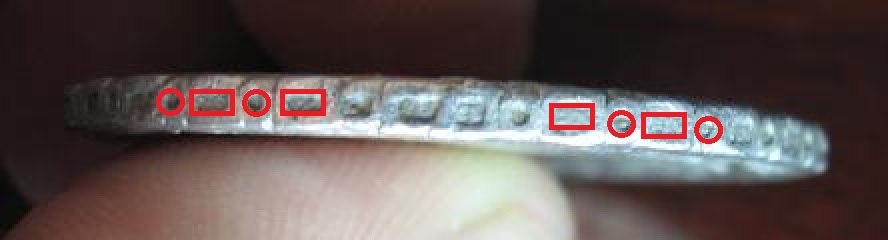
There are definitely 4 elements that "look" wrong. I may be incorrect but these look like the overlap. I can not tell where it is positioned on the coin but the length is about right for a manual edging mill.
I suggest checking the point exactly opposite this area to make sure there is a second overlap of the same length. If I had to guess I believe this point may be captured at the right side of the first picture.
So bogdanjovi the first coin is most likely genuine pending in person reviews.
Then wonghinghi posted a second 1808 Pts for comparison. This coin too looks correct. The edge design is very similar to the first edge.
Also note that both coins have the "odd" looking smile of Potosi that is quite unlike Mexico City.
The only issue I would look into very closely are the lumps (probably die rust) that appear in the upper right quadrant of the Portrait side of the coin. A decent 30X binocular microscope would be adequate to make sure they are appropriate for die rust pits.
There are others posted as well - one with an edge that looks like it was applied to a coin which had the original edge shaved off. This pertains to one of the two 1780 issues of Charles III. These two are both broken castle coins - which I have long suspected of being spurious. I own several broken castle coins which are definitely COUNTERFEIT. The counterfeits have Specific Gravities indicating low silver content and one example is clearly a Sheffield Plate copy. So some broken castle coins are counterfeit. Others appear to be full weight silver. Were these intended for the China trade?
It is better in my opinion to stick to one subject in a thread. Just my late 2 cents.
Potosi edges are often more crude than Mexican. This however does not excuse Potosi edges from following the required mechanics involved with a parallel two flat die edger (a Spanish Milling machine or a French Castang machine). There must be two overlaps exactly opposite one another. The two overlaps must be identical in length.
With regard to wobble, I maintain that the channel in the edging die limits the side to side wobble permissible. Are the limits the same as Mexico City probably but I would want to study the results before stating that with 100% certainty.
With regard to squared circles - there is more room for variation at Potosi than Mexico City - but the pattern should repeat. The edge dies were "supposed" to be made with the standard three segment (circle - rectangle - circle) pattern found on the Matrix blocks from Spain. The question of the possible use of single element punches - a square and a circle - in Potosi needs to be evaluated by studying hundreds of examples before drawing a conclusion. I do not believe any mint used that procedure but I may be wrong about very low volume mints.
Each coin posted here needs its own review. Adding new coins can and in this case does get confusing.
The first coin posted by bogdanjovi "appears to be genuine" in my opinion, at least in the series of pictures available.
The coin should be "bent toward the center", provided that you mean that the coin is slightly cup shaped with the Portrait bowing outward (convex) and the shield side bowing slightly inward (concave). This was done typically so that the 8R's could be stacked on counting boards. A perfectly flat coin produces a coin that wobbles (due to raised central elements). A coin that wobbles or rocks makes for a stack that tips over.
Later on added pictures of part of the edge are shown.
These pictures do not show parts of the face of the coin to allow for orientation. The last picture apparently raised the question about the squared circles. I enlarged the photo and added red circles and rectangles OVER the clear segments. See next picture:
There are definitely 4 elements that "look" wrong. I may be incorrect but these look like the overlap. I can not tell where it is positioned on the coin but the length is about right for a manual edging mill.
I suggest checking the point exactly opposite this area to make sure there is a second overlap of the same length. If I had to guess I believe this point may be captured at the right side of the first picture.
So bogdanjovi the first coin is most likely genuine pending in person reviews.
Then wonghinghi posted a second 1808 Pts for comparison. This coin too looks correct. The edge design is very similar to the first edge.
Also note that both coins have the "odd" looking smile of Potosi that is quite unlike Mexico City.
The only issue I would look into very closely are the lumps (probably die rust) that appear in the upper right quadrant of the Portrait side of the coin. A decent 30X binocular microscope would be adequate to make sure they are appropriate for die rust pits.
There are others posted as well - one with an edge that looks like it was applied to a coin which had the original edge shaved off. This pertains to one of the two 1780 issues of Charles III. These two are both broken castle coins - which I have long suspected of being spurious. I own several broken castle coins which are definitely COUNTERFEIT. The counterfeits have Specific Gravities indicating low silver content and one example is clearly a Sheffield Plate copy. So some broken castle coins are counterfeit. Others appear to be full weight silver. Were these intended for the China trade?
It is better in my opinion to stick to one subject in a thread. Just my late 2 cents.


