











 Posted 06/20/2013 12:40 am


I had a chance to run this coin by Mike Diamond who is one of the persons running the http://error-ref.com website.
Mike pointed out something that I should know but never took into account. Our loonies are not alloys but plated coins. I am surprised that no one in this forum picked it up (or perhaps members left it for me to discover )
)
Somehow I only attributed plating to coins after 2000 or so and that too everything other than loonies and toonies. The loonies and toonies were touted to be plated from 2012 onwards.
Is it just me or did others erroneously believe that loonie was a complete alloy?
Even the main Canadian Catalog of coins identifies it as nickel/bronze without ever (my highlight) mentioning that these are bronze plated. It lists it as Composition: 91.5% nickel, 8.5% bronze the same way it lists the silver coins as Composition: 0.8 silver, 0.2 copper.
The RCM website correctly identifies the composition of the loonies as Composition: 91.5% nickel, 8.5% bronze plating (my highlightint) and IMHO the catalog should correctly identify the composition as done by RCM.
So what does that all mean to the loonie error.
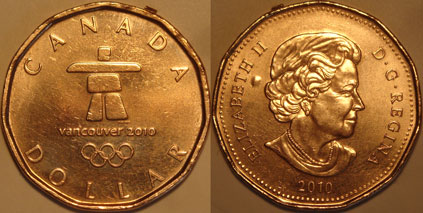
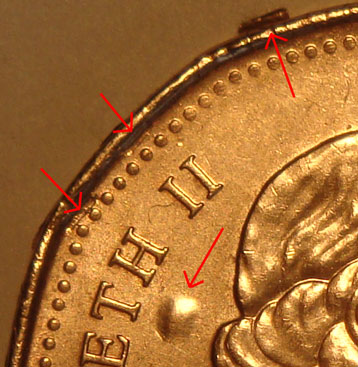
Planchet: Plating Errors: Plating Blister - Circular
and
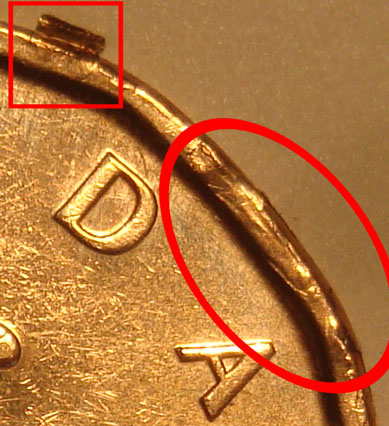
Plancet: Plating Error: Cracked, split, peeling plating
I discussed with Mike the possibility that it may be a heat blister and in his opinion the blister appeared too small to be a heat blister. The possibility of the bubble being a die dent was explored and Mike identified a method to test the bubble that would help answer that question. It was rather interesting to touch the bubble with a tooth pick. It seemed like I was chasing the air in the bubble. I wish I could make a video of that I think it my trend.
The possibility of peeling happening post mint was discussed and I left with an understanding that the underlying issue of debonding of plating was a mint related issue. Some of the delamination could occur in circulation.
The interesting thing in all this for me is that the coin has such sharp edge that it easily catches the threads of cloth and can also hurt the skin. Luckily this is probably a rare situation but the possibility if it occurs more frequently in plated coins could really be an issue in design. I would love to see the opinion of RCM on this one.
Mike pointed out something that I should know but never took into account. Our loonies are not alloys but plated coins. I am surprised that no one in this forum picked it up (or perhaps members left it for me to discover
)Somehow I only attributed plating to coins after 2000 or so and that too everything other than loonies and toonies. The loonies and toonies were touted to be plated from 2012 onwards.
Is it just me or did others erroneously believe that loonie was a complete alloy?
Even the main Canadian Catalog of coins identifies it as nickel/bronze without ever (my highlight) mentioning that these are bronze plated. It lists it as Composition: 91.5% nickel, 8.5% bronze the same way it lists the silver coins as Composition: 0.8 silver, 0.2 copper.
The RCM website correctly identifies the composition of the loonies as Composition: 91.5% nickel, 8.5% bronze plating (my highlightint) and IMHO the catalog should correctly identify the composition as done by RCM.
So what does that all mean to the loonie error.
Planchet: Plating Errors: Plating Blister - Circular
and
Plancet: Plating Error: Cracked, split, peeling plating
I discussed with Mike the possibility that it may be a heat blister and in his opinion the blister appeared too small to be a heat blister. The possibility of the bubble being a die dent was explored and Mike identified a method to test the bubble that would help answer that question. It was rather interesting to touch the bubble with a tooth pick. It seemed like I was chasing the air in the bubble. I wish I could make a video of that I think it my trend.
The possibility of peeling happening post mint was discussed and I left with an understanding that the underlying issue of debonding of plating was a mint related issue. Some of the delamination could occur in circulation.
The interesting thing in all this for me is that the coin has such sharp edge that it easily catches the threads of cloth and can also hurt the skin. Luckily this is probably a rare situation but the possibility if it occurs more frequently in plated coins could really be an issue in design. I would love to see the opinion of RCM on this one.


 !
!


