

 Posted 06/14/2013 8:42 pm


I have a book by Brian Hannon which show a series of these, which degenerated in style over a period of centuries.
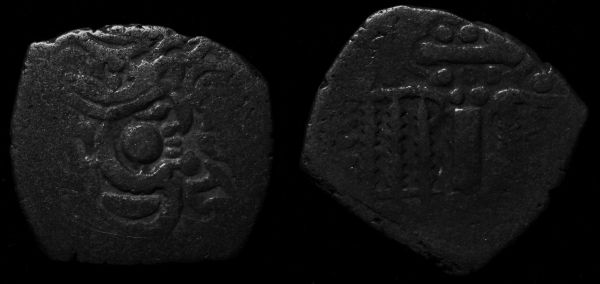
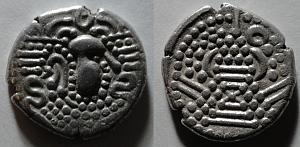
The coin shown here is of a fairly degenerate style.
Acording to my reference, the prototype (first entry in Hannons book), for these was a dramma of about 640 A.D., of the Gurjarahs.
It shows the bust of the King (obv.) and a flaming fire altar between male and female attendants, moon and sun above.
However, the style of the prototype is very different from the pure Sassanian series of very thin drachm, and is obviously more 'Indian' in style than the Sassanian drachms..
The prototype for the coin pictured is classified in the 'Indo Sassanian' series.
The next entry in Hannon's book shows a dramma of the Pratiharas, around the period of 730 - 835 A.D., and shows a coin very similar in style to the coin pictured here. Weight abot 4 grammes.
The third entry in Hannon's book shows another example of the Pratiharas, that circulated in the area of Gujerat and Malwa, over a period of 780 - 900 A.D. Also of similar style.
The fourth entry is of a dramma of the Silharas, around the period of 900 - 1100 A.D., which curiously enough, is also of similar style to the coin pictured in this thread. Hannon's note to his fourth entry is VERY different in regards to what is depicted on the coin. He notes it as a
"Battle encounter between two horsemen, three casuties l., two further ones below. 'A charming example of native art!' Unfortunately, only a portion of the gory scene is displayed on each coin".
My comment: How it is possible to get from the description on Hannon's first entry to that of his fourth entry is beyond MY numismatic imagination! More research required.
The coin shown here is of a fairly degenerate style.
Acording to my reference, the prototype (first entry in Hannons book), for these was a dramma of about 640 A.D., of the Gurjarahs.
It shows the bust of the King (obv.) and a flaming fire altar between male and female attendants, moon and sun above.
However, the style of the prototype is very different from the pure Sassanian series of very thin drachm, and is obviously more 'Indian' in style than the Sassanian drachms..
The prototype for the coin pictured is classified in the 'Indo Sassanian' series.
The next entry in Hannon's book shows a dramma of the Pratiharas, around the period of 730 - 835 A.D., and shows a coin very similar in style to the coin pictured here. Weight abot 4 grammes.
The third entry in Hannon's book shows another example of the Pratiharas, that circulated in the area of Gujerat and Malwa, over a period of 780 - 900 A.D. Also of similar style.
The fourth entry is of a dramma of the Silharas, around the period of 900 - 1100 A.D., which curiously enough, is also of similar style to the coin pictured in this thread. Hannon's note to his fourth entry is VERY different in regards to what is depicted on the coin. He notes it as a
"Battle encounter between two horsemen, three casuties l., two further ones below. 'A charming example of native art!' Unfortunately, only a portion of the gory scene is displayed on each coin".
My comment: How it is possible to get from the description on Hannon's first entry to that of his fourth entry is beyond MY numismatic imagination! More research required.