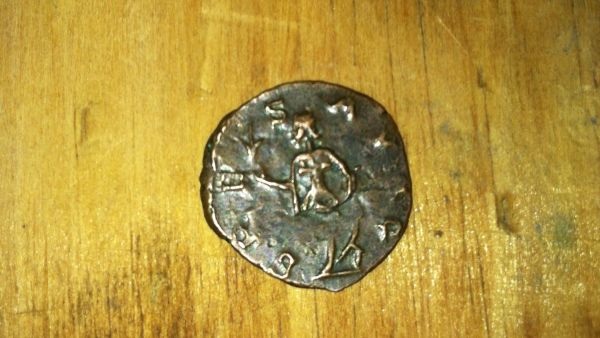
Quote:
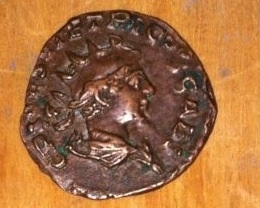
Anglo-Gallic emperor Tetricus II-Sap
England didn't exist as a nation back then.

The Gallic empire by the time of Tetricus I and his son (
http://en.wikipedia.org/wiki/Tetricus_II) had shrunk in territory but still possessed northern Gaul, including the the major frontier cities of Trier and Cologne.
And so Tetricus & son cannot be referred to as "Britannic" as Carausius and Allecus were 22 years later, though he too had possession of northern Gaul for a while.
The empire of Postumus to Tetricus I, as we know, is known as the "Gallic empire".
http://en.wikipedia.org/wiki/Gallic_EmpireThe coin in question is real but a typical contemporary imitation, and a nice one, done by local Romans, and this imitating seems to occur along the frontiers, from southern Britain to the Rhine.
It seems to have had its Patina zapped off by over cleaning unfortunately.Onviously the imitators did not know Latin well enough to know what the abbreviated letters stood for.
It may be surprising to think that not every citizen or Slave in the empire knew Latin.
From the mid 3rd century the empire in Gaul and Britain was not a land of glistening marble cities were everyone was semi-divine Polymath and knew every single Latin work every written.
By that time a lot of cities were being walled off, both due to the civil wars and to "Barbarian" raids.
Civic structures, built a hundred years earlier, were decaying. And this impoverishment would be reflected in the knowledge locals and Slaves had of proper Latin.
To add to this, the former lands of the Iceni in southern Britain seem to have been deliberately neglected after the failed Boudiccan revolt of 61 A.D.
Venta Icenorum seems to also have been a walled settlement, but not much more.
http://en.wikipedia.org/wiki/Venta_IcenorumThis was the frontier region, later known as the "Saxon Shore" from which such contemporary imitations of Gallic Empire coins, came from. So knowing that the local populace had been deliberately impoverished it would not be surprising if not all the locals knew Latin properly.
Contemporary imitations from the posthumous issues of Claudius II to Tetricus II are labelled "Barbarous" but the actual "Barbarians" of Germany and eastern Europe had no interest in making coins of their own, rather they preferred Loot such as Bullion and Slaves.












 Posted 06/24/2013 06:33 am


 to the community