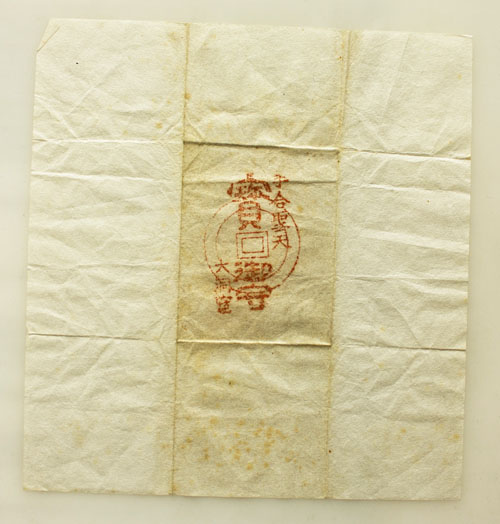
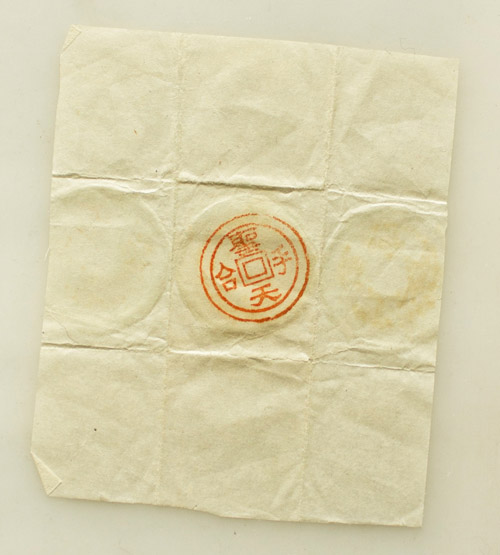
The four characters on the second item, arranged cash-coin-style, are the exact same four characters you can see in the top left of the stamp on the first item. Reading them in the top-to-bottom order they appear on the first one, the characters are (in modern Pinyin romanization) "shou he

tian", literally "hand union
heaven". Unfortunately, I can't read the third character, either. But I would assume these four characters are the name of the coin dealership shipping the coins. The large character at the top centre is "bao", which is the symbol for "coin" or "money" found on cash coins; unfortunately, I can't read the other large character.
For I'm fairly certain they are home-made shipping/storage envelopes. The bottom one has clearly been very tightly wrapped around a large cash-style coin, either a Song Dynasty piece or one of the larger Qing Dynasty pieces. Such objects have not been used as actual money since the mid-1800s, and these pieces of paper, while certainly old (at least 50 years, I would guess) are almost certainly not 150 years old. The only kind of person needing to wrap up an obsolete coin in a piece of paper like this is somebody selling obsolete coins - a coin dealer.
And yes, they would have been used as a form of receipt, or at least a reminder of a coin's provenance - which is why they would have been kept.
Don't say "infinitely" when you mean "very"; otherwise, you'll have no word left when you want to talk about something really infinite. - C. S. Lewis












 Posted 06/30/2013 02:17 am


