| Author |
 Replies: 9 / Views: 2,033 Replies: 9 / Views: 2,033 |
|
|
Pillar of the Community
United States
3499 Posts |
I just got this out of a dealer's junk box thinking that it was either from French West Africa or Togo, but I am not seeing a coin in my Krause with the same legend and with the date 1959. Any guesses? Thanks! 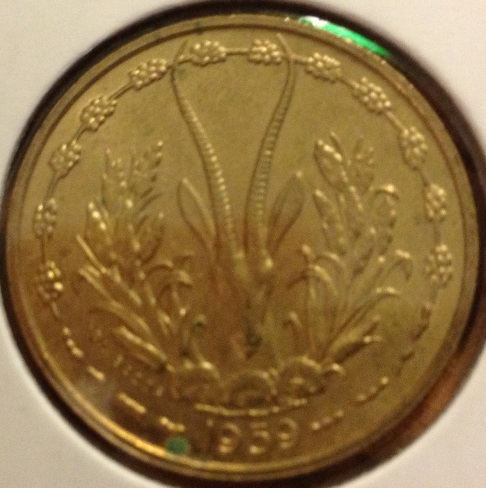 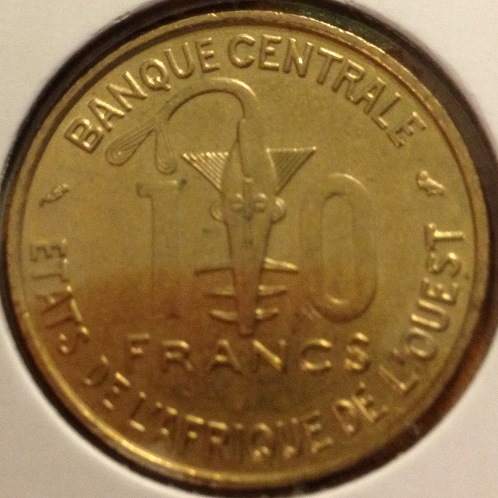 |
|
|
|
Pillar of the Community
United Kingdom
2928 Posts |
It's probably listed under West African States.
|
|
Pillar of the Community
United States
4212 Posts |
You have it right. I have one on my desk, marked KM1.
Love that kritter.
|
|
Valued Member
United States
365 Posts |
Yup, Bacchus has got it. This is a coin made by the French mint--note the mint and privy marks: cornucopia for Paris mint, owl for the 'big cheese' (his name's escaping me). Yours is in good shape, I saw a lot of these in West Africa still in circulation in the 90s but very, very worn! I love the device that splits the denomination.
|
|
Pillar of the Community
 United States
3499 Posts |
|
|
Bedrock of the Community
United Kingdom
18703 Posts |
The owl is the privy mark of chief engraver Raymond Joly, who held the office from 1958 - 1974.
|
|
Valued Member
United States
365 Posts |
That's it, Joly, thanks NumisRob. His is the famous owl mintmark on the very popular 1958 100 franc variety. And the obverse device, if I recall correctly, is a representation of an old weight used to measure value in trade.
|
|
Pillar of the Community
United States
3486 Posts |
The same "kritter" was kept on the Coins of Cameroon, Chad and Gabon after they became independent.
It is my understanding that they freely circulated much as the Euros do in Europe.
1959 would be just prior to independence which happened in 1960 or 1961.
|
|
Pillar of the Community
Belgium
506 Posts |
After independence the money supply was still regulated by the Banque de France with a Franc CFA fixed in parity to the french Franc. It greatly favored trade among the former french colonies and prevented local presidents or dictators from excessively debasing the currency as was the case elsewhere througout Africa.
|
|
Pillar of the Community
Germany
1238 Posts |
Both the central bank and the West African Franc still exist; here are the current coins: http://www.bceao.int/Pieces-en-circulation.htmlNote that there are two "CFA" currency unions, this one (BCEAO) in West Africa, and the BEAC in Central Africa. The two currency unions have a fixed (1-1) exchange rate, and both have a fixed euro exchange rate (€1 = 655.957 FCFA). The symbol is the sawfish (poisson-scie) from the central bank's logo. Such sawfish figures in bronze were used as gold weights by some people in that region. It is also a symbol of power and prosperity ... Christian Edited by chrisild
07/15/2013 10:06 am
|
| |
Replies: 9 / Views: 2,033 |
|







 Posted 07/14/2013 4:04 pm





