I got this coin along with a bulk purchase of rare Indo coins. This one is one of my favorites of the lot. This coin hails from the Kuninda Kingdom, which lay at the foothills of the Himalayas, on what is the modern India/ Nepal border. The ancient Greek historian Ptolemy places the origins of the homeland of the Kuninda where the rivers Sutlej, Yamuna and the Ganges originate. Although unfamiliar to most collectors of ancient coins, the Kuninda Kingdom is mentioned in the famous Indian epic The Mahabharata, where it is said their armies were defeated by the Undefeated Hero Arjuna.
The Kuninda Kingdom emerges from obscurity in two distinct series of coins. One minted in the 2nd to 1st century BC and the other around the 2nd century AD shortly before they disappear from the historical record. They struck coins in bronze and silver, while bronze coins are often crude and weakly struck the silver coins are amazingly gorgeous made from highly detailed and cramped dies, conveying an multitude of Buddhist symbolisms.
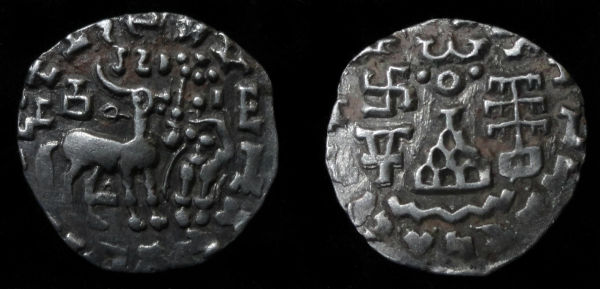
Here I will show my example, dating from the 2nd century BC, a coin struck in the name of King Amoghabhuti. These drachms were struck in the same numismatic model as their Indo-Greek contemporaries. They followed a nearly identical weight standard of about 2.18 grams and 19 millimeter in diameter. Currently there is no catalog that thoroughly covers these coins and an unknown number of variations exist. Although due to hoard evidence, these coin have been found along side the coins of Apollodotus, cementing a solid, equal and peaceful economic exchange.
It is thought that coins bearing the name of King Amoghabhuti were struck and circulated long after his death well into the 3rd century AD, and often bare the likeness of the Hindu God Shiva.
In the end I felt I certainly needed one of these for my collection.
India,
Kuninda Kingdom
Amoghabhuti c. 2nd cent. BC
17 mm x 2.11 g
obverse: Deer standing crowned by two cobras attended by Lakshmi holding lotus flower, ghadiya under deer. Brahmi Legend- Rajanah Kunindasa Amohabhutisa maharajasa.
Reverse: Buddhist Stupa surmounted by the Buddhist symbol triratna and surrounded by a Swastika a "Y" symbol and a tree.-Kharoshti legend Rana Kunindasa Amoghabtusia maharajasa. (Great King Amoghabhuti of the Kunindas)
ref: MACW 4440-4441, ACC #3










 Posted 08/17/2013 11:30 am


