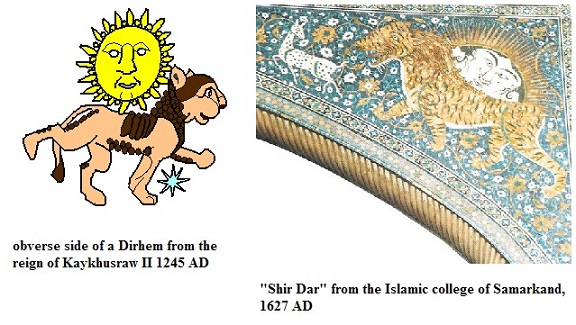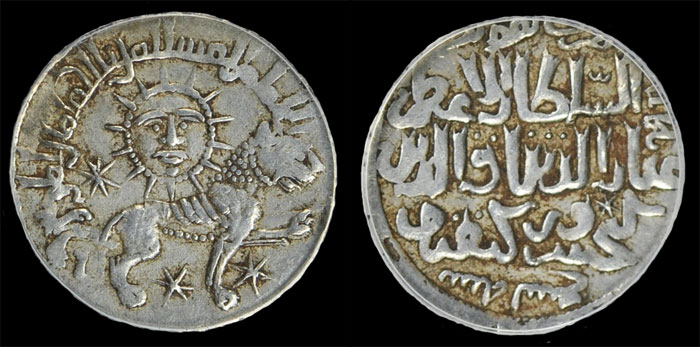
Guess it was the lion, the smiley sun, and stars that grabbed my attention. Plus, isn't it somewhat uncommon to have animals on Islamic coins?
I
think I did OK on the price but it's hard to know at this early stage. Not sure what came over me. Maybe a recent thread and all of Anoob's obscure and interesting coins.
Anyway, this very interesting coin is winging its way to me now. Pictures are modified from the seller. If the edges look odd its because this poor coin is entombed in a plastic prison and I tried to photoshop it out. Don't worry, I'll set it free as soon as it arrives. I suspect it will look better in hand and unhindered by scratched plastic.
I did some comparison research prior to buying but WOW, the variations in spelling make it hard, plus I have no clue about reading Islamic coins. Did find a helpful website though...
http://mehmeteti.150m.com/index.htmSome background on these people, from the above-cited website:
Quote:
Seljuqs of Rum is a branch of Great Seljuqs of Iran who are the Turks migrated from Central Asia. Following the battle and victory of Alp-Arslan at Manzikert (1071) , against Byzantine emperor Ramonus IV Diogenes, Seljuqs, step by step, took control of Anatolia (Asia Minor) (Rum: means Roma, Byzantine Empire). The dynasty of Seljuqs of Rum is established by Sulayman, the son of Qutalmish, in Iznik (Nicaea). Afterwards the capital moved to Konya. They lived their most glamorous time during the reign of Ala ad-Din Kay-Kubadh I. By this time Seljuqs of Rum emerged as one of the most important Muslim states of age. After Kay-Khusraw II was defeated by the Mongol commander Bayju at Köse Dag (1243), the Sultanate of Anatolian Seljuqs entered in a period of decline. But, nevertheless, the sovereignty survived till 1318, the reign of Qilich Arslan V. Following the demolition of the last Seljuq dynasty, the way was opened for Anatolian Beyliks to come to the stage.
Here is the attribution, which seems to be correct although the spelling varies everywhere I look:
Seljuqs (Seljuks) of Rum, Kusru II (Kaykhusraw II, Ghiyath al-Din Kai Khusrau II, Kay Khusrow II, etc)
Silver Dirham (Dirhem)
Konya Mint
1241-1242 A.D. (AH639)
Obverse: Sun and Lion
Reverse: uh, I'll have to get back to you on that.







 Posted 08/19/2013 10:23 am