







 Posted 09/27/2013 04:13 am


Technically, neither the Crusader nor Viking eras are "ancient". While the boundary between ancient and mediaeval is somewhat rubbery, a date of around AD 500 is useful as a benchmark.
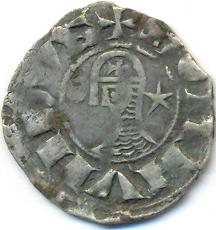
Dealers tend to advertise pretty much any coin from the 1100-1300 time period as "Crusader", even if the issuer in question had nothing to do with the Crusades. Collectors generally limit "Crusader coins" to those coins issued by and for the Frankish states established by the Crusaders in eastern Europe and the Middle East. Probably one of the neatest coin designs from the actual crusader states are the silver deniers of the Principality of Antioch. They depict the Prince in full military regalia, with chain-mail armour and nose-bridge helmet. Here's my example:
The Vikings did not make their own coins during their golden age (say around AD 700-900); they tended to treat plundered coins the same as any other object of silver they captured, as mere bullion. It was only after they started colonizing and conquering rather than mere raiding that truly Viking coinages are easily obtainable. The Viking state centred on Jorvik (York) in England issued coins, for example, including the "St Peters penny" depicting Thor's hammer and St Peters sword - a mixture of Christian and Norse pagan imagery.
For coins the "real Vikings" might have plundered, you can choose pretty much any coinage from Dark Age Europe - Northumbrian sceats and stycas, Anglo-Saxon pennies and Carolingian deniers form Europe would all be suitable. However, I should warn you that coins of this era generally aren't cheap, and almost always are pretty small, ugly-looking things to modern eyes. The artwork on mediaeval hammered silver coins is generally pretty crude, and the lettering can take some practice to read. Northumbrian stycas are probably the easiest coins of this time period to obtain; they're also amongst the crudest and cheapest-looking, too.
All I'm saying is, be prepared to pay an awful lot of money for something your mother might look at and say, "It looks like something you found on the driveway". My mother says this about my coins all the time.
There are, of course, plenty of other options. This famous Viking hoard found in Sweden was comprised almost entirely of Islamic silver dirhams from what is now Syria and Iraq - not a region typically associated with the Vikings, but illustrative of the far-reaching trade routes the Vikings carved out across eastern Europe. While Europe languished in the Dark Ages, the Islamic Caliphate was enjoying its golden age and their silver coins were the biggest and highest purity in circulation anywhere at that time.
Dealers tend to advertise pretty much any coin from the 1100-1300 time period as "Crusader", even if the issuer in question had nothing to do with the Crusades. Collectors generally limit "Crusader coins" to those coins issued by and for the Frankish states established by the Crusaders in eastern Europe and the Middle East. Probably one of the neatest coin designs from the actual crusader states are the silver deniers of the Principality of Antioch. They depict the Prince in full military regalia, with chain-mail armour and nose-bridge helmet. Here's my example:
The Vikings did not make their own coins during their golden age (say around AD 700-900); they tended to treat plundered coins the same as any other object of silver they captured, as mere bullion. It was only after they started colonizing and conquering rather than mere raiding that truly Viking coinages are easily obtainable. The Viking state centred on Jorvik (York) in England issued coins, for example, including the "St Peters penny" depicting Thor's hammer and St Peters sword - a mixture of Christian and Norse pagan imagery.
For coins the "real Vikings" might have plundered, you can choose pretty much any coinage from Dark Age Europe - Northumbrian sceats and stycas, Anglo-Saxon pennies and Carolingian deniers form Europe would all be suitable. However, I should warn you that coins of this era generally aren't cheap, and almost always are pretty small, ugly-looking things to modern eyes. The artwork on mediaeval hammered silver coins is generally pretty crude, and the lettering can take some practice to read. Northumbrian stycas are probably the easiest coins of this time period to obtain; they're also amongst the crudest and cheapest-looking, too.
All I'm saying is, be prepared to pay an awful lot of money for something your mother might look at and say, "It looks like something you found on the driveway". My mother says this about my coins all the time.
There are, of course, plenty of other options. This famous Viking hoard found in Sweden was comprised almost entirely of Islamic silver dirhams from what is now Syria and Iraq - not a region typically associated with the Vikings, but illustrative of the far-reaching trade routes the Vikings carved out across eastern Europe. While Europe languished in the Dark Ages, the Islamic Caliphate was enjoying its golden age and their silver coins were the biggest and highest purity in circulation anywhere at that time.
Don't say "infinitely" when you mean "very"; otherwise, you'll have no word left when you want to talk about something really infinite. - C. S. Lewis


