More usually called the "Sultanate of Malwa".

As a general rule for Islamic coins, the "obverse" is considered the side which names the ruler who issued the coin. If it isn't named, then there's usually a Kalima (Islamic statement of faith), and the side with the Kalima is the obverse.
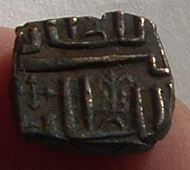
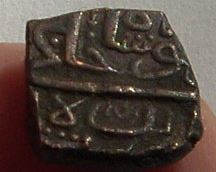
In the case of this coin, one side contains most of the useful information: the bottom pic, which contains the name of the sultan (in this case, Mahmud II) and the date (in this case, the date I believe appears inside the broad-U-shaped N of BIN, in the lower line), so the bottom pic is the obverse. I can't read the date, but the Goron & Goenka catalogue lists the peculiarly angular plant-shaped mintmark in the centre of the reverse as only appearing on copper coins of this ruler dated "924".
You haven't said how big/heavy it is do I can't tell if it's supposed to be a falus, half-falus or quarter-falus; I'm betting from the amount of detail present that it's a half-falus. Compare with the examples of copper coins from this ruler on
these zeno.ru pages; scroll through from the ones numbered "M170" to "M175".
Don't say "infinitely" when you mean "very"; otherwise, you'll have no word left when you want to talk about something really infinite. - C. S. Lewis










 Posted 10/06/2013 5:28 pm


