Posted 10/14/2013 12:28 am


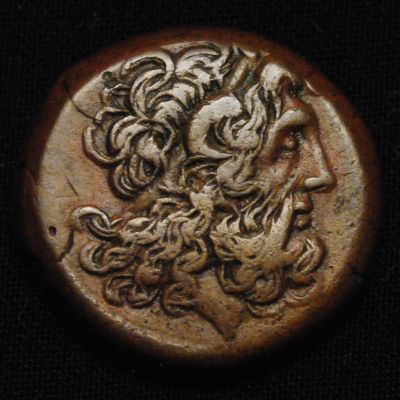
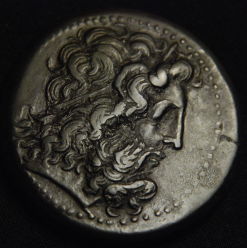
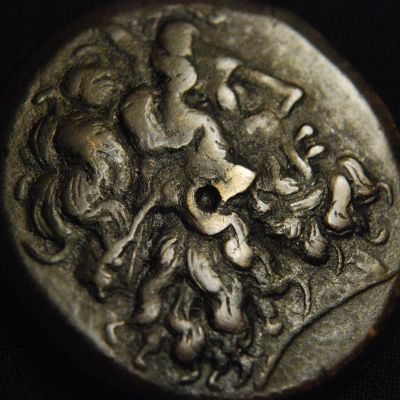
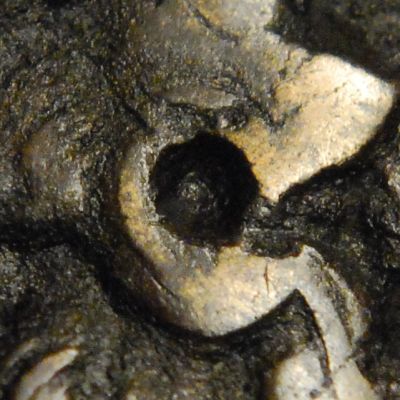
There are two contending theories as to the cause of "centration dimples" found on certain ancient bronze coins (specifically, the bronzes of Ptolemaic Egypt and of certain Roman Provincial cities in the Danube region and Asia Minor).
1. The blank was screwed onto a lathe to allow the edge to be smoothed into a more-or-less round shape prior to striking. The faces may also have had some smoothing done at the same time. Evidence: dimpled coins do tend to be smoother and rounder than undimpled coins of similar size and age. Further, the faces of some severely dimpled, weakly struck coins bear clear signs of lathe turning-marks.
2. Pincer-tongs were used to hold the blank in the forge until it just started to get soft, at which point the coin would then be placed between the dies and then struck. If the furnace were too far away from the anvil and/or the slave carrying the blank was too slow, the metal got too cool for the blow to obliterate all traces of the hole left behind by the tongs. Evidence: on some double-dimpled coins the dimples are asymmetric, which would be possible with tongs but not a lathe. Further, experimental archaeology has shown that large bronze coin blanks would have needed to have somehow been pre-heated to softening point prior to striking since hand-striking a cold blank simply does not bring up the details we see on ancient bronzes.
It is entirely possible that both theories are true for different coin series and different time periods. Minting technologies and techniques were closely guarded trade secrets which were no doubt lost and re-invented several times over the 1000 year long period of "ancient" coinage.
1. The blank was screwed onto a lathe to allow the edge to be smoothed into a more-or-less round shape prior to striking. The faces may also have had some smoothing done at the same time. Evidence: dimpled coins do tend to be smoother and rounder than undimpled coins of similar size and age. Further, the faces of some severely dimpled, weakly struck coins bear clear signs of lathe turning-marks.
2. Pincer-tongs were used to hold the blank in the forge until it just started to get soft, at which point the coin would then be placed between the dies and then struck. If the furnace were too far away from the anvil and/or the slave carrying the blank was too slow, the metal got too cool for the blow to obliterate all traces of the hole left behind by the tongs. Evidence: on some double-dimpled coins the dimples are asymmetric, which would be possible with tongs but not a lathe. Further, experimental archaeology has shown that large bronze coin blanks would have needed to have somehow been pre-heated to softening point prior to striking since hand-striking a cold blank simply does not bring up the details we see on ancient bronzes.
It is entirely possible that both theories are true for different coin series and different time periods. Minting technologies and techniques were closely guarded trade secrets which were no doubt lost and re-invented several times over the 1000 year long period of "ancient" coinage.
Don't say "infinitely" when you mean "very"; otherwise, you'll have no word left when you want to talk about something really infinite. - C. S. Lewis