I have always went by the philosophy that if you see something rare but it seems common in the market I should own it. If a hoard of a particular type makes it self known to the market place and you have several to choose from you should always get the best coin you can afford and make concessions according to your budget.
I have seen this particular coin and about 4 others like it being sold right now. They are what I consider a "must have" coin.
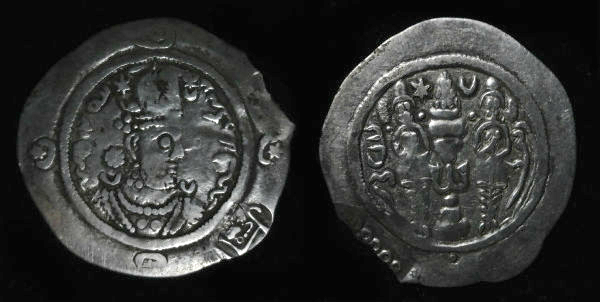
While making budget concession I had to think about what I really wanted out of the type. So I opted for the VF coin with compete countermarks. I know what your all going to say, there is a rarer version with 3 counter marks instead of two. Mine as you can see has only two.

First, lets talk about the coin its self. I have always been fascinated by cultures who are only predominantly know to us from the coins they struck. The coin is of a well known Shah named Hormizd IV. He ruled Persia from 579-590 AD and he was the son of Khusro I, and a woman from a Turkish tribe. He
inherited Khusro's wars with the Byzantines in the West and the various tribes in the East. The coin dates to year 11 the final year of Hormizd's reign and the same year that the named mint city of Balkh (Bactria) fell to the Hephthalites. The coin is said to be an imitation (not a counterfeit) of a Sassanid Dirham of Hormizd. Although from what I understand it is not agreed upon by all. There still is the possibility that the coin is an official issue of regal year 11 and they entered circulation as loot from Balkh. The prevailing opinion is that the coin was struck sometime around in the 630's AD as a stroke for stroke copy of the RY 11 coins. I wonder when does a coin stop being an imitation of a coin and when does it become its own coin type.
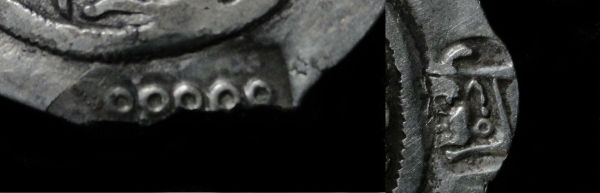
The countermarks. Very interesting. One is a that of a man's bust wearing an earring. Presumably the bust of the ruling authority. We may never know which of two countermarks were applied first, or if they were applied at the same time.
The other counter mark is cursive Bactrian Greek text, that reads PHRORO. This has been attributed to the Hephthalite warlord. Phormo Kesaro. Who is said to have been in power in the mid 740's AD. Although there is further information that the Phormo Kesaro is not the name of the ruler but rather a title. The word PHRORO is often found on some coins to be PHORO, weather this is a mistake or a different ruler. Studing the development of language in the area experts surmise that the PHRORO does indeed refer to the title of Phromo Kesaro which loosely translates to Caesar of Rome. A title bestowed upon the various tribal strongman who aided the Byzantine Emperor's in there defense against the Arabs in that century.
32 mm x 3.59 grams
ref:Gobl Dokumente-D.Schnadelback ONS Newsletter 169 (spring 2001) p.3.
for c/m Gobl Dokumente KM 59 var





 Posted 10/19/2013 6:21 pm





