| Author |
 Replies: 11 / Views: 1,514 Replies: 11 / Views: 1,514 |
|
|
New Member
United States
9 Posts |
Hello all, Can someone identify this coin? I think its Japanese. It might be Chinese. Date? Denomination? Which side is the obverse? Is it upside down? Thanks. 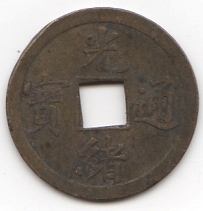 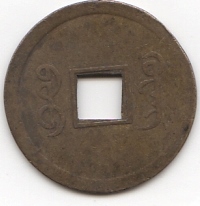 |
|
|
|
Pillar of the Community
United Kingdom
739 Posts |
|
|
Pillar of the Community
United States
602 Posts |
I never actually understood why people minted square holes in coins like that.
|
|
Pillar of the Community
Canada
937 Posts |
From what I understand, it was symbolic -- along the lines of each side of the hole representing East, West, North, South, or the 4 corners of the earth, etc. The round shape of the coin was to represent the universe. Not sure if I've got it right, but it might be in the right direction.
|
|
Pillar of the Community
Canada
2805 Posts |
Did you ever notice how Western ancient coins are thick, lumpy and dumpy?
Meanwhile, 2000-year-old cash coins are perfectly round.
They were cast in shape - then slid onto a square rod, which rotated to lathe them into shape.
It also made it easy to tie hundreds of these very low-value coins together - 1000 of these made a dollar, and 1000 of them weighed over 3 pounds. Imagine counting that out every time you wanted to buy something... you can find neatly tied bundles of exactly 1000 of these from time to time, like on display at the National Currency Museum in Ottawa (now, unfortunately, closed for 3 years - but the new location will be awesome! I got in on the very last day they were open).
|
|
New Member
United States
10 Posts |
Chinese-I have about a dozen or so
|
|
Pillar of the Community
United Kingdom
1324 Posts |
This one is struck though - not cast.
I think Y#190 in Krause, under Kwangtung
|
|
Pillar of the Community
United Kingdom
739 Posts |
Well spotted andyg - still struggling with the pics but it does like look like Kwangtung rather than Yunnan
|
|
Valued Member
United States
347 Posts |
|
|
Moderator
 Australia
17016 Posts |
Quote:
Which side is the obverse? Is it upside down? The top pic is the obverse; the four Chinese characters are read in the order top-bottom-right-left. The first two are the reign-name of the emperor (in this case, the Guangxu emperor) while the last two characters are best translated by the phrase "current coin". On the back is written, in Manchu rather than Chinese script, the mint name (in this case, "Kuang") and the Manchu word for "mint". Your pics are both right-way-up.  Quote:
Yoshirules asked:
I never actually understood why people minted square holes in coins like that.
Then pennysaver said:
From what I understand, it was symbolic -- along the lines of each side of the hole representing East, West, North, South, or the 4 corners of the earth, etc. The round shape of the coin was to represent the universe. Not sure if I've got it right, but it might be in the right direction.
...then nalaberong said:
They were cast in shape - then slid onto a square rod, which rotated to lathe them into shape.Nalaberong's explanation is correct; square holes began to be used purely for pragmatic purposes. The mystical meaning and symbolism supplied by pennysaver were attached later. By the time machine-struck coins were introduced in China in the late 1800s, people were so used to round coins with square holes that they went to the trouble and expense of punching square holes out of the blanks for the struck coins. I have some Song Dynasty cast cash coins with star-shaped holes. They are not hard to find, and have an equally pragmatic explanation: the coin fell off the square rod, so it was shoved back onto the rod again at a different angle. As for the date, this particular design is known to have been struck from 1890 through to 1908. Just over a billion of them were made over that time period, a huge mintage for coins of that era. Don't say "infinitely" when you mean "very"; otherwise, you'll have no word left when you want to talk about something really infinite. - C. S. Lewis
|
|
Valued Member
United States
347 Posts |
|
|
New Member
 United States
9 Posts |
|
| |
Replies: 11 / Views: 1,514 |
|




 Posted 10/26/2013 2:10 pm





