| Author |
 Replies: 14 / Views: 5,019 Replies: 14 / Views: 5,019 |
|
|
Pillar of the Community
United States
3546 Posts |
I have not A clue where to begin on this old piece of round medal. This piece has a diameter of about 1.5" across. The non-uniform thickness varies from 1/16" to 1/8". Because of the corrosion it is difficult to say for sure but I think the obverse lettering states. 'WIVSTINI ANVSFPAV' Please help me identify and date this coin or token? Thanks, mdpmedia 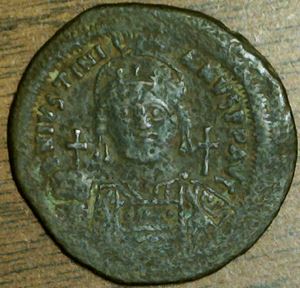 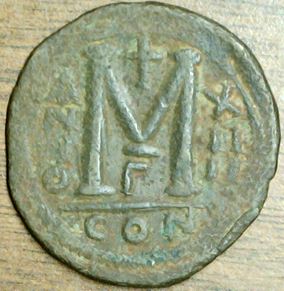 *** Moved by Staff to a more appropriate forum. *** *** Moved by Staff to a more appropriate forum. *** |
|
|
|
Pillar of the Community
United Kingdom
2490 Posts |
Looks to be Byzantine, Emperor Maurice. Not much, but it's a start.
|
|
Moderator
 Australia
16982 Posts |
It is indeed Byzantine, emperor Justinian I, a follis of the type listed in the Sear Byzantine catalogue as number 168. "ANNO XIIII" is the date, the 14th year of the emperor's reign (AD 540-541). The obverse inscription is actually supposed to say "DN IVSTINIANVS PF AVG", though by the time this emperor came to power hardly anyone in the Empire could speak Latin anymore, including the people who made the coins, so the legends tend to get a bit mixed up. Click on this Wildwinds page and scroll down to the entries labelled "SB 163" to see what a couple of similar coins sold for. Don't say "infinitely" when you mean "very"; otherwise, you'll have no word left when you want to talk about something really infinite. - C. S. Lewis
|
|
Moderator
United States
23731 Posts |
Very nice example with clear legend and excellent details.
|
|
Pillar of the Community
United States
5007 Posts |
oh yeah, that's a very nice one.
|
|
Pillar of the Community
United States
3229 Posts |
Very nice!  Most of these are worn to the point that the face shows little detail. |
|
Pillar of the Community
 United States
3546 Posts |
Hello,
I read the past 2002 realized sale prices ($ 200 - $ 400 range) for this coin at the Wildwinds page and wondered if additional value could be realized based upon the fact that the reverse side of this token is actually rotated 45 degrees from center.
In other words this token has Coin Alignment orientation and must be flipped on its horizontal axis to see the big 'M' etc. tilted 45 degrees clockwise.
Because this is my initial venture into the Byzantine coinage I do not yet know if those past mint production facilities attempted to stamp their coins using Coin Alignment orientation with 0 degrees off center.
Please let me know the facts.
If needed I will upload another photo with both sides showing (with the use of a mirror) to demonstrate the 45 degrees off center feature.
mdpmedia
|
|
Pillar of the Community
United States
870 Posts |
Most ancient coinage usually had either a 0 or 180 degree die axis. However, an error like that is not likely to increase the value of the coin.
Nice example by the way.
|
|
Moderator
Australia
16982 Posts |
Dies for ancient and mediaeval coins like this were hand-held. There was no standard die orientation; they were aligned at random.
Don't say "infinitely" when you mean "very"; otherwise, you'll have no word left when you want to talk about something really infinite. - C. S. Lewis
|
|
Pillar of the Community
United States
3546 Posts |
Hello, I would like to present another similar coin currently up for bid on ebay located at the following URL: http://www.ebay.com/itm/35085316850....m1423.l2649My previously-discussed coin's x‘s obverse and reverse sides are shown along side of the ebay coin y below. My questions are: a) Since it appears that coin y's surface has a richer, darker, and possibly treated texture compared to coin x could coin y have some type of reconditioning chemical applied to its surface? a. If this is the case, what chemical(s) are typically used for coins like this to prevent further pitting similar to what is seen on the left part of the chin on coin x? b) Also, one can notice the lighter rust-colored area on coin x to the right of the big ‘M'. If this growth is rust, what should one do to prevent further rust formation and to simultaneously visually mask this chemical complex/compound? a. Does this rust bring the resale value downward? i. If it does, what percentage decrease do you guess would be expected? c) Being that both coin's devices illustrate that a great deal of variation can and does exist between these two coins which were probably minted with the same or similar tools during the same time frame; how can someone like myself distinguish between an authentic and counterfeit coin of this nature when inspecting these types of coins down the road? d) Finally, the ebay owner of coin y wants more than $ 500 for his/her coin while the Wildwinds page SB 163 comments for my coin x indicated that the sales were between $ 200 - $ 400. a. Does coin y appear to be worth double the value of coin x ? b. What specific characteristics overall would cause coin y to be more valuable than coin x? Thanks for answering each question above to further enlighten a Byzantine newbie like myself. mdpmedia 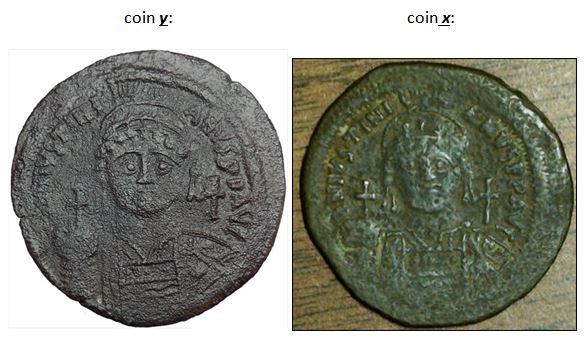 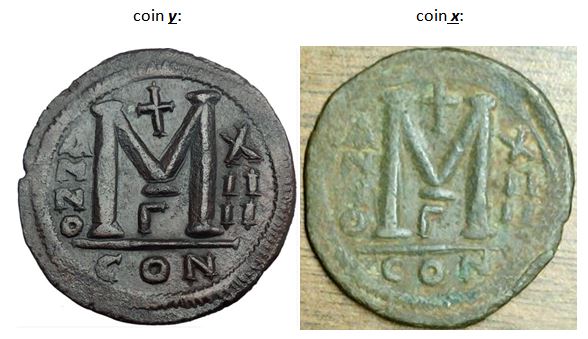 |
|
Moderator
United States
23731 Posts |
The difference in the color of the patina can be caused by several things mostly due to the type of soil where it laid for 1500 years. Also if whoever cleaned coin y used olive oil it tends to darken the color. As to the value of the coins, granted the price has been going up over the last few years but $500 is way too much. I'd value coin x at $90-$125 and coin y at about $100. While coin y may have a better looking patina the coin appears porous. I prefer coin x.
|
|
Moderator
Australia
16982 Posts |
(a) - Yes. All ancient bronze coins require "cleaning" of some kind, since they usually come out of the ground looking like little green rocks. How severe the cleaning needs to be depends to a large extent, as echizento said, on the chemical composition of the soil in which it was buried. "Desert" or "sand" patinas are relatively easy to remove and leave the coin looking quite dark. Any pitting that has happened on your coin occurred centuries ago, while it was still buried. Nothing you do to it now can undo such damage. The green patina on your con can be stripped away with chemicals, but this will likely reveal all of the pitting and corrosion on your coin currently hidden by the patina. Ancients collectors prefer if possible to keep the patina in place for this reason. Coins that have been stripped down to bare metal can be "repatinated" with proprietary formulas such as Dellers Darkener, though doing so without revealing that this has been done is considered deceptive. (b) - it is not "rust", it is patina - chemically, it is a mixture of metal, metallic compounds and soil and dirt still clinging to the surface. It should not expand or get any worse. Ancients collectors like their coins "crusty" like this. You should, however, be warned of the existence of "bronze disease". This is a particularly virulent form of corrosion and is contagious and can spread, especially if the coin is kept in a moist, salty environment. Bronze disease is typically pale greenish-blue in colour and powdery in appearance. If it appears on your coins (and it can appear on modern coppers as well as ancient ones), it will need treating to stabilize it. But until and unless bronze disease develops, leave your nicely patinated coin alone. (c) - it all comes down to experience. When trying to avoid counterfeits, the following general rules of thumb apply. Consider the source. You're much more likely to obtain a fake from a random seller on ebay than you are from a trusted dealer in ancients who's been in the business for fifty years. You're also, ironically, much more likely to obtain fakes from people in (or who have recently visited) Greece, Turkey, Italy and the Middle East - in those countries, selling genuine ancient coins is illegal or tightly controlled, but selling fakes to tourists is perfectly OK. Bulgaria and other former Communist countries are the current hotspots for fake ancient coin production. Use the resources available. The FORVM fake database, for example, is a little unwieldy to use if you're not used to it but is good for detecting previously-known types of fakes. Most fake-makers re-use the same dies and designs over and over, so you can use diagnostics to spot them when they reappear. See the fake Byzantine follis of Justinian in this thread for an excellent example of a fake spotted using FORVM. (d) - No, not to me anyway. Don't say "infinitely" when you mean "very"; otherwise, you'll have no word left when you want to talk about something really infinite. - C. S. Lewis
|
|
Pillar of the Community
United States
549 Posts |
You are comparing one coin X to an ebay coin Y. Be aware that the seller of that ebay coin is well-known to overprice his coins by a factor of ten or more. He then offers a big discount and hopes a sucker will pay far too much, thinking 50-70% off must be a good deal. Wrong! Obviously the ebay coin (coin Y) has suffered a great deal of corrosion on the obverse. The obverse is a mismatch with the nice reverse. That knocks an awful lot off the value. Not many buyers who throw around good money decide to buy coins with that type of severe problem. Coin X is worth more than coin Y, but nowhere near the ebay list price, which is pure fantasy. |
|
Pillar of the Community
United States
3546 Posts |
I thought everyone would like to see the final NGC slabbed product: I like this because with NGC (or PCGS for that matter) one can zoom in on any area with extremely high magnification. Before clicking on the URL first take a stab at the grade NGC assigned to it; hone up on your 'ancient' grading skills especially if you haven't taken any recent CE grading classes lately.  https://www.NGCcoin.com/certlookup/...NGCAncients/ https://www.vocabulary.com/dictionary/hone https://www.NGCcoin.com/certlookup/...NGCAncients/ https://www.vocabulary.com/dictionary/hone |
|
Moderator
United States
34541 Posts |
Great follow-up to an earlier thread @mdpmedia. Thx!
"If you climb a good tree, you get a push."
-----Ghanaian proverb
"The danger we all now face is distinguishing between what is authentic and what is performed."
-----King Adz
|
| |
Replies: 14 / Views: 5,019 |
|










 Posted 11/03/2013 10:40 am


