











 Posted 11/03/2013 9:03 pm


Back then, Hong Kong was a popular tourist destination in its own right (just as it is today, and still for much the same reasons - cheap shopping!) as well as a stopover point for travellers - in an age when there were very few direct international flights, Hong Kong was a major intercontinental transit point. So even if your grandfather never went there directly, he may have visited there on the way to somewhere else - or perhaps, if it was found in an envelope by itself, he was given the coin by a friend who had travelled there.
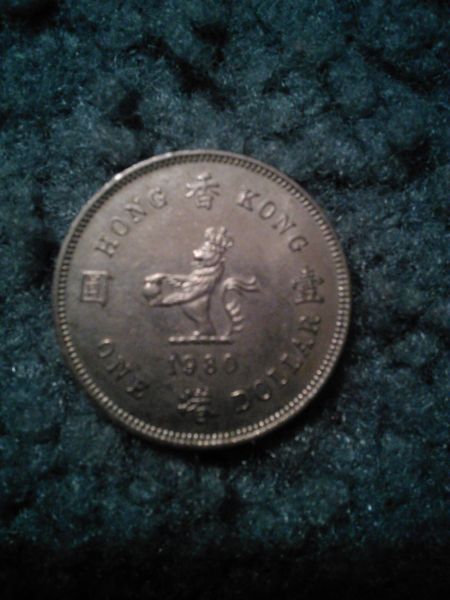
The four Chinese characters say exactly the same thing that the English words on this side say: "Hong Kong" at top and bottom, "One Dollar" at right and left.
The symbol in the centre is derived from the crest of the coat of arms of colonial Hong Kong. The lion (symbolising Britain) is holding a pearl (symbolising Hong Kong, the "Pearl of the Orient").
Coins such as this one, with the Queen's portrait on them, are still legal tender in Hong Kong, although rarely seen - the banks are actively withdrawing them and replacing them with new Chinese SAR coins.
The four Chinese characters say exactly the same thing that the English words on this side say: "Hong Kong" at top and bottom, "One Dollar" at right and left.
The symbol in the centre is derived from the crest of the coat of arms of colonial Hong Kong. The lion (symbolising Britain) is holding a pearl (symbolising Hong Kong, the "Pearl of the Orient").
Coins such as this one, with the Queen's portrait on them, are still legal tender in Hong Kong, although rarely seen - the banks are actively withdrawing them and replacing them with new Chinese SAR coins.
Don't say "infinitely" when you mean "very"; otherwise, you'll have no word left when you want to talk about something really infinite. - C. S. Lewis


