| Author |
 Replies: 30 / Views: 6,489 Replies: 30 / Views: 6,489 |
|
Pillar of the Community
Australia
3841 Posts |
I have been hunting for this coin for a while and it turns out to be a lot more difficult than you can imagine. This is the coin for discussion: 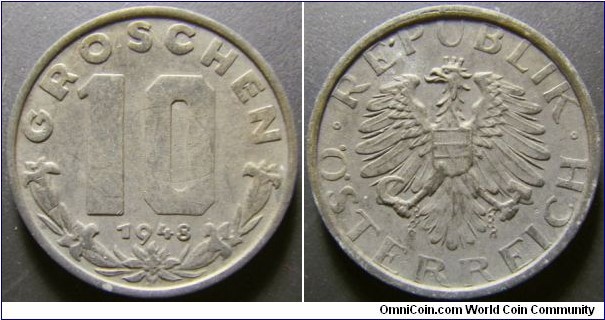 Overstruck over this particular coin: 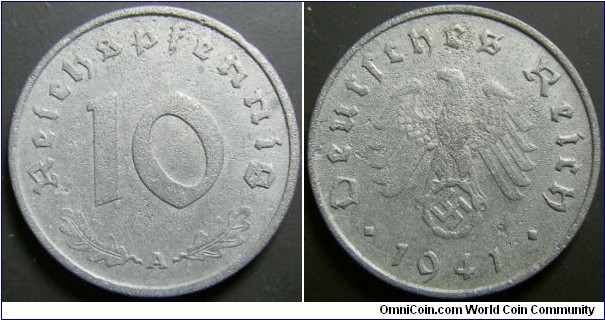 I'll be honest - this has obliterated most of the details from the original host coin and I cannot tell what the year and mintmark is. However, if you rotate the coin about 20 degrees clockwise, you should be able to see the figure "10". This design is only present in the German / Nazi era coinage. As of why this happened, I'm not too sure but I suspect this occured after the time when Austria was under German "unification". Austria would have been minting coins under the Reich regime and when this was over, some left over planchets and coins were used to strike new coins. Very interesting coinage and I reckon it's difficult to assemble a nice clear set of overstrike. While this is not a clear overstrike and I hope to get a better example, there is a better image found here: http://www.moneymuseum.com/moneymus...ods/coin.jsp jsessionid=0A9070A6B4AAA83FBCF3753C4AC6CD07?i=8&aid=8&gid=16&cid=47&pi=0&ps=10 |
|
|
|
Pillar of the Community
United States
1674 Posts |
Makes perfect sense why they would recycle the then-obsolete coins. Economy was in ruins and all spare metal used up in the war effort and any remaining needed for reconstruction.
|
|
Pillar of the Community
United Kingdom
2139 Posts |
Unfortunately I can't see any under details.
|
|
Valued Member
Belgium
83 Posts |
|
|
Valued Member
Canada
414 Posts |
Cool, I like coins that have a story or meaning behind them. My type of coin!
|
|
Pillar of the Community
United Kingdom
2139 Posts |
Thanks, Jupke. For those whose German isn't up to the mark, http://www.moneymuseum.com/moneymus...7&pi=0&ps=10 is in English. Very interesting, I will look at my post-war Austrian again and keep an eye out in future. Are coins where the underlying coin is visible much rarer than those where it's not ? |
|
Pillar of the Community
 Australia
3841 Posts |
Pertinax, I have rotated it to the right alignment. You should be able to see the figure "10" if you look carefully. It is definitely more valuable if you can find coins with better details of the underlayer.  I found it hard to find a better example for now. But again, you might have one hiding around - would be best to give it a search first. I like collecting overstrike coins hence I have a sharp eye for it when it comes to challenging overstruck 'low details' underlayer host coin. Here's a list of Russian overstrike coins if you are interested: http://gxseries.com/numis/rus_imper...erstruck.htmThere are a fair number of world coins that are overstruck as well, such as Swiss, Sweden, France, Italy, China, Brazil and so forth. Will have to work on a page on that as well... My partial coin collection http://www.omnicoin.com/collection/gxseriesMy numismatics articles and collection: http://www.gxseries.com/numis/numis_index.htmRegularly updated at least once a month. |
|
Moderator
 Australia
16985 Posts |
Finding late 20th century overstrikes is not common; it's usually considered more efficient these days to melt and recycle scrap coins rather than use them directly as blanks for new coins. The website linked to above with the other example says that "large numbers" of overstrikes were made. How large is "large"? Is there any documentation from the era to indicate that this was a deliberate act of the Vienna mint and/or policy of the Austrian government, or was it simply an accident or quick'n'cheap shortcut taken by mint workers, with some bags of old Nazi coins simply getting tossed into the hopper along with the blanks? The example used to illustrate this type in the Krause catalogues is dated 1949 and is also an overstrike; you can clearly see much of the Nazi eagle beneath the Austrian "10" on the NGC page. But there's no mention there of the overstriking. Don't say "infinitely" when you mean "very"; otherwise, you'll have no word left when you want to talk about something really infinite. - C. S. Lewis
|
|
Pillar of the Community
United States
3253 Posts |
That's a great example, Sap! Not only is the overstrike obvious, the swastika is clearly visible. Oops!
|
|
Pillar of the Community
United Kingdom
2139 Posts |
gxseries,
Thanks for pointing it out.
I now find I have one too, on a 10 groschen of 1948 the 10 over a very faint 10 and on the obv, the merest trace of some other letters under the Austrian legend.
None of the other 3 coins I have of this series shows any under-coin.
|
|
Pillar of the Community
Canada
2805 Posts |
I haven't found anything on my pair of 10 groschen coins.
What's interesting is that, while the 10 groschen coin was replaced with an aluminum version in the early 50s, the zinc 5 groschen coin maintained the same composition until the introduction of the Euro.
So how long did it take before they ran out of 5-reichpfennig planchets?
And how did they phrase the order to the zinc refiner? "We'd like 5,000,000 more. Yes... just like the Nazi ones. No, we're not Nazis, ha ha. OK, thanks. Gotta go!"
|
|
Pillar of the Community
United Kingdom
2139 Posts |
I wonder whether they used the 5 reichspfennig coins as blanks for very long.
I wonder how they could call them in and in any case, it would probably be cheaper to produce 5 groschen blanks once the economy was up and running.
|
|
Pillar of the Community
Australia
3841 Posts |
I don't think this was the case nalaberong. When Austria was occupied under Germany, Austria was minting coins for Nazi Germany under the mintmark B. I would presume that Austrian mint would have the equipment to make fresh planchets and it was probably cheaper to produce zinc coins rather than aluminum coins. Here's more details of various coins struck during this era. http://en.wikipedia.org/wiki/Catego...World_War_IIInterestingly, I found this article and thought it is interesting. http://trove.nla.gov.au/ndp/del/article/26491150 Nazi coins were still circulating till the end of 15th Feburary 1949. The way I see it is, there could have been plenty of Nazi and overstruck coins when it was first released. However the public was to return anything that had the swastika to not remind them of the war. Whatever coins with the clear underhost either were not noticed or was overstruck to the extent that almost the none of the details remained. The quest still continues for me to hunt better details of such coins as well as an entire set where possible. My partial coin collection http://www.omnicoin.com/collection/gxseriesMy numismatics articles and collection: http://www.gxseries.com/numis/numis_index.htmRegularly updated at least once a month. |
|
Pillar of the Community
United States
1674 Posts |
I'm down with the hunt =) we know they are out there
|
|
Pillar of the Community
Germany
1238 Posts |
Quote:
Interestingly, I found this article and thought it is interesting. Interesting, but that does not make it right. ;) The question of whether the "Anschluss" was an "occupation" ... well, I think it was an annexation based on a referendum in Austria which was about as democratic and free as the pre-1938 Austrofascist regime. :) The point is that, as from '38, the mint in Vienna made coins for the Reich just like the other mints. After WW2 Austria had its own currency reforms, one in Nov-1945 (1 Reichsmark = 1 Schilling), one in Nov-1947 (3 old schillings) but the three lowest denominations (1, 5, 10 Rpf) were not affected by that devaluation. And now I will get to my point. ;) The 1 Reichspfennig zinc coins (Nazi Germany, Allied Control) continued to be legal tender in Austria until the end of February 2002. Not the other denominations, just that one - so I suppose it had simply been forgotten ... Christian |
|
Pillar of the Community
2087 Posts |
Quote:
Interesting, but that does not make it right. ;) The question of whether the "Anschluss" was an "occupation" ... well, I think it was an annexation based on a referendum in Austria which was about as democratic and free as the pre-1938 Austrofascist regime From the Austrian fascist governments point of view it was an annexation. The Austrian Chancellor at the time found out about his "retirement" through the German sponsored media. a great but depressing read from his point of view is his book "Austria Requiem" |
| |
Replies: 30 / Views: 6,489 |







 Posted 11/05/2013 09:50 am





