| Author |
 Replies: 10 / Views: 1,719 Replies: 10 / Views: 1,719 |
|
|
Valued Member
United States
388 Posts |
So, what magnification do you use to verify coins. I use a macro lens with 90X mag. Is it even worth it to look for errors that can only be seen by a microscope. I think it kinda defeats the purpose of "eye-appeal". IMO anyway. What do you all think?  |
|
|
|
Bedrock of the Community
United States
62064 Posts |
10X is the range most collectors will buy a doubled die or RPM. Anything over this is over kill. But I use a zoom microscope that I can go to 35X. This helps to get the shot you want. Also if you are having a hard time getting an image to show what you see in your scope and it doesn't show in the image: it is too minor to worry about. I found a log of proof DDR's with the die notch in the ONE CENT that I can't get images of. They are too minor and probably too minor to list. I still save them. Maybe someday they will. When they get that minor the problems is that there maybe many different dies that have that minor DD. It is too hard to determine if they are from the same die. 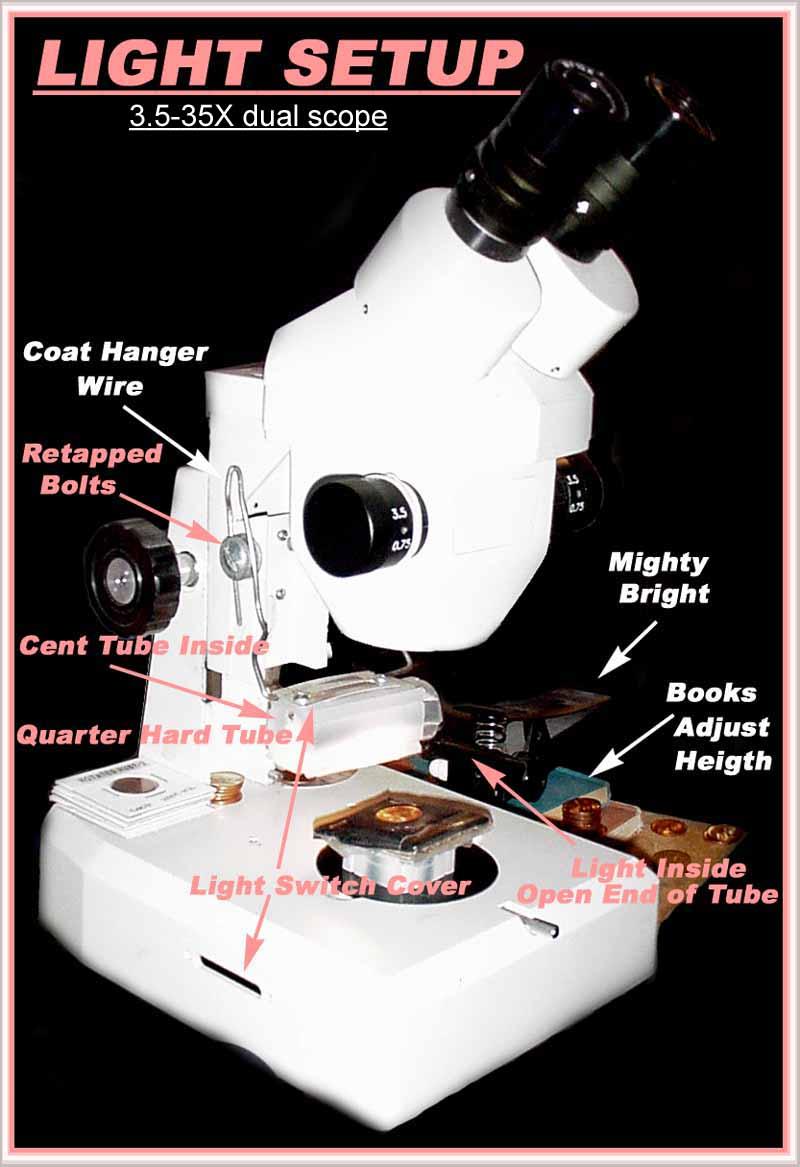 |
|
Moderator
 United States
56855 Posts |
I roll search cents for errors/varieties and use a 14x doublet jewelers loupe. If I need a bit more I use a usb microscope 10x-40x- 150x. John1  |
|
Valued Member
United States
207 Posts |
I agree with the above. If you have difficulty distinguishing it at about 15X then it's really not worth it that much to collectors.
I use a 16X wide-angle Erfle eyepiece for basic searching. If I spot something peculiar then I switch to a 28X eyepiece for further study, but at this magnification these will usually end up in my TTOM ("too tiny to mention") bin.
So yeah, 90X is way overkill, imo.
Edited by coinaki
11/05/2013 8:26 pm
|
|
Bedrock of the Community
United States
62064 Posts |
Also if you have a zoom on your camera, don't use it for shooting though an eyepiece. It just does not work. If you have the option on your camera to take the max size of images, you get better quality when you reduce them. If you have small images and enlarge them, you won't be happy with that either. I'm still using Sony Mavica cameras. I got three today on auction because they are dirt cheap right now. I seen them list them as not working. Not a problem. They just don't go through the procedure to set them up. Without that the camera will not work. So now I have 5 back ups. The key is know which model works great. The only problem is working with a 3.5 floppy, but not a biggie to me. When you get the results that you want to just deal with it. I have yet to wear one of them out. My first camera I took over 30,000 with it and it worked even after I got rid of it.
|
|
Pillar of the Community
United States
5825 Posts |
TPG graders don't even use a loupe half the time. If they want one it's most often 3x, maybe as high as 5x. 10x is about the limit for seeing the diagnostics for die varieties. More than that you're looking for "flyspeck" variations which rarely adds to a coin's value. The higher magnifications are also used for images of diagnostics in publications.
|
|
Pillar of the Community
872 Posts |
I have an AmScope Trinocular STEREO microscope with 20x 30x 40x and 80x magnification. I think the 20x and 40x are sufficient. The AmScope microscope 5 megapixel camera is a great addon, when used with the upgraded software. I am going to get a 2nd AmScope microscope, with lower magnification. It will still be a stereo microscope, but at 5x, 10x, 15x and 30x. That way the son and I have two scopes, covering about any range required. The camera can be swapped over to the other scope if its needed to take full pics of the obverse and reverse with the 5x magnification in place. Two scopes means the son and I can process coins a lot faster. The monocular version of the AmScope 5x, 10x, 15x and 30x I think is $145.00, which is a steal, in my opinion. I've given up on Loupes and magnifying glasses long ago. With the microscope, it easier on the eyes. You see the details needed to make an accurate call of what the issue is at hand. You can provide crisp clear pictures that are editable if you get the optional camera. Its probably one, if not the best investment we have made in years when it comes to equipment for use in the coin collecting and searching phase. My lighting consists of two Walmart 30 watt LED medium sized desktop lamps that are the gooseneck type. I have one on the left hand side, and one on the right. It allows plenty of lighting without shadowing the coin. 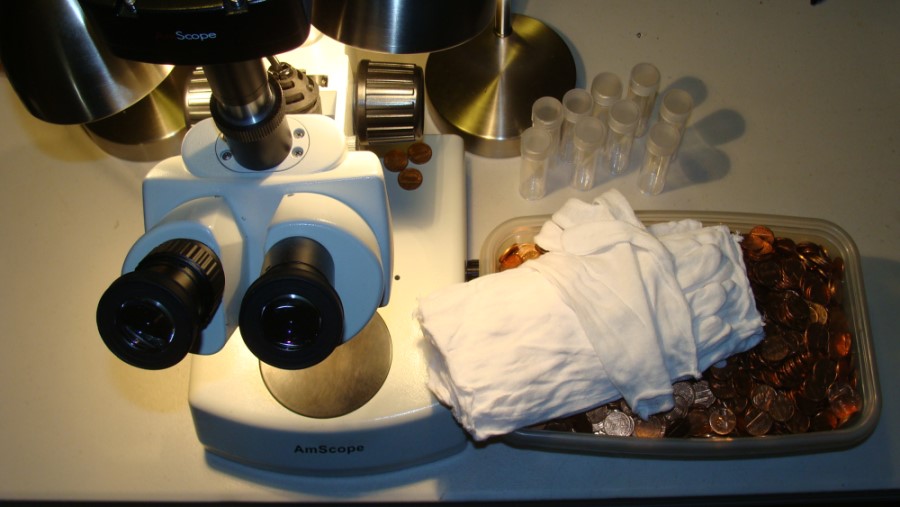 Edited by Collector-Corner
11/06/2013 01:31 am
|
|
Moderator
United States
56855 Posts |
A single light source is best,coop can tell you more on that. John1 |
|
Pillar of the Community
872 Posts |
The good thing about this is, I have a choice, and what works best for me is dual lighting. Pictures for others is one thing. The lighting is for identifying the potential varieties and errors when looking under the scope. We use what woks for us. Its comfortable on the eyes, there is no strain what so ever. That is ideal, and thats what we use.
There is alot more involved in the setup process than most people know. I have a wide view stereo microscope. With that wide view, when I go to higher magnifications, the lighting is significantly reduced. I prefer the setup I have to eliminate any shadowing what so ever. As a matter of fact, my son and I have been toying around alittle and we found the nearly perfect positioning for this type of lighting. I'll more than likely use that setup for all future closeups, especially for pics posted on the store, auction house and blog.
They are at the same wattage, its not overly sophisticated and the pictures come out absolutely fine for what I need.
I'll attempt to snap a single pic using the new lighting location and you can tell me what you think. No promises on posting it here, but these pics may be posted on this website in the near future.
Edited by Collector-Corner
11/06/2013 10:34 am
|
|
Pillar of the Community
United States
8534 Posts |
CC...you could try diffusing your light sources so your pics come out better.
Oregon coin geek.....*** GO BEAVS ! ! ! ***
|
|
Pillar of the Community
872 Posts |
Your assuming that the coins will require the same amount of intensity when you diffuse lighting. then you have to either adjust the the lamps to another position. So if your shooting a shiny Red Lincoln, and then your next coin is a deep brown lincoln, the amount of light required will change.
The amount of required light is variable function determined by the amount of light the source requires. The pictures I post on this forum are NOT the same ones I will use on the websites. The ones in my posts are mainly quick and dirty. The posts and pictures dissolve over time and there is no capital involved, so I am not going to go out of my way to shoot elite pics. They are difinitive enough, and that is good enough = )
Edited by Collector-Corner
11/06/2013 2:19 pm
|
| |
Replies: 10 / Views: 1,719 |
|







 Posted 11/05/2013 6:05 pm





