Quote:
can we just examine the edge patterns - "circles are actually circles, squares are actually squares" to determine it is a coin of original or a contemporary counterfeit. Is that really reliable?
The simple answer is NO. Not if that is all you do. I have never advocated that position. But the edge is a critical factor that coupled with other data - points to a conclusion. Sometimes edge clues are absolutely definitive - ONE OVERLAP is a case where that's all you need. Or a row of SQUARES that are identical is also a good clue to forgery. But a few out of round circles with a variation in spacing on a coin with laminating errors and odd surface cracks and lumps certainly would draw my attention and concern.

The opposite end of the spectrum is the "any edge is OK" approach relying on very randomly applied edges being fine because they might have been made that way. But is there any proof yet that such coins test as genuine using all tests available?
Not as far as I am concerned.
I see the edge as conceptually an anti-fraud device. It added significant labor costs to production. Clipping and grinding were the easy obvious targets for elimination - but a standard edge design also made forgery harder. It was another thing they had to get right. Remember each branch mint used a different edge so a forger needed to not only get the two faces right but also that darned edge NO ONE LOOKS AT.
Today - how many security devices are added to a $100 bill? Does the government always explain exactly how they are applied? What process they use? Do they do it randomly for the Heck of it?
Then think of the 8R as the $100 bill of 1776.
If your goal is to
AVOID AT ALL COSTS counterfeits (or restrikes) you will approach the edge discussion one way. But if you are OK with potentially buying silver counterfeits you will think very differently.
As I have said, right now the average dealer basically does not care which type he is selling as long as the coin is silver and he makes a profit. Because he does not care his prices for a genuine and restrike coin will be the SAME.

So given your choice between two otherwise identical coins, which do you pick? The one with a variable edge? Or one with a near perfect edge?
Let the Buyer Beware and be WARY. Cherry-picking is the name of the game.

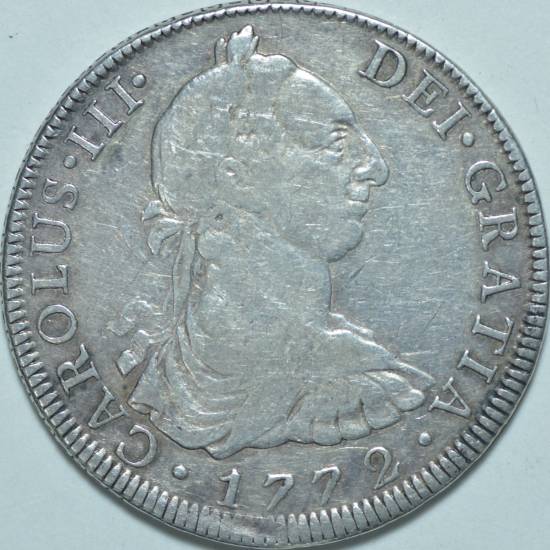
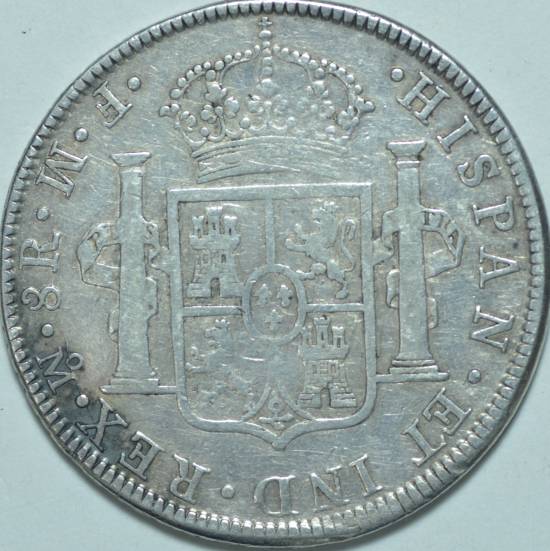
That said the edge on the 1772 Mo FM of Charles III posted last does look pretty good to me. Nice repeated pattern - same size - same wall thicknesses - same spacing - rather boring to look at. That is GREAT. Originals are BORING. SG is a bit low but I will go with that since 10.23 is usually within a possible range of variation for a 1/100th scale result. If that SG was tested on an analytical 1/1000th scale I would be somewhat concerned.
This coin would get a 0/20 rating on my scale of clues.
I would buy it as real if I wanted a real one provided the price was fair.

Regarding the shapes of the O - one side can be compressed very slightly by coming too close to the edge of the coin or of course by crossing the actual plane of the edge which happens on Henry's 1772 coin. The pressure of the strike - especially on well struck up examples (like this one) can compress and distort VERY SLIGHTLY features in close proximity to the faces of the coin. Similar in nature to the effect a post strike edging can have on dentils (though not as pronounced however). It is a stress distribution issue.
But I do not believe compression of the sides of the circle that are PERPENDICULAR to the faces of the coin will happen on genuine coins except at overlaps. Between laps that only happens when the O is punched in a different application than the adjacent rectangle. That has no leeway at all in a Genuine Mexico City struck coin. It did not happen.
The only other reason for a change in the shape or size of the segments is post strike damage and that must always be taken into account.
For anyone interested in seeing a good edge, the best way is by looking at a few dozen
genuine MS examples that have not yet been imprisoned in those crazy plastic tombs. They may not all actually be genuine but after viewing a few dozen in person the difference will start to appear. It is not magic
it is familiarity.
That was a lot more possible 30-40 years ago than it is today. Back then I couldn't afford $50 for an MS Charles III but I could actually handle them. Ten bucks for an EF-AU was manageable. Most of my exposure to genuine Portrait 8Rs came when I worked in Boston and was training as an authenticator between 1972 and 1978. The shop where I was sold MANY very high end MS examples over that period - thousands in fact. I became as familiar with an 8R edge as any bank teller gets by handling cash.
That same exposure is hard to come-by today. But it is like riding a bike as long as you try until you get it. Once you get it you WILL REMEMBER.








 First Page


 Posted 12/10/2013 08:35 am