Coin Community Family of Web Sites Join Thousands of Coin, Bullion, & Money Collectors
Specializing in Modern Numismatics Royal Canadian Mint products, Canadian, Polish, American, and world coins and banknotes. Join Thousands of Coin, Bullion, & Money Collectors 300,000 items to help build your collection! Coin, Banknote and Medal Collectors's Online Mall Shop for APMEX Bullion on eBay!Vancouvers #1 Coin and Paper Money Dealer


Username:
Password:
Save Password
Forgot your Password?


This page may contain links that result in small commissions to keep this free site up and running.

Welcome Guest! Registering and/or logging in will remove the anchor (bottom) ads. It's Free!

Coin 'Topography'

To participate in the forum you must log in or register.
Author Previous TopicReplies: 7 / Views: 2,135Next Topic  
Pillar of the Community
rking007's Avatar
United States
784 Posts
 Posted 12/06/2013  8:50 pm Show Profile   Bookmark this topic Add rking007 to your friends list Get a Link to this Message Number of Subscribers
A long time ago when I was in my 'not so serious about coins' phase I read an article about Morgan dollars. In it, the author had provided a color coded wear area on an uncirculated Morgan. The areas that typically wear first were in red and then yellow and so forth so you could learn about the high spots and what will, well, wear first...

My question is, has anyone done something like this for all US coin types and if so where do I find it. And if not, why not and when do we make the first database of CCF coin topography!? :)
Moderator
Learn More...
vermontensium's Avatar
United States
16679 Posts
 Posted 12/06/2013  9:01 pm  Show Profile   Check vermontensium's eBay Listings Check vermontensium's eCrater Listings Bookmark this reply Add vermontensium to your friends list Get a Link to this Reply
Interesting topic. I would have to say a mid-level graded coin (F-VF) would show the high point wear pattern the best.
Every coin is different in the way they wear. Also has to do with the handling obviously.

The only database that comes to mind would be the PCGS photograde database but it doesn't colorize the high and low points.
swcoin.ecrater.com
Moderator
Learn More...
SsuperDdave's Avatar
United States
23522 Posts
 Posted 12/06/2013  10:11 pm  Show Profile   Bookmark this reply Add SsuperDdave to your friends list Get a Link to this Reply
You're talking about How to Grade US Coins published by James Halperin in 1985, whether you're aware of it or not. Go buy it so you can see the same colors applied to every US issue.

Just so you know, it's the publication upon which PCGS and NGC helped form their grading standards, and after becoming bored with establishing modern grading standards Mr. Halperin went out and founded Heritage Auctions with Steve Ivy. That was after liquidating the investors' fund for rare coins he established, which returned 460% to investors in a 4-year period. Oh, and while he was at it he wrote two rather important science fiction books, one of which is currently in development by Morgan Freeman's company as a movie.

And coins are barely the beginning of what he collects:

http://www.jhalpe.com/

A true Renaissance Man.
Pillar of the Community
rking007's Avatar
United States
784 Posts
 Posted 12/06/2013  10:15 pm  Show Profile   Bookmark this reply Add rking007 to your friends list Get a Link to this Reply
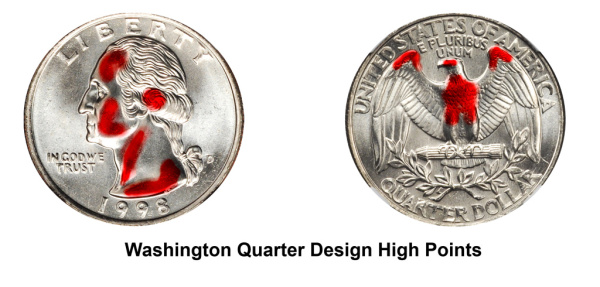
Well, I kinda found something like what I'm talking about. I did a Google Image search for 'coin high points' and it looks like about.com has quite a few US coins and their high points marked in red. Here is an Washington quarter...

Coin-'Topography'

As a newer collector, this is worth it's weight in gold when tackling learning how to grade a new series. I'm good a Lincoln Wheats but toss a Buffalo nickle at me and I'm a moron. How cool would it be to have some kind of data base on the site (maybe under each coin type in the US coins Fasts Page) that showed something like this?

Going further, how cool would it be to have a grading app like PCGS photo grade that utilized a layover type function for each grade that you could toggle on and off? Talk about learning how to grade coins!

Maybe it's just me but I don't like scrolling back and forth and just trying to visually compare the difference between a VF20 and VF25 to see if I can see what they are trying to tell me in Photograde. I'm also definitely not saying it should just be all about wear but man, it would be a cool help.
Pillar of the Community
rking007's Avatar
United States
784 Posts
 Posted 12/06/2013  10:18 pm  Show Profile   Bookmark this reply Add rking007 to your friends list Get a Link to this Reply
Haha well there you go, Dave, I didn't see your post before posting my last. Thanks for knowing what I was talking about!
Moderator
Learn More...
vermontensium's Avatar
United States
16679 Posts
 Posted 12/06/2013  10:23 pm  Show Profile   Check vermontensium's eBay Listings Check vermontensium's eCrater Listings Bookmark this reply Add vermontensium to your friends list Get a Link to this Reply
Keep in mind also grading is a subjective practice.
What PCGS calls an XF, I may call a VF.
It does give you a general guide on what to look for.
swcoin.ecrater.com
Moderator
Learn More...
SsuperDdave's Avatar
United States
23522 Posts
 Posted 12/06/2013  11:55 pm  Show Profile   Bookmark this reply Add SsuperDdave to your friends list Get a Link to this Reply
This isn't automatic, rking007. Grading is an expertise, a teachable talent but all the same a learned one. Wear patterns are but a small slice of the picture because with every coin issue, ever, one must always factor die wear, strike pressure, planchet quality and the phase of the moon (perhaps not the latter) into a judgment of the qualities of a given coin.

Knowing what wears first on a Morgan dollar is not so much help but obfuscation if the Morgan you hold was minted in New Orleans. The obverse of the Seated coin you hold will likely be called a liar, grade-wise, by the reverse. The left corn stalk of a Liberty nickel has undergone circulation wear before the planchet ever reached the press. Every Lincoln Cent has only circulated as much as the degree of die wear tells upon the coin released into the public hand.

These are all different. Each series is different; heck, little continuity exists between individual mintages of each series. No general rule applies to grading except one:

Learn the coin.

Numismatics is about that differentiation, because no two guys/gals at the Mint press were the same. No two designs, no two processes, no two days were the same. It's our job to figure those differences; to learn the subtleties of the issues we like, knowing that very little of what we learn here matters at all there.

The fact that James Halperin collected all of this into one book should not discount the fact that he essentially had to learn eleventeen different languages, numismatically-speaking, to do it. What he realized was that one can look at a coin, imagine the die, picture it in his mind's eye, and conclude where that coin will wear first. All that matters afterward is to test the theory by looking at thousands of coins to determine if you're correct.

Which is the point. You can read every book, and none of them will offer the least of help until you've looked at coins. Nothing on the Internet, nothing printed on treeware, is ever going to be more than a minor nudge in the right direction.

You have to look at coins.
Bedrock of the Community
Conder101's Avatar
United States
17884 Posts
 Posted 12/07/2013  09:27 am  Show Profile   Bookmark this reply Add Conder101 to your friends list Get a Link to this Reply
There has been another book with similar type color indicators. I think it was the grading book published by Coin World "Making the Grade"

Did some checking and yes that was it,and it's color "maps" are based on Halperin's.

Halperin's color maps were also used in "The NCI Grading Guide" (But then Halperin was one of the principals of NCI and it was most likely affiliated with Heritage in some way. In the same building, with the same address. But Heritage claims there was no connection.)
  Previous TopicReplies: 7 / Views: 2,135Next Topic  

To participate in the forum you must log in or register.


Disclaimer: While a tremendous amount of effort goes into ensuring the accuracy of the information contained in this site, Coin Community assumes no liability for errors. Copyright 2005 - 2026 Coin Community Family- all rights reserved worldwide. Use of any images or content on this website without prior written permission of Coin Community or the original lender is strictly prohibited.
Contact Us  |  Advertise Here  |  Privacy Policy / Terms of Use

Coin Community Forum © 2005 - 2026 Coin Community Forums
It took 0.32 seconds to rattle this change. Forums