| Author |
 Replies: 13 / Views: 3,215 Replies: 13 / Views: 3,215 |
|
|
New Member
United States
8 Posts |
A friend brought me a 1921 Peace dollar with what appears to be a die break on the obverse and reverse. The obverse break covers half of the left side and is curved, the reverse has 2 that cross the entire chest area and form an X. Both areas are raised similar to the rays. Any ideas?  Can't take pictures no longer have coin. Edited by lmsc86
12/26/2013 6:05 pm
|
|
|
|
Pillar of the Community
United Kingdom
2139 Posts |
|
|
Pillar of the Community
United States
2624 Posts |
|
|
Pillar of the Community
United States
3184 Posts |
|
|
New Member
 United States
8 Posts |
Sorry I can't take pictures the Owner picked-up the coin.
|
|
Bedrock of the Community
United States
62064 Posts |
Sounds like die cracks if they were raised. Damage if they are incuse.
|
|
New Member
United States
8 Posts |
Is it worth sending to a TPG, is it worth a premium, which TPG is the best for this ? |
|
New Member
United States
8 Posts |
|
|
Valued Member
United States
142 Posts |
There is a lot to consider before sending something to any of the TPGs. Without a photo to access the condition and to see these supposed die cracks it's impossible to say. If the coin is damaged, you're wasting money sending it to anyone. If the condition is typical, and there are die cracks, it depends on the magnitude of the die cracks and the year of the coin to try and guess if the coin would be coveted by an error collector or ignored.
|
|
Moderator
 United States
23522 Posts |
I've moved this to appear before a more qualified audience. As described, the obverse feature seems possible; Peace dollars are noted for die cracks of that shape and orientation, although I can't think of a 1921 with it off the top of my head. That's not a definitive opinion, though. The reverse "feature" is almost certainly postmint damage. 1921 is a very well-researched mintage, such a break would not happen on a single coin if it's as-struck by the Mint, and no such feature is known for 1921's. Or any other Peace dollar, for that matter. |
|
New Member
United States
8 Posts |
SsuperDdave:
The lines on the reverse are definitely raised and I don't see how they could be caused by post mint damage. Using a digital microscope you can see how the lines appear to wrap around the eagle breast. Several members in our coin club have looked at this coin and all agree that it is mint damage. If this is in fact one of a kind would there be additional value? I'm at a loss.
|
|
Bedrock of the Community
United States
17884 Posts |
It is possible to create raised lines through post mint damage. Take a look at this dime. The marks are all raised but were created by undercutting the metal to create raised lines then applying some pressure to push the edge down and hide the cuts. 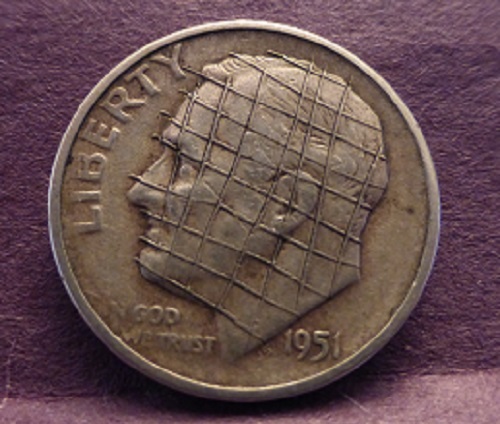 |
|
Valued Member
United States
217 Posts |
Holy cow! That is a pretty crazy coin Conder. Always makes me wonder why someone took enough time to do something like that XD
|
|
Moderator
United States
23522 Posts |
Quote:
Several members in our coin club have looked at this coin and all agree that it is mint damage. If this is in fact one of a kind would there be additional value? I'm at a loss. It would probably have considerable value if it's as-struck, since I'm quite sure after looking around that die cracks of this type are pretty much unknown on 1921 Peace dollars. The striking process for these was an enormous problem. With such a high relief at the center of the coin, fully striking it led to dies breaking. They cracked radially (on a line from the center outward) under the stress of full strikes. That's why you so rarely see a fully-struck 1921 - they were quite capable of it, but with this design it was only at great cost to die survival. And the lesser pressure of lower relief - poorer strikes - kept the dies from cracking in the normal fashion. Images are imperative for any further speculation. Without them, we're just tilting at windmills. |
| |
Replies: 13 / Views: 3,215 |
|







 Posted 12/26/2013 6:06 pm





