| Author |
 Replies: 12 / Views: 1,779 Replies: 12 / Views: 1,779 |
|
|
Rest in Peace
United States
637 Posts |
I picked up the 1988P MAD 5C clasher last night, but I could not find any information on the coin aside from confirmation photos. Does anyone have any additional information such as condition census, rarity, and perhaps approximate value? I will attempt to load a couple pictures. 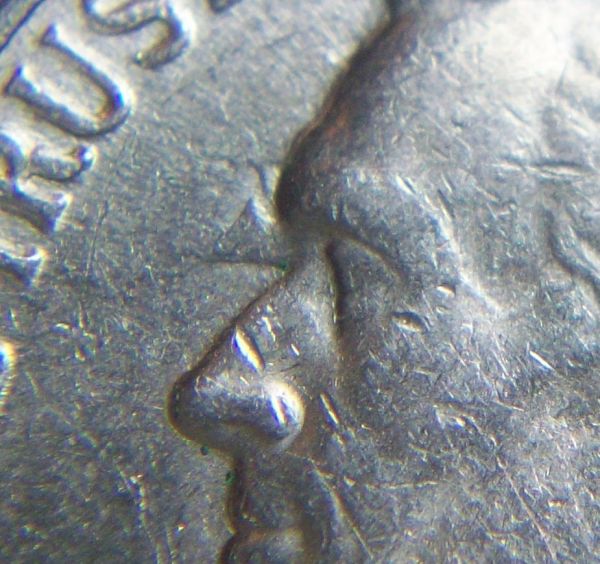 |
|
|
|
Moderator
 United States
56855 Posts |
Are you sure it's a MAD. All I see is a clash mark. John1  |
|
Rest in Peace
 United States
637 Posts |
|
|
Rest in Peace
United States
637 Posts |
It matches the 1988P 5c on the MAD clashed dies site.
|
|
Pillar of the Community
United States
8534 Posts |
Oregon coin geek.....*** GO BEAVS ! ! ! ***
Edited by 52Raymo
01/04/2014 1:44 pm
|
|
Rest in Peace
United States
637 Posts |
Thank you! Is there any additional information on these MAD coins other than what is on the MAD site? I don't know if this is a very common variety, or somewhat rare or elusive... maybe somewhere in the middle. Definitely about time I found one of these after looking for almost a year.
|
|
Pillar of the Community
United States
8534 Posts |
I never could find anything.
Oregon coin geek.....*** GO BEAVS ! ! ! ***
|
|
Rest in Peace
United States
637 Posts |
Thanks again! I posted on another forum, but haven't learned much else yet either.
|
|
Pillar of the Community
United States
2624 Posts |
twodsonegf: A little help with terminology. MAD means MisAligned Die. A clash happens when the dies come together whithout a planchet in the chamber. The dies strike each other transferring part of the design to the other die. A mad clash is a clash that happens when the dies ara misaligned. The transferred element is not where a normal clash would be.
|
|
Moderator
United States
56855 Posts |
MAD= Misaligned Die MDC= Misaligned Die Clash John1 |
|
Pillar of the Community
United States
853 Posts |
Yeah, that's a typical or atypical clash. Cool find though.
|
|
Valued Member
United States
142 Posts |
A MAD clash is really a radically misaligned die clash and has to have an enormous degree of horizontal misalignment and some degree of tilt. Our prevailing notion is that the clashes occur from the hammer die being dropped or slammed into the anvil die during installation leaving marks on one or both dies. What you are showing is a nice conventional die clash on a Jefferson nickel. Are there additional marks present behind the head in the field (we often see the O from MONTICELLO or the bottom of the building) or on the reverse in corresponding areas. |
|
Pillar of the Community
United States
2624 Posts |
Jason; thanks for the clarification on MAD clashes.
|
| |
Replies: 12 / Views: 1,779 |
|





 Posted 01/04/2014 1:31 pm





