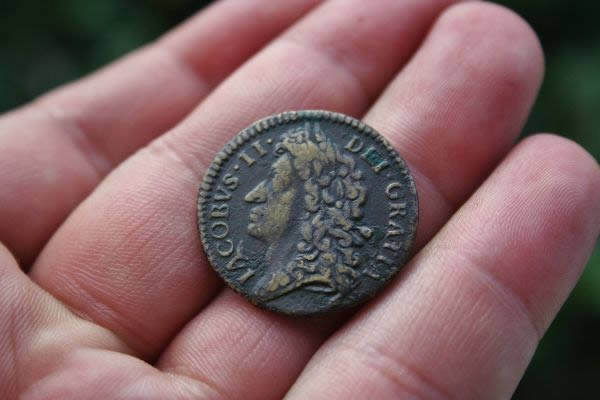
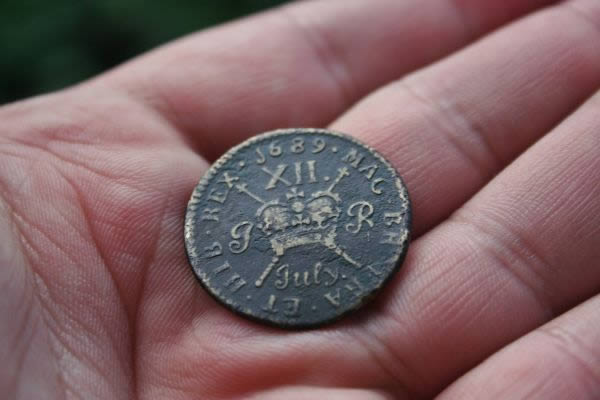
Picked this up today at the 59th Annual Florida United Numismatists Coin Show in Orlando. Its a little worn, but its still a nice example.
These coins were struck in Ireland and used to pay the common soldiers of James II's army, who were helping him to regain the English throne from William and Mary (Williamite War in Ireland 1689-1691). Most historians believe that the foreign officers - mostly French, Spanish and Portuguese - refused to be paid in anything other than gold or silver. "Gun Money" consists mostly of old cannon or church bells, and they looked brassy or coppery according to the "mix". The main mint was at Dublin, but in 1690 - when Limerick was under siege until 1691 - a second mint was set up.
In 1689, at the start of proceedings, three denominations were minted: halfcrowns, shillings, and sixpences. They were all dated 1689 and bore the month of the year, abbreviated in some cases to three letters only on the reverse. On the obverse they bore a portrait of James II. Sixpences were the first to be struck in June 1689 - all these coins are unique in having the month and date on them, as they are the only British coins to have this distinction. As 1689 progressed, however, James' first issue of coins was running out owing to a lack of materials at the Dublin mint. Not only that, but James was also running out of funds to pay his army, so he hit on a cunning scheme - by issuing a Royal Proclamation dated June 1690, he had all the old original halfcrowns struck before the preceding and were handed in and restamped or coined as crown (five shilling) pieces of the same size. A second minting of shillings and sixpences was also made, both on smaller size flans in order to conserve stocks. As mentioned previously, the Limerick mint helped to produce these coins and in addition they struck a few crowns in gold, silver, pewter, and white metal. All coins were dated 1690, with the latter being very rare. James was responsible for one of the first devaluations of the coinage, and certainly for the biggest since the reign of Henry VIII.







 Posted 01/10/2014 11:36 pm





