| Author |
 Replies: 11 / Views: 9,234 Replies: 11 / Views: 9,234 |
|
|
Valued Member
United States
80 Posts |
One last post before I take a break/give up for a while from coins. I have been interested in these types of errors and I know its a little unclear exactly what happens to cause the dramatic effects seen on some of the better examples. I think I have come up with an alternate theory at least for clad coins and or the ones I have seen in person. Maybe the clad layer was rolled thin in one area because of a bulge in the cu core causeing the clad to thin out over that area or was thinned/marbled/missing towards the end of the coinstock or something. Then the thinned marbled/missing clad layer/areas/spots of cladding or just a partial layer area. Or in other words a rolled to full thickness in cu blank with some spots and specs of clad metal dust kind of blended into the surface. Then when the planchet was annealed maybe the top layer of mostly copper core metal which is softer then the clad and probably wouldn't handle the heat as well as a consistant layer of clad. So when the coin gets annealed to soften the whole planchet and sinter/bond the specs and spots of the remaining clading areas onto the top layer of the rolled to proper thickness cu blank. Then another side effect might be the top layer of cu exposed to the intense heat and atmosphere of the annealer causes the top layer to transform a bit in its stucture more so then the core of the coin slightly changing the compisition of top layer of the cu planchet also cuasing gas bubbles and rasied areas to form on the blank while also annealing the whole coin at the same time. Then the surfaces are further transformed by the pressure and flow of metal on the surface of the coin as it is being pressed by the die's. Maybe the annealed cu metal would also have rasied areas of gas bubbles under the cu area and the clad areas that get flatend down when the coin is pressed and sometimes bracks off in spots and flakes where you can see what looks like a clad layer of cu and a grainy more consistant layer of pure cu on the underlayer of the blanks cu annealed surface. Its really just that the properties of the surface were changed by the annealing process whether it was in the annealer to long or just because it was missing the protective clad layer and didnt hold up to the heat of a normal cycle in the annealer.So the layer of cu that looks like a transformed via cu migration cladded layer is really just a tranformed structure of the cu surface that was aready there to begin with. So it would really be a rolled to proper thickness cu core blank that just looks like it has a normal clad that unergone some kind of metal tranformation from nickel to cu where the flakes are missing and you see what looks like a tranformed cladding but like a said everything was in the same spot that it started out in the annealing just changed the properties of the surface creating this effect. The clad specs/spots/dust left on the planchet might get a little charred/darkend/oxidized, or transform slightly due to somewhat merging with the majority of pure cu already on the planchet or something like that. You might think the metal ions migrated and segregated in to relitivly pure areas but really thats kinda how the planchet looked before the annealing. Then what ever specs/spots/areas of burnt nickel metal and any raised areas of cu surface area would be pressed down into the planchet futher bonding the darkend clad specs and spots into the planchet. The highest raised areas of metal would then break in the center of the raised areas causing the pieces/flacks to fall off after the coin is ejected or fall into the coin chamber and getting struck into the next coin that is pressed. Im not saying the metal ions dont migrate on some of the coins that are out there this theory only applies one of the more extreme examples of these types of coins that I have seen. It is only that a theory nothing more but it makes sense to me so I'm sticking to it for now. I'm sure it can be refined some and maybe simplified a bit to. Here a picture of part of the coin I am talking about... 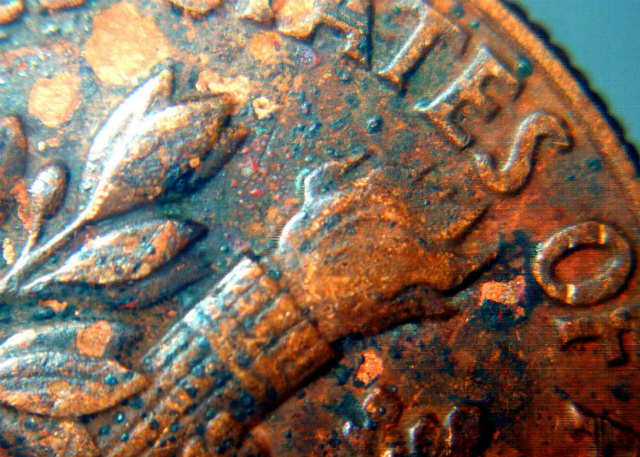 |
|
|
|
Valued Member
 United States
80 Posts |
|
|
Bedrock of the Community
United States
12437 Posts |
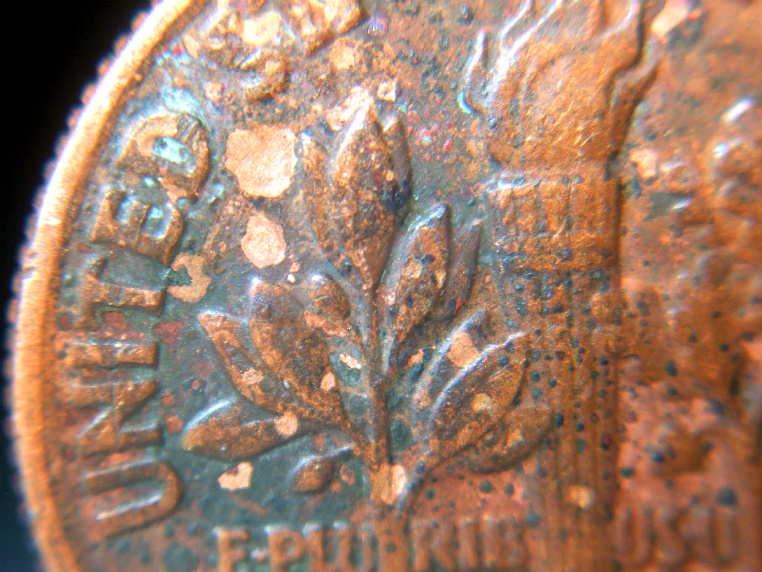
I fancy myself as being smarter than the average bear but I could not make any sense whatsoever out of your stream-of-consciousness wall of text  You are overlooking two critical things. First, why do you think the copper core has any involvement in the process at all? The outer clad layers are 75% copper so there is an abundance of Cu in the coin outside of the core. Second, cupronickel five cent planchets can be improperly annealed but they do not have a copper core so that basically refutes your theory. Also, I have never seen an improperly annealed coin suffering from chipping and flaking. Genuine examples have smooth surfaces with muted luster while environmental damage will impair luster on a coin. As for the photos you posted, I see a coin with corrosion/environmental damage. The bluish-green spotting is consistent with copper salt buildup and chipping/flaking of metal is sometimes seen on coins suffering from severe environmental damage. Cupronickel coins will typically develop a coppery to dark brown patination when buried in some types of soil. |
|
Bedrock of the Community
United States
12437 Posts |
Quote:
what kind of coin you are talking about clad coins or nickels That is my point- it does not matter which one I was referring to, the processes and results of sintering and improperly annealing are the same for both types and that is why I said that the copper core of a clad coin does not play a role. Nickels are composed of the exact same 75/25 cupronickel alloy as the outer clad layers on a dime, quarter, and half dollar- there is no metallurgical difference. Quote:
I have read a lot of things about sintering where there is ''metal dust'' pressed into the coin Sintering occurs when metal dust fuses to the surface of a planchet at high temperatures but below the melting point of any involved metals, pressure is not involved. |
|
Pillar of the Community
United States
2760 Posts |
There is no chance your coin came out of the mint like that. Your coin suffers from PMD and looks like it went through a fire. |
|
Bedrock of the Community
United States
10065 Posts |
I know I pulled a lot of change out from the ashes of a house fire before. This was the first thing I thought of when I saw the dime you posted. If you had no title on this thread and asked what happened to it I would not have hesitated to say it looks just like a dime that went through a hot fire.
|
|
Bedrock of the Community
United States
12437 Posts |
Quote:
Has this been proven as fact? Yes, of course. The term "sintering" refers to a very well-known process utilized in metallurgy and ceramics manufacturing, it does not only apply to coins. Quote:
Could the sintered plating be a build up of carbon on top of the coin from impurities being burnt off in the annealing oven? Other than a little machine oil, there should not be any significant volatile impurities. Any carbon buildup would most likely be removed by the planchet cleaning process prior to striking. Quote:
here is a picture of a sintered plating nickel No, that is a picture of a nickel with a huge amount of surface crud buildup, possibly paint or old tar. |
|
Pillar of the Community
United States
1699 Posts |
Quote:
"Sintered plating" refers to the hypothesis that copper
dust in the annealing drum adheres to copper-nickel or Cu-Ni clad
planchets (perhaps due to electrostatic attraction) and the dust
particles are baked and fused into continuous layer.
Whatever the cause, end result is that copper-nickel and Cu-Ni clad
planchets end up with a layer of copper at the surface How old is this quote? This theory has lost much support from the error community in favor of the migrating/segregating atom theory. edit: I see that you have mentioned this theory. I guess I don't really know what you're arguing and this point  Both the nickel and the dime that you've posted pictures of have environmental damage, staining, discoloration and in the specific case of the nickel, some type of substance applied to it. Edited by ErrorCoins222
01/15/2014 04:53 am
|
|
Moderator
 United States
56855 Posts |
The OP's coins look PMD to me. John1 |
|
Pillar of the Community
United States
2752 Posts |
The dime that leads off this thread shows corrosion and discoloration, all of which occurred outside the Mint. "Sintered plating" has been discarded as a legitimate error type as has "copper wash". For an up-to-date treatment of improper annealing errors, see this link: http://error-ref.com/improper-annealing.htmlError coin writer and researcher.
|
|
Pillar of the Community
United States
571 Posts |
Looks like corrosion to me too. Mike Diamond just posted and said it looked like corrosion too. Since he is THE expert on errors, I'm pretty sure it's corrosion. You can speculate and theorize until the cows come home, but there is a finite number of things that can happen to a coin at the mint. Once it leaves the mint, there are untold numbers of things that can happen to a coin to make it look like an "error" but it is just damage. The best thing you can do is research the facts about coin manufacturing, and know what can, and what cannot happen at the mint. Don't try to over-analyze a coin that is not an error to try to convince others or yourself that it is an error. Keep looking though, there is good stuff out there to be found.
|
|
Valued Member
United States
80 Posts |
Dispite some bad grammer and spelleing my idea/theory makes complete sense at least for the picture I posted.
Edited by uman2
01/16/2014 5:47 pm
|
| |
Replies: 11 / Views: 9,234 |
|












 Posted 01/14/2014 12:47 pm


