| Author |
 Replies: 19 / Views: 4,425 Replies: 19 / Views: 4,425 |
|
Pillar of the Community
Australia
1041 Posts |
Edited by shanew
01/14/2014 4:32 pm
|
|
|
|
Pillar of the Community
Canada
4912 Posts |
I'm not 100% sure but isn't this type of thing illegal.
Feel free to call me Will.
|
|
Pillar of the Community
Canada
4912 Posts |
But on the other hand its pretty awesome  Feel free to call me Will.
|
|
Pillar of the Community
Thailand
1509 Posts |
Chinese? Similar to Chi'ing Dynasty 1644-1911, Krause ref. AA10 1 Kuan. But then I can only compare. I've also made mirror images of the text. 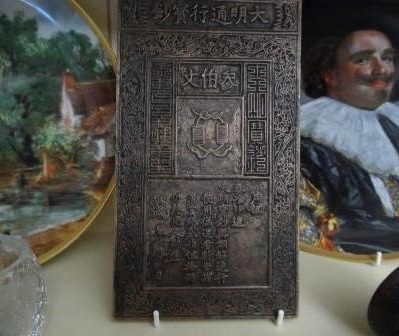 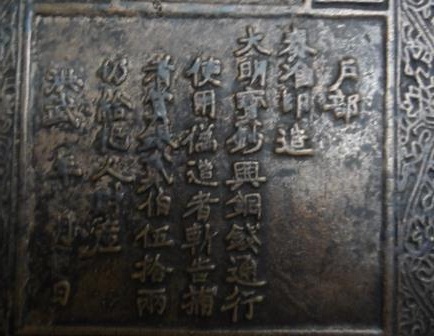 Tried to capture image in the catalog but no can do. Edited by thai-vic
01/14/2014 07:59 am
|
|
Pillar of the Community
Canada
4912 Posts |
If real and not stolen I'd imagine it would be stamped or partially ground off like coin dies.
Feel free to call me Will.
|
|
Rest in Peace
United States
4078 Posts |
This is intriguing. Let me tag along to see any information and good story from the op.
|
|
Pillar of the Community
 Australia
1041 Posts |
what do you mean stolen from who do you need any more pictures and is it worth the $100 to buy it
|
|
Moderator
 Australia
17002 Posts |
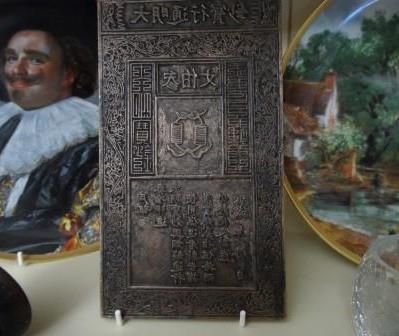
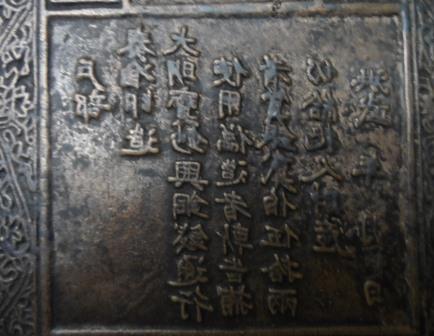
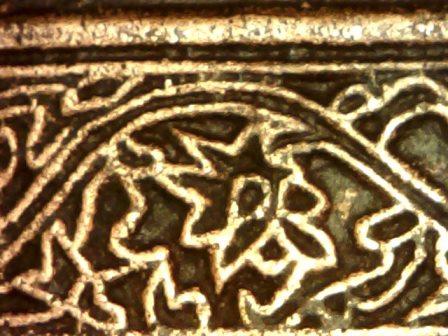
The note is Chinese, a 200 cash note from the Ming Dynasty; this website illustrates one. I don't see any reason why a genuine Ming Dynasty printing plate would be in Japan. However, I can think of plenty of reasons why a fake Ming Dynasty printing plate would be in Japan. Long before China was the hotbed of fake-making in Asia, the Japanese were at it, making fake/replica Chinese and Japanese antiquities including, I would imagine, fake banknotes and fake banknote-plates. Furthermore, from what we know of early Chinese money printing techniques, the notes were printed with much of the Chinese script section done in "movable type" blocks, with each character a separate piece of bronze. Plates were not made as a single monolithic piece of bronze, like yours is. This was apparently an anti-counterfeiting measure; a thief would have to steal an entire workshop of tools in order to assemble a complete printing plate. This article has a picture of a genuine printing plate. Don't say "infinitely" when you mean "very"; otherwise, you'll have no word left when you want to talk about something really infinite. - C. S. Lewis
|
|
Pillar of the Community
Australia
1041 Posts |
thanks sap during the war the Japanese invaded china and stole many item lot of item were taken back to japan she tells me she bought this in a market in kobe in 1947 and the market were full of item bought back from the war she bought this as here father was a printer and she thought he would like it but by the time she got back to austaralia in 1948 he had passed of a stroke and it has been on here sideboard this hole time it was once a black in colour but the mrsheen has changed its colour so if it was stolen it was in war time she is very worried about it now and thinks it will be taken from her found this link http://commons.wikimedia.org/wiki/F...banknote.jpg also from what I can find they were whole plates just the date and the emporer was I separate plate one more link http://en.wikipedia.org/wiki/File:Y...ate_1287.jpg she also had these and thought they were printing plate they are pure silver bars hand engraved about 8,5oz each came from the same market in kobe this auction site has some like what I have as I cant read chinese and have no idea whatthey say or are should I pay the $100 for it or can I get in trouble for having it 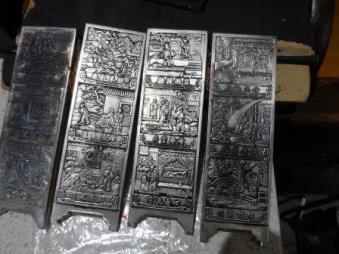 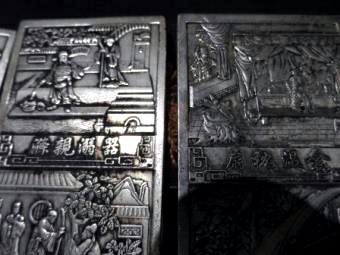 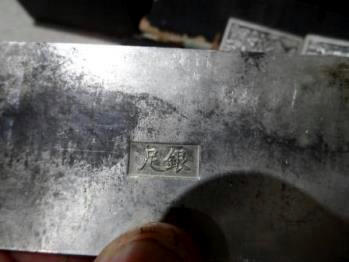 |
|
Valued Member
United States
347 Posts |
Quote:
The note is Chinese, a 200 cash note from the Ming Dynasty... The printing plate shows two strings of coins indicating that the note is "200 cash" (è´°ä½°æ-‡). However, the plate states in Chinese that the denomination is "300 cash" (å��ä½°æ-‡). Authentic "300 cash" notes display three strings of coins, not two strings. The printing plate is a fake. Gary |
|
Pillar of the Community
Australia
1041 Posts |
|
|
Pillar of the Community
Thailand
1509 Posts |
Shanew
I wouldn't worry about anyone claiming it back. For the Japanese (soldier I assume) who took it home it was war plunder. And how can the Chinese claim it back? Considering the number of fake coins and banknotes that flood out of China nowadays they can hardly lay a moral claim to it. I wonder how Chinese note collectors would react to being sold fakes!
As for A$100? I'd buy it as a nice piece of history even if it's a fake. I'd love to see a contemporary printing from the plate (done with the right materials and then carefully cleaned after). If there was an interest it could turn out to be a nice little money earner (advertised as contemporary copies of course)!
Edited by thai-vic
01/15/2014 05:48 am
|
|
Pillar of the Community
Australia
1041 Posts |
thanks thai vic I just have a feeling about this item
if you know the old lady she would not tell porkies
you no when you get that gut feeling about a item done the deal for $80 and $400 for the 4 silver plates is there any were on it were it says the year or who was the emporer was
|
|
Valued Member
United States
347 Posts |
Quote:thanks gary nice link to the blog I found this on the net he collects these notes I think and it only has 2 strings and its a 200cash any idea why this would have 2 strings http://www.pinterest.com/pin/575616396093265733/ The Pinterest image shows 2 strings and the Chinese denomination above the 2 strings reads æ-‡ä½°è´° which translates as "200 cash". This is all correct. However, the poster writes in English that this is "300 cash", which is not correct. If it were "300 cash", the denomination would read æ-‡ä½°å�� and not æ-‡ä½°è´°. Your printing plate, however, states the denomination in Chinese is "300 cash" (æ-‡ä½°å��) but displays only two strings ("200 cash") instead of three strings. This would be impossible and the mistake would be obvious to any Chinese. Each "string" on these Ming notes represents 100 cash coins. The two strings on your plate thus visually represents only 200 cash coins even though the denomination is stated as 300 cash coins. Of course, you do not have to accept my translation. However, I have some experience with Chinese paper money. If you do a search on Google for "Chinese paper money", you will see that the first two images in the results, and the seventh website listed in the search results (at this particular moment), is my web page on Chinese Paper Money. To see an authentic "300 cash" note, please scroll down to the middle of this Chinese website. You will see that it has the same denomination (æ-‡ä½°å��) written in Chinese as your printing plate but has the image of three strings, not two strings like your specimen. For a comparison between a 200 cash note and a 300 cash note please scroll down the page of this Chinese website. The first image is a 300 cash note (with three strings) and the second image is a 200 cash note (with two strings). Incidentally to see what a real Ming Dynasty printing plate looks like, please see this printing plate for a 30 cash note auctioned by Guardian. These plates are extremely rare. You can see how well each character is engraved. Also, please note the thickness of an authentic printing plate. For the reasons mentioned above, I have concluded that your printing plate can only be a fake. Gary |
|
Pillar of the Community
Australia
1041 Posts |
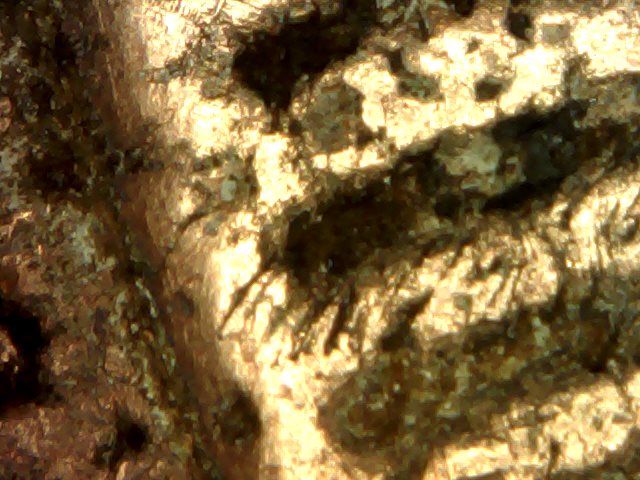
thank manymore for the feed back I took it to a mate who is a metallurgist he has a xrf and he says that if it a fake it was faked many year ago well before they new how to extract pure of better quality metals as it has a great mix of metal he would say are the same as item from he has tested from 300 years old I have read they were fakes and people were killed for there forgerys back then and this could have made them many year ago he would bank on it being very old instead if very new he will do more work on it he would like to find pictures of the forged notes to check them with the plate sorry I am not good with chemistry any way still would love some help thanks 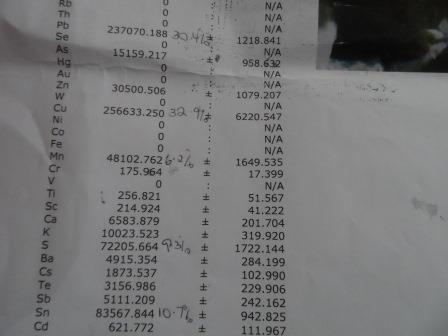 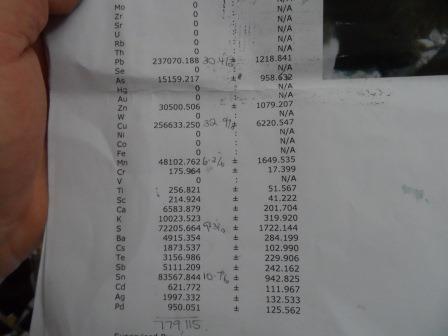 |
|
Valued Member
United States
347 Posts |
The cheapest source of bronze to make fake coins (and fake printing plates) has always been from old Chinese cash coins.
Cash coins were cast for 2,000 years and their quantity ran into the billions and billions. Even today, they are dug up from the ground by the ton. There are so many of them in corroded condition that they are melted down for scrap metal.
Therefore, it would be expected that an analysis of the metal of your piece would reveal a composition primarily of copper, lead and tin. This is the same composition as bronze cash coins.
This does not mean that your printing plate is old. A fake coin made today from reclaimed bronze would have exactly the same composition as the old coins from which it was cast.
In my posts above, I have explained in detail, and provided Chinese sources, as to why your printing plate cannot possibly be authentic.
Of course, you are free to believe whatever you wish.
I have tried to help you but there is nothing more that I can add to this discussion.
Gary
|
| |
Replies: 19 / Views: 4,425 |









 Posted 01/14/2014 07:46 am





