| Author |
 Replies: 16 / Views: 3,406 Replies: 16 / Views: 3,406 |
|
Pillar of the Community
Australia
539 Posts |
|
|
|
|
New Member
Thailand
14 Posts |
Hello,
It looks like a fake. The real coin is almost 2g heavier...
|
|
Pillar of the Community
 Australia
539 Posts |
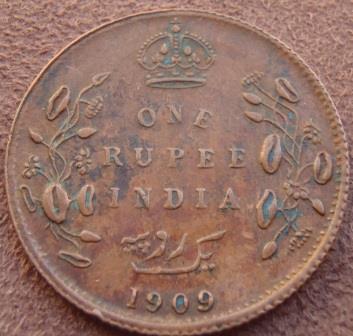
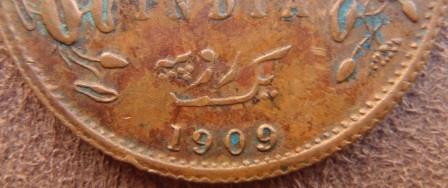
I know it doesn't weigh the right amount for a rupee. what I would like to know is it a penny planchet struck with a rupee die or a fake that someone did in bronze for some reason?
did the uk mint pennys in india at the time?
|
|
Bedrock of the Community
Australia
21789 Posts |
Pennies weigh 9.45 grams, so it wasn't struck on a penny blank.
Edwardian .925 silver rupees weigh 11.66 grams.
Pure silver has a density of 10.5 grams / cc,
pure copper has a density of 8.93 grams / cc.
so the mass of 9.9 grams for this coin in this case is certainly in the right ballpark for a bronze blank of standard diameter and thickness for a silver rupee.
I have yet to do the exact density calculations for the bronze alloy of 97% copper, 2.5%zinc, 0.5% tin, (usual alloy for pennies),
or for the sterling silver alloy of .925 silver, .075 copper.
What needs to be done next is to examine the fine design detail against a standard Edwardian silver rupee, and to obtain exact dimensions: Diameter, minimum thickness between field points on opposite sides of the coin, and rim thickness. Compare that information against an equivalent silver rupee.
XRF analysis of the surface to check for bronze alloy would also help. XRF testing is relatively cheap.
Edited by sel_69l
02/13/2014 06:22 am
|
|
Pillar of the Community
Australia
852 Posts |
Sel
There is no such thing as a usual alloy for pennies. Imperial bronze had at least 5 different tweaks to the alloy in Australia, English pennies may not have had as many but they did change at least once that I know of.
You also need to consider that the mints would have minted for various princely states as well as various parts of the empire.
Just like the 1916 mule halfpenny shows a difference in weight from Australian (and English) halfpennies this off metal strike will differ in weight from the penny.
If it is a fake then the strike is superb, in which case the forgers would get the colour right (debased silver, white metal etc) and not mess about with bronze.
|
|
Bedrock of the Community
Australia
21789 Posts |
I was aware of that.
Renniks lists Australian bronze pennies as the alloy above.
One problem: A copper alloy that has predominantly more zinc than tin is really a brass.
This variability made me somewhat reticent to calculate the exact densities for all possible alloys.
Lots of work that may well end up being an exercise in futility.
It certainly appears to be die struck, in which case some patience needs to be applied to account for die variations of genuine silver rupees, and then compared to this one. Best examined for die variance with a 10x loupe.
Edge milling needs to be compared with a genuine silver example, side by side.
Weight is very plausible for a 'generic' bronze alloy.
Edited by sel_69l
02/13/2014 08:02 am
|
|
Pillar of the Community
Australia
539 Posts |
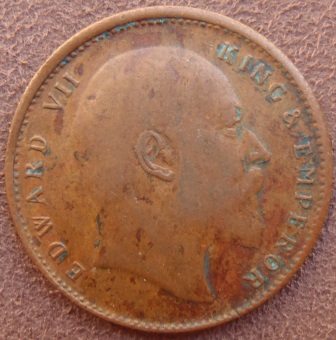
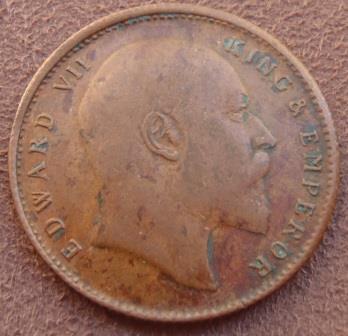
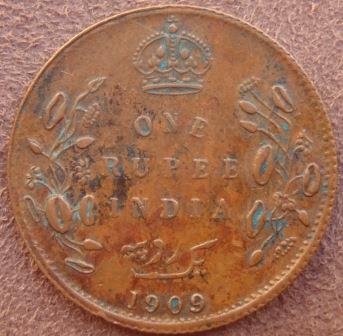
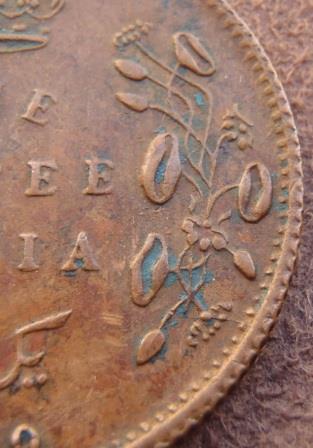
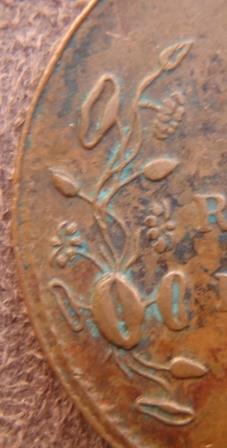
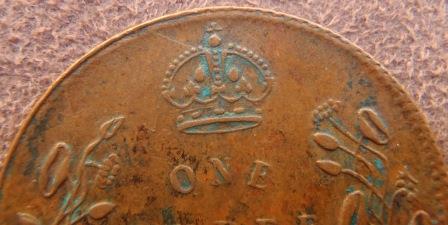
I actually did line it up with another rupee I have 1906 vintage and Calcutta two. the biggest difference I can see is that the strike is a lot weaker. I checked details against denticals and where thinks match up, etc. it all seems to match. I 1st thought "forgory" but the strike is just to good and why would someone forge a silver coin in bronze?!!? it also doesn't appear cleaned so I kinda figured that someone at the Calcutta mint stuck a rupee on a bronze planchet but that would make it worth a lot and the person I got it off didn't appear the sort to have inherited a pattern coin. I don't know what to do with it. all advice is welcome |
|
Pillar of the Community
Australia
539 Posts |
|
|
Pillar of the Community
Australia
539 Posts |
see what I mean? despite being weaker the teeth position match the design
|
|
Moderator
 Australia
16964 Posts |
I'd conclude it's a fake. Quote:
did the uk mint pennys in india at the time? No. Prior to WWI the Indian mints struck local coins and coins for Indian Ocean colonies (in what are now Malaysia and Kenya), but no sterling. I don't think any of the Princely States or other territories issued copper coins this big. Quote:
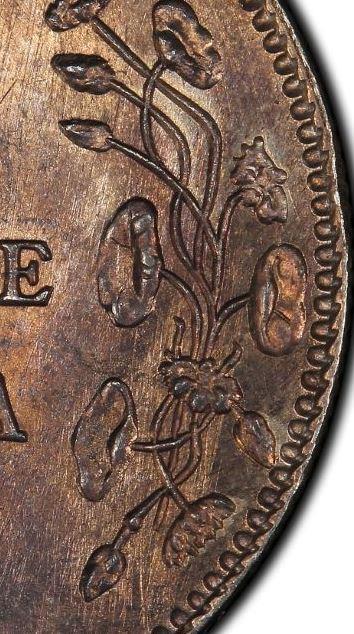
but the strike is just to good and why would someone forge a silver coin in bronze?!!? It would have had a silver wash when it was first made. Perhaps they used mercury, which has since evaporated. The strike is not particularly good, especially when one examines the details of the flowers. Look at the flowers on the nice closeup of the silver coin, especially the two lotus flowers at 2:3 and 5 o'clock; they look like flowers. Those same flowers look like groups of blobs on the bronze coin. And the other leaves/flowers, that ones that look like ears on the silver coin, look more like cowrie shells on the bronze. This kind of "detail" is what I would expect from a cast die that had been "touched up". Don't say "infinitely" when you mean "very"; otherwise, you'll have no word left when you want to talk about something really infinite. - C. S. Lewis
|
|
Pillar of the Community
Australia
539 Posts |
but sap the strike of the other coin is a ms 64 coin. I am saying that the details are not there because it is a weak stuck coin because I believe the same die used to strike silver coins was used on this harder metal resulting in a poor strike due to a lack of pressure. what I tried to show is how all the details match up with the corresponding teeth.
but lets say worse case scenario it is an old forgery. is it a bin job or is it still worth keeping?
|
|
Moderator
Australia
16964 Posts |
Quote:
I am saying that the details are not there because it is a weak stuck coin because I believe the same die used to strike silver coins was used on this harder metal resulting in a poor strike due to a lack of pressure. The details I'm highlighting aren't so much "missing" as "wrong" - parts you would expect to disappear if it were a weak strike have not disappeared, and "new" detail has appeared instead. Quote:
...lets say worse case scenario it is an old forgery. is it a bin job or is it still worth keeping? Actually, "worst case" is that it's a modern Chinese forgery. This is unlikely, given the amount of green corrosion on it and it doesn't show any of the "usual" traits of modern Chinese fakery. So I'd conclude it's a circulating counterfeit. As such, it is collectable to those interested in such things, a few dollars at least. It is, as you say, a pretty good die-struck job. I think I've got a fake rupee of Edward VII sitting in by black bag. Much cruder than this one, a simple cast job with severe shrinkage cracks, porous surfaces and crude silvering over some kind of black lead-pewter alloy. Don't say "infinitely" when you mean "very"; otherwise, you'll have no word left when you want to talk about something really infinite. - C. S. Lewis
|
|
Bedrock of the Community
Australia
21789 Posts |
I can't entirely dismiss from my mind that this piece may be a die trial, albeit in an 'off' metal; it certainly weighs within 0.1 of a gram for a 'generic' bronze blank.
I have two KNOWN, but different types of die trials in my collection:
1. A 1917M Australian florin, in 'as struck' condition. This coin has all of the lower parts of the design perfectly struck, but most of the higher points of the design are flat.
Eddie Cummings, a respected coin dealer from Canberra, explained the florin to me, showing that it was a trial strike to determine what striking pressure would be required for production. The coin should have been immediately re melted, but somehow it escaped from the Melbourne Mint. It is the correct weight for an issued .925 sterling silver florin.
2. A 1977 1 Baht from Thailand struck on a rectangular copper clip. The issued coin was struck in copper nickel. Both obverse and reverse dies are struck, opposing each other. The die impressions are a little weak, although all of the design from both dies can be seen.
I again make the point that the subject of this thread should be examined closely in comparison with a genuine Edwardian silver rupee.
I say this, because I cannot also entirely dismiss from my mind the possibility that his piece could have been a trial for a silver plated FORGERY. (not a fake)
|
|
Pillar of the Community
Australia
539 Posts |
so I have decided to send it to Jim Noble to look at and decide if it is real or not. if it is then it will be up at his next auction
Edited by serial
02/14/2014 12:15 am
|
|
Bedrock of the Community
Australia
21789 Posts |
Actually, I know Jim reasonably well. Give him my regards!
|
|
Valued Member
Australia
315 Posts |
I think the flower at 5 o'clock shows it as a sure sign that it isn't genuine. They are completely different to each other
|
| |
Replies: 16 / Views: 3,406 |












 Posted 02/13/2014 06:08 am