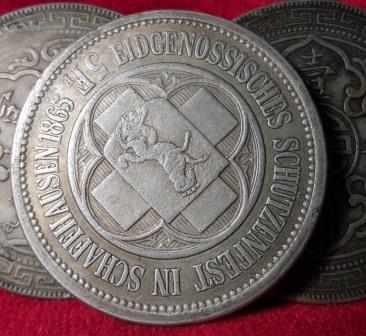
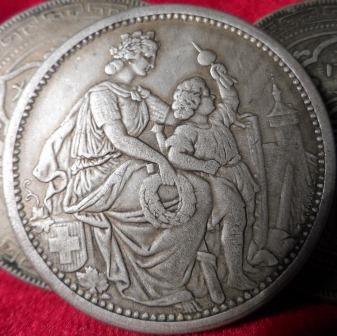
OK, first the easiest one - the Swiss shooting thaler. The problems I have with it are:
- It's too heavy. Swiss 5 franc coins are only supposed to weigh 25.00 grams.
- At the bottom of the shield, beneath the feet of the goat, the base of the shield appears to be missing - is it corrosion, damage, or the result of poor casting? My guess is poor casting.
- The background of the coat of arms is supposed to have dots all over it in a regular pattern - this is the Petra-Sancta heraldic code for the colour yellow, since the coat of arms of Schaffhausen canton is a black goat on a yellow shield. On your coin, these dots simply aren't there, or are very faint. They're not missing because of wear, they're missing because of weak strike.
- The rims are too wide. I suspect that's because the coin is actually larger than the genuine article - which may also account for the extra weight this coin seems to be carrying.
- The denticles on both sides look suspicious. On the shield side, they're assymetrical - the ones at the bottom of your picture are much longer than the ones at the top; that's just not right. And the ones on the woman-and-child side appear to be detached from the rim at several points, such as at about 3 o'clock. A misalignment or disconnect between denticles and rim is a very common symptom of Chinese fakes, because of the way they make their fake dies.
- Some of the fine detail does not seem to have transferred over correctly. The fletching on the arrow the child is holding, for example, should be more symmetrical, and the base of the sword-scabbard at the woman's feet does not seem to be pointy enough.
Now, on to the
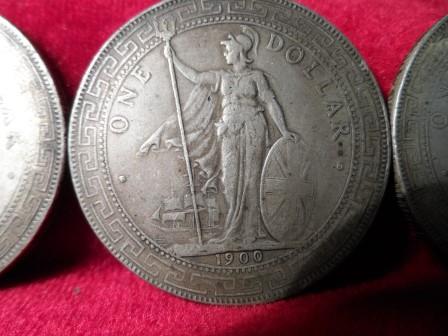
Trade dollars. As a general rule, I always, always assume that British
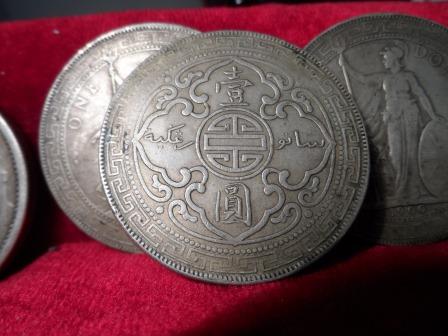
Trade dollars are fake, unless I find good reasons otherwise. They are one of the most commonly faked dollars out there and the Chinese have been faking them ever since they were first made. So that, plus the fact that every other coin in the album they came from has proven to be a fake, is not going to predispose me towards trusting them. Understand also that I can only make judgements about the one I can see clearly.
- First off, it has the same kind of "weak strike" appearance that has caused the low-relief parts of the design to seem to fade away into the background. The far side of the shield, for example, and much of the masts and rigging on the ship are barely visible, if present at all.
- There's other places - such as on the back, at about 1 o'clock, where there's an entire weak or missing patch. Particularly, following the inner circle of dots, they disappear completely at that point. They almost disappear at around 10-11 o'clock, too. Coins don't wear unevenly like that, but badly made fakes often have patches where the design transferred poorly.
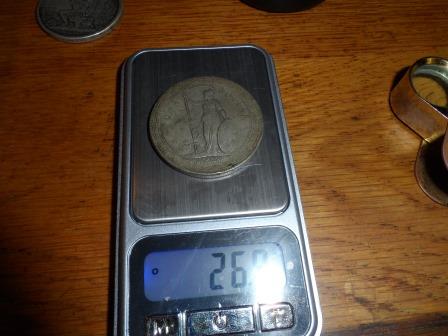
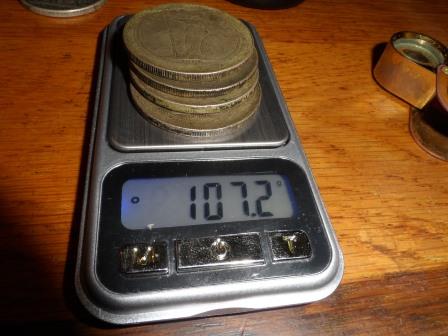
- Any overweight ones are definitely suspicious, though I'd double-check the accuracy of your balance before condemning a coin on that alone. These coins should not weigh over 27 grams. The British Empire was not in the habit of giving away free silver to its Chinese customers, so overweight genuine coins, even a tiny bit overweight, are very, very improbable.
Don't say "infinitely" when you mean "very"; otherwise, you'll have no word left when you want to talk about something really infinite. - C. S. Lewis












 Posted 02/17/2014 09:40 am


