| Author |
 Replies: 23 / Views: 3,154 Replies: 23 / Views: 3,154 |
|
Pillar of the Community
United States
1903 Posts |
I have seen this "coin" posted all over the place for sale. But is there a point where due to dimensional parameters, something ceases to be a coin and becomes something else entirely? Even if it is assigned face value...does something like the Polish "coin" below become something else? 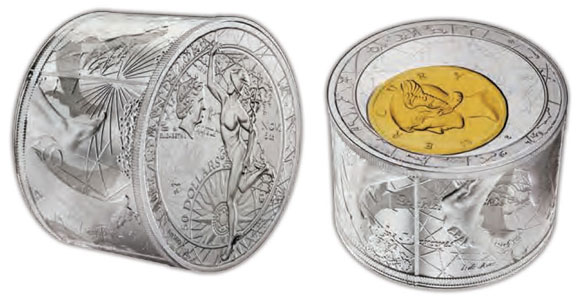 *** Moved by Staff to a more appropriate forum. *** *** Moved by Staff to a more appropriate forum. *** |
|
|
|
Pillar of the Community
United States
621 Posts |
Personally I feel like something like the above is more an art piece than a coin because of the large designs on the sides of the piece. if it had a reeded edge or edge lettering or something like that I would consider it a goofy shaped collector coin. That's just my personal feelings on the matter.
|
|
Pillar of the Community
United States
1234 Posts |
It's more of a COIN than a string of digital characters that disappears when the lights go out  |
|
New Member
United States
38 Posts |
There is an old currency called "rai stones". They were basically a giant "coin" with a 12 ft diameter and weighing in at a hefty 4 tons. Some nice pocket change. But anyway I guess they could call it a coin but I wouldn't consider it one. Thats just my opinion though.
|
|
Pillar of the Community
United States
1007 Posts |
MY definition of a coin is something that is issued by the government where it is intended to circulate, designed to be used in commerce at face value and readily acceptable or intended to be such.
All these specialty items offered by private mints, sometimes "blessed" by rent-a-countries, are not coins. While things like the American Eagle or the Maple Leaf are legal tender at face value and issued by government mints they were never intended for commerce and I don't consider them real coins. Perhaps officially issued "artistic rounds" would be more definitive.
Those things in the original post certainly are not intended to be used at face value (do they even have a face value?) but rather to be collected.
|
|
Valued Member
United States
453 Posts |
I would say its more of an art piece show casing some coin making techniques.
|
|
Valued Member
United States
179 Posts |
It's as fuzzy a definition as you care to make it
|
|
Moderator
 United States
195203 Posts |
|
|
Pillar of the Community
United States
4212 Posts |
What is Fuzzy's definition?
|
|
Moderator
United States
195203 Posts |
No, the definition of a coin is "fuzzy," that is, varied or subjective.
|
|
Bedrock of the Community
United States
20753 Posts |
What ever it is if you can't put it in a vending machine, just not a coin. |
|
Bedrock of the Community
United States
17884 Posts |
By Carl's definition Bust, Seated, Morgan,Peace,and Ike dollars are not coins. SBA's Sac,NA and President dollars are coins, sometimes.  Personally I agree with n9jig's definition. If it wasn't INTENDED to circulate as money and issued by a government of some kind,it is not a coin. |
|
Valued Member
United States
217 Posts |
So where does the intent have to originate? Some us pieces are produced only for collectors sets and thus not intended to circulate and thus not be considered coins under such a definition. You can get around that by saying when they were designed the intent was for them to circulate. Going back to a traditional definition of coin it need to have a value (to distinguish it from medals) and issued by a government (to distinguish it from tokens). One might want to go further and say that it has to be made out of metal (to distinguish it from other forms of money although that could be debatable.) One might also bring in how it was produced.
Bottom line, I agree it is fuzzy!
|
|
Moderator
Australia
16982 Posts |
Quote:
Personally I agree with n9jig's definition. If it wasn't INTENDED to circulate as money and issued by a government of some kind,it is not a coin. I'm thinking that's too narrow. By that definition, every single commemorative coin ever issued by the United States except for the 1976 coins and some of the modern cents and nickels, is "not a coin", since they were not intended to circulate and for the most part have not and do not circulate. The traditional definition is as Wiggam007 stated above: to qualify as a "coin", an object needs two things: official issue or sanction by a government (and one can debate about the legitimacy of certain "coins" owing to the legitimacy of the "government" that issued them) and the allocation or denotation of potential monetary use by a denomination or face value. If a coin-like metallic object has monetary use but no government sanction then it's a "token"; if it has no monetary use then it's a "medal", whether issued by a government or not. The problem comes about when we have modern "gimmicky" "coins" like the one in the OP, and like those "geometric solids" "coins" mentioned in the other threads, which do not resemble more traditional coins simply due to their shape. I am reluctant to call them "medals" or "rounds" for the same reason folks are reluctant to call them "coins": their odd shape. So I have a suggestion as to how to perhaps think of them; you might find it helpful. Many cultures and societies have, in the past, used various forms of "primitive-money" - objects made specifically for use as money, but are not coin-like in shape or form. They vary wildly, from the knives and spades of ancient China and the katanga crosses and kissi pennies of West Africa to the feather-coil money of the Solomon Islands and the wampum of eastern North America. Some of these objects were issued by governments - such as the "bullet money" of Thailand and the "tiger tongues" from elsewhere in Southeast Asia. Many numismatists consider primitive-money to be perfectly collectable, and some even make it into the Krause catalogues. So I suggest, for those reluctant to classify a ten-ounce cylinder of solid silver a "coin", that they call it "modern primitive-money" instead. For myself, I stick to the mantra, "if it doesn't fit in a 2x2, I don't really want it". This allows me to disqualify primitive-money, both early and modern. Don't say "infinitely" when you mean "very"; otherwise, you'll have no word left when you want to talk about something really infinite. - C. S. Lewis
|
|
Pillar of the Community
United States
8904 Posts |
Quote:
What is Fuzzy's definition?  |
|
Pillar of the Community
United States
1007 Posts |
Perhaps a separation of definitions is needed. How about "Circulation Coins" for those coins intended and issued for everyday circulation; and "Non-Circulation Coins" for those such as proofs, bullion, commemorative, and collector coins.
|
| |
Replies: 23 / Views: 3,154 |







 Posted 02/26/2014 12:54 am





